Galleries
WWII – Battle of the Bulge
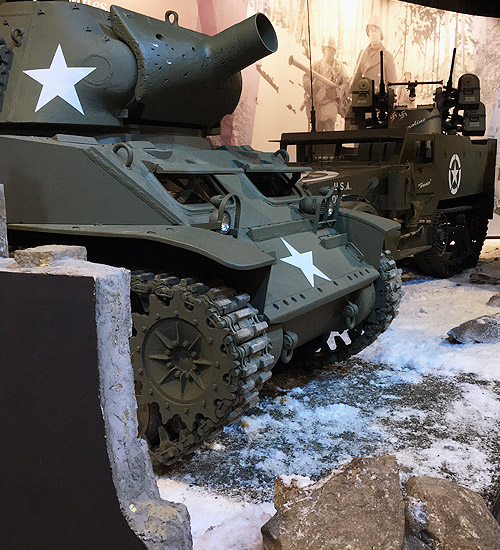
After the breakout from Normandy at the end of July 1944, and the Allied landings in southern France on August 15th, 1944, the Allies advanced toward Germany’s borders very quickly. But then a rapid thrust into the Netherlands was blocked by recovering German forces, compelling the Allies to retreat out of Holland. American and French armies attacked the fortified Siegfried Line and Metz farther south, while other Americans bogged down in close and bloody fighting in the Huertgen Forest. The nearby Ardennes Forest, where Americans had fought Germans in WWI in 1918, looked to be a quiet sector. It soon turned into a bloody battle zone when the German Army launched a surprise counterattack.
The Battle of the Bulge, named for the bulge in American lines created by the German attack, is also known as the Ardennes Offensive. It was the last major German offensive campaign on the Western Front during World War II. It took place from December 16th, 1944 to January 25th, 1945. It was launched through the densely forested Ardennes region of eastern Belgium, northeast France, and Luxembourg. The offensive was intended to stop Allied use of the Belgian port of Antwerp and to split the Allied lines, allowing the Germans to divide the Allied armies and stave off looming defeat for a little while longer.
American forces bore the brunt of the attack and incurred their highest casualties of any operation during the war. The battle also severely depleted Germany’s armored forces and all but eliminated the last of its air forces (Luftwaffe). Around 98,000 Germans were killed, missing, wounded in action, or captured. For the Americans, out of a peak of 610,000 troops, 89,000 became casualties, and over 19,000 were killed. The “Bulge” was one of the largest and bloodiest single battles fought by the United States in World War II.
Because of troop shortages during the Battle of the Bulge, Eisenhower decided to integrate the service for the first time. This was an important step toward a desegregated United States military, although that did not formally take place until after the war ended. More than 2,000 black soldiers volunteered to carry rifles and go to the front. Others served a vital role as drivers of supply trucks that ran 24 hours a day in the “Red Ball Express.” The 761st tank battalion was the first African American tank battalion to see combat in World War II. The “Black Panthers” received nearly 400 combat decorations, fighting in France, in Belgium during the Bulge, and ending the war in south Germany and Austria.
Gallery Artifacts
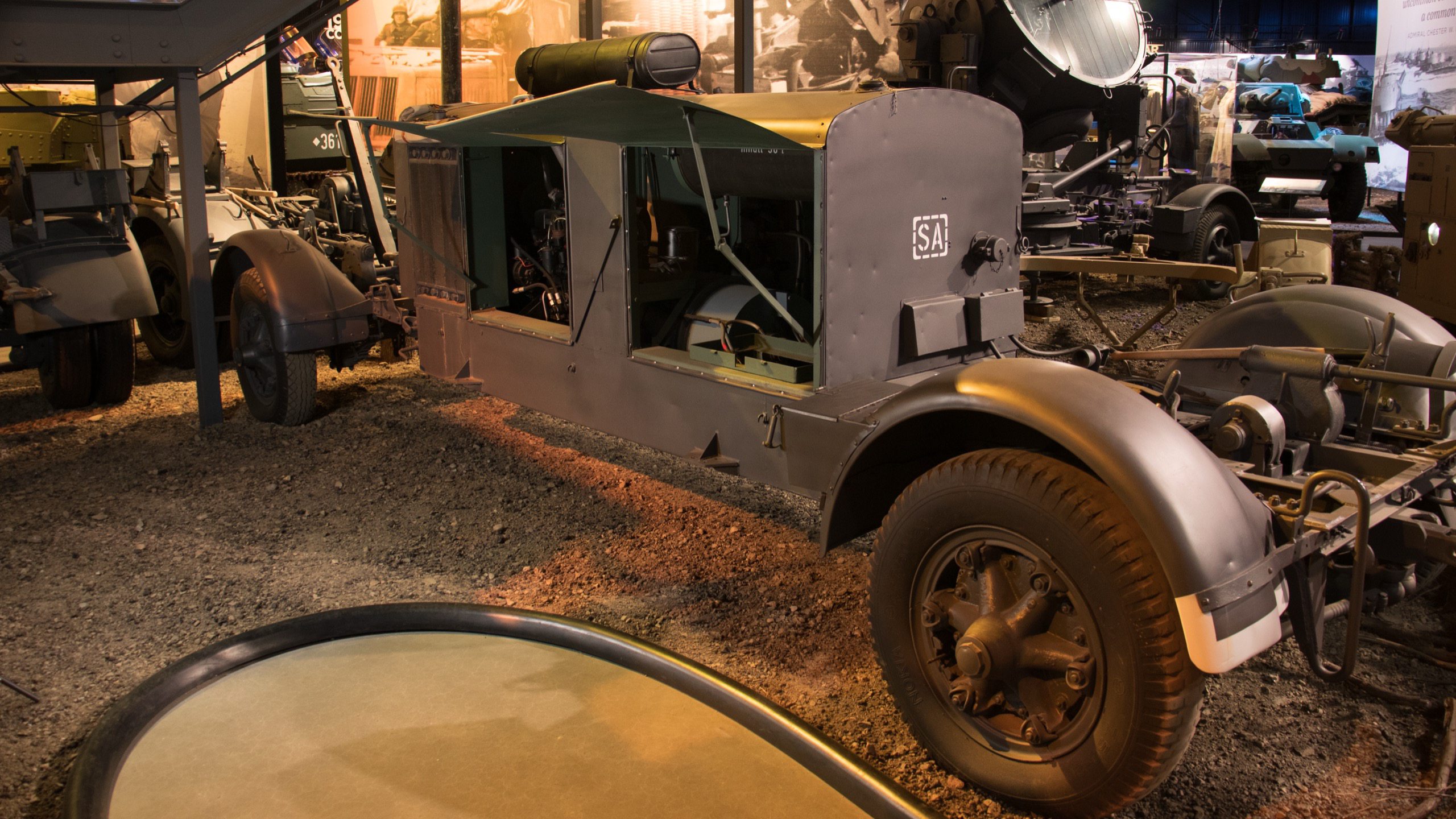
150cm Flakscheinwerfer 34 Searchlight & 24 Kw Generator