Artifacts
M26A1 Pershing
United States | 1945–1951 | World War II & Korean War
| General Information | |
|---|---|
| Model | M26A1 Pershing |
| Class | Armor |
| Type | Heavy Tank |
| Use | Military |
| Era | 1946-1955 |
| Gallery Focus | Korean War |
| Manufacturer | Detroit Arsenal Tank Plant, Fisher Tank Arsenal |
| Year | 1948 |
| Country | United States |
| Ownership | CF Inc. |
| Gallery Location | Korean War |
| Status | Operational, Online |
Additional Photos


The American M26A1 Pershing represents a pivotal advancement in U.S. armored warfare, bridging the gap between the medium tanks of World War II and the powerful main battle tanks developed during the Cold War. Originally designed to confront heavily armored German tanks, the Pershing became one of America’s most important armored vehicles during the opening stages of the Korean War.
Named in honor of General John J. “Black Jack” Pershing, commander of the American Expeditionary Forces during World War I, the M26 emerged from a development program begun in 1942 to create a more heavily armed and protected successor to the M4 Sherman. Production began in November 1944, but delays meant that only a limited number reached Europe before Germany’s defeat in May 1945.
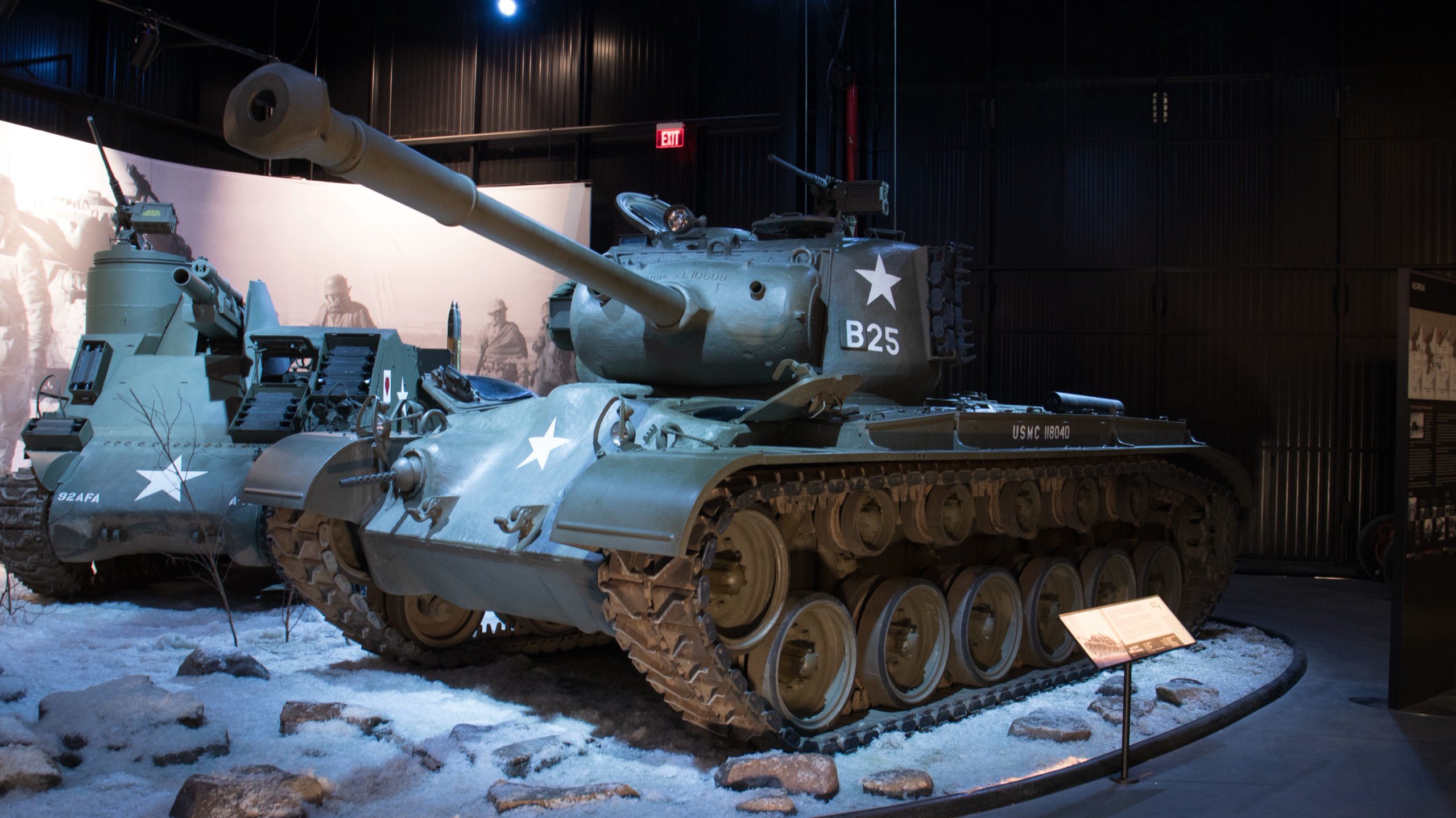
The Pershing’s powerful 90mm cannon, heavy frontal armor, and advanced torsion-bar suspension offered significant improvements over earlier American tanks. Weighing approximately 46 tons and operated by a five-man crew, it featured a Ford GAF V-8 gasoline engine producing approximately 500 horsepower.
During the final months of World War II, Pershings participated in several notable engagements against German armor. On March 6, 1945, an M26 of the 3rd Armored Division famously destroyed a German Panther tank during fighting in Cologne, an engagement captured on U.S. Army film. The following day, Pershings of the 9th Armored Division provided vital fire support during the unexpected American capture of the Ludendorff Bridge at Remagen.
Following the war, surviving M26s received several improvements. The M26A1 variant incorporated the upgraded 90mm M3A1 cannon, featuring a bore evacuator to reduce dangerous propellant gases entering the fighting compartment and a redesigned single-baffle muzzle brake.
When North Korean forces invaded South Korea in June 1950, American armored units initially struggled against Soviet-built T-34/85 tanks. The lightly armed M24 Chaffee proved inadequate, prompting the urgent deployment of heavier M26 Pershings.
The Pershing’s 90mm cannon and substantial armor protection gave American crews an important advantage against North Korean armor. On August 17, 1950, a Marine Corps Pershing destroyed three T-34/85 tanks during fighting near the Pusan Perimeter. Other Pershings achieved notable successes during the Battle of the Bowling Alley and the subsequent United Nations counteroffensive.
However, Korea’s steep mountains, narrow roads, and difficult terrain exposed the Pershing’s greatest weakness: its relatively underpowered engine and troublesome drivetrain. These limitations increasingly hindered mobility and reliability, leading to its replacement during 1951 by the improved M46 Patton, which featured a more powerful engine and redesigned transmission.
The M26A1 displayed at the American Heritage Museum was manufactured in May 1945 by the Fisher Body Division of General Motors. Later acquired by Jacques Littlefield’s Military Vehicle Technology Foundation, the tank was rescued from a collection of deteriorating Pershings scheduled to become range targets. Extensive restoration returned this historically significant vehicle to its present condition.
Displayed in the museum’s Korean War Gallery, the M26A1 Pershing illustrates the rapid evolution of American tank technology and the challenges faced by armored crews during the opening battles of the Cold War.