Artifacts
M4A3(76)W HVSS (M4A3E8) Sherman
United States | 1944–1953 | World War II & Korean War
| General Information | |
|---|---|
| Model | M4A3(76)W HVSS (M4A3E8) Sherman |
| Class | Armor |
| Type | Medium Tank |
| Use | Military |
| Era | 1946-1955 |
| Gallery Focus | Korean War |
| Manufacturer | Detroit Tank Arsenal |
| Year | 1945 |
| Country | United States |
| Ownership | CF Inc. |
| Gallery Location | Korean War |
| Status | Operational, Offline |
Additional Photos


The American M4A3(76)W HVSS Sherman, popularly known as the “Easy Eight,” represented one of the most advanced versions of the legendary M4 Sherman medium tank. Introduced during the final months of World War II, it combined improved firepower, ammunition protection, and mobility in a proven design that would continue serving American forces throughout the Korean War.
The Easy Eight’s designation reflected several important improvements. Its 76mm M1-series cannon provided greater armor penetration than the 75mm gun fitted to earlier Shermans. The “W” indicated wet ammunition storage, which employed water-glycol-protected ammunition racks to reduce the likelihood of catastrophic fires following enemy hits.
Perhaps its most important mechanical improvement was the Horizontal Volute Spring Suspension (HVSS) system, which provided a smoother ride and accommodated wider tracks. These improvements reduced ground pressure and increased mobility across snow, mud, and difficult terrain. Powered by a Ford GAA V-8 gasoline engine and operated by a five-man crew, the Easy Eight became one of the most effective American medium tanks of the late-war period.
When North Korean forces invaded South Korea in June 1950, the Sherman returned to combat. Although newer American tanks were entering service, the Easy Eight’s reliability, mobility, and 76mm cannon made it a valuable weapon against North Korean T-34/85 tanks. As the war progressed, Shermans increasingly supported infantry assaults, defended strategic positions, and helped maintain vital transportation routes.
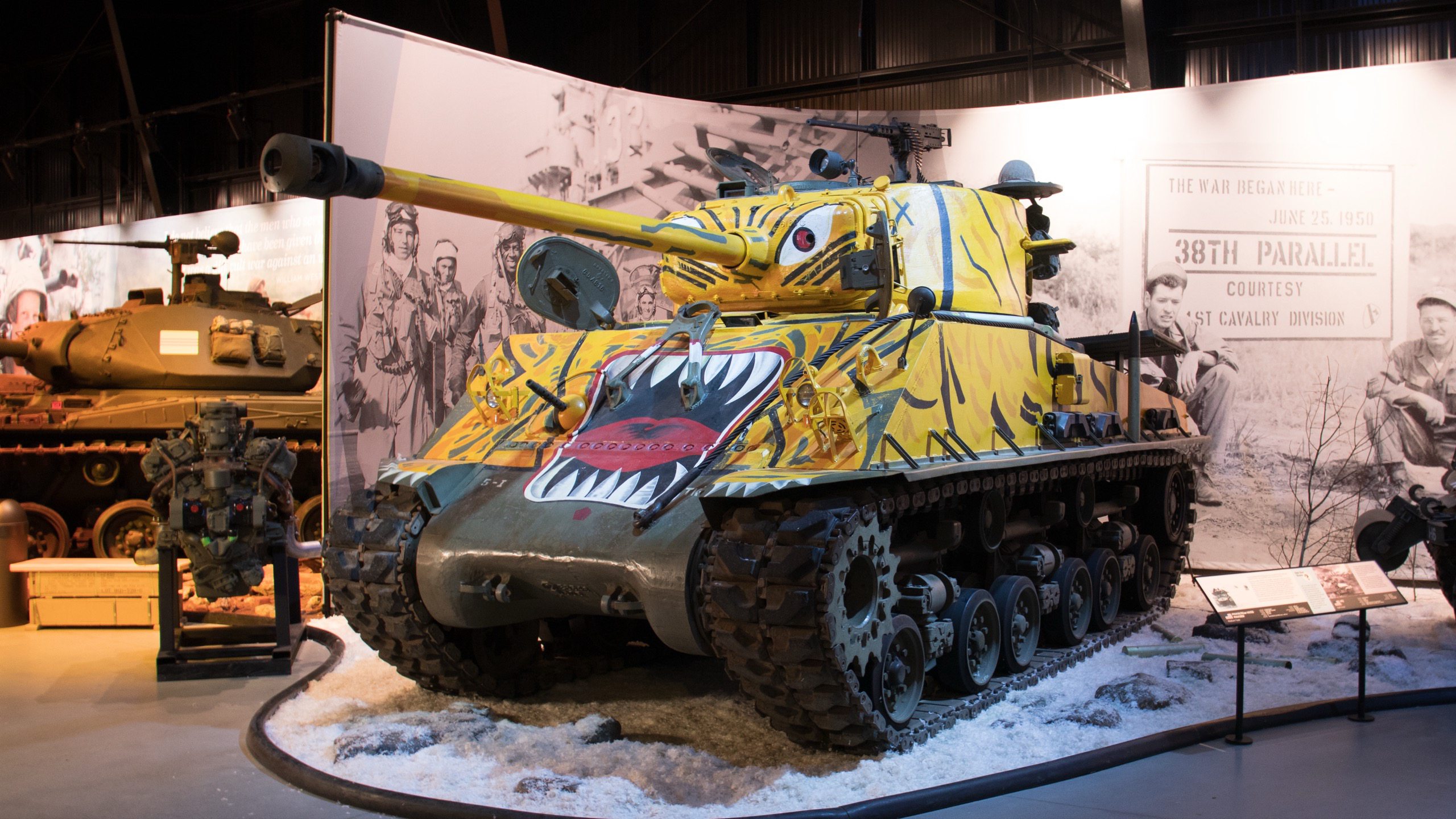
Why does this Sherman have a tiger painted across its hull and turret?
One of the most unusual episodes of the Korean War involved American tank crews transforming their vehicles into brightly painted, fearsome-looking tigers. During the winter of 1950–1951, U.S. armored units began decorating Shermans, M46 Pattons, and other tanks with enormous eyes, snarling teeth, and distinctive tiger stripes.
The practice was inspired by the Chinese zodiac’s Year of the Tiger, which ended in February 1951. American commanders hoped these dramatic designs would intimidate Chinese troops or cause momentary hesitation during battle. Although the psychological effectiveness of the markings was never conclusively established, the paintings became a memorable expression of the ingenuity and spirit of American tank crews.
The M4A3E8 displayed at the American Heritage Museum faithfully recreates the distinctive appearance of TK-45, a Sherman assigned to the 4th Platoon of the 5th Regimental Combat Team’s tank company. Photographed near the Han River in early 1951, TK-45 featured one of the most elaborate tiger-face designs of the war, with enormous painted eyes, a snarling mouth, and prominent teeth.
The museum’s Sherman preserves the appearance of this remarkable combat vehicle rather than claiming to be the original TK-45.
Displayed in the American Heritage Museum’s Korean War Gallery, the Easy Eight illustrates both the continued effectiveness of World War II armored technology and the unconventional measures employed by American soldiers during one of the Cold War’s earliest and most demanding conflicts.