
Artifacts
Berlin Wall – Original Segment
Germany | 1961–1989 | Cold War
| General Information | |
|---|---|
| Model | Berlin Wall |
| Class | Large Artifact |
| Type | Construction Artifact |
| Use | Military |
| Era | 1947-1991 |
| Gallery Focus | Cold War |
| Manufacturer | N/A |
| Year | 1961 |
| Country | East Germany |
| Ownership | CF Inc. |
| Gallery Location | Cold War |
| Status | Static Only |
The Berlin Wall stood for 28 years as one of the most powerful symbols of the Cold War, physically and ideologically dividing communist East Germany from democratic West Germany. Constructed in 1961 by the German Democratic Republic (East Germany), the Wall became a stark reminder of the political confrontation between the Soviet Union and the Western Allies following World War II.
After Germany’s defeat in 1945, the country and its capital, Berlin, were divided into four Allied occupation zones. As tensions between the Soviet Union and the Western powers intensified, two separate German nations emerged in 1949. Millions of East Germans subsequently fled to the West, seeking greater political freedom and economic opportunity.
To halt this exodus, East German authorities began constructing the Berlin Wall on August 13, 1961. What initially consisted of barbed wire and temporary barriers evolved into a massive fortified border system extending approximately 96 miles around West Berlin. Its most formidable sections featured 12-foot-high concrete walls, guard towers, floodlights, armed patrols, and a heavily guarded area known as the “Death Strip.”
The Wall separated families, divided neighborhoods, and restricted the movement of millions of people. Despite the enormous risks, more than 5,000 individuals successfully escaped across the Berlin border. According to the Berlin Wall Foundation, at least 140 people lost their lives in circumstances directly connected to the East German border regime.
The Berlin Wall also became a powerful symbol of the struggle between communism and democracy. On June 12, 1987, President Ronald Reagan stood before the Brandenburg Gate and delivered his famous challenge to Soviet leader Mikhail Gorbachev: “Mr. Gorbachev, tear down this wall!”
On November 9, 1989, following months of peaceful demonstrations and growing political unrest throughout Eastern Europe, East German authorities unexpectedly opened the border crossings. Thousands of jubilant Berliners streamed across the formerly impenetrable frontier, embracing relatives and strangers in an extraordinary celebration of freedom. The Wall’s opening became a defining moment in the collapse of communist rule across Eastern Europe and paved the way for German reunification on October 3, 1990.
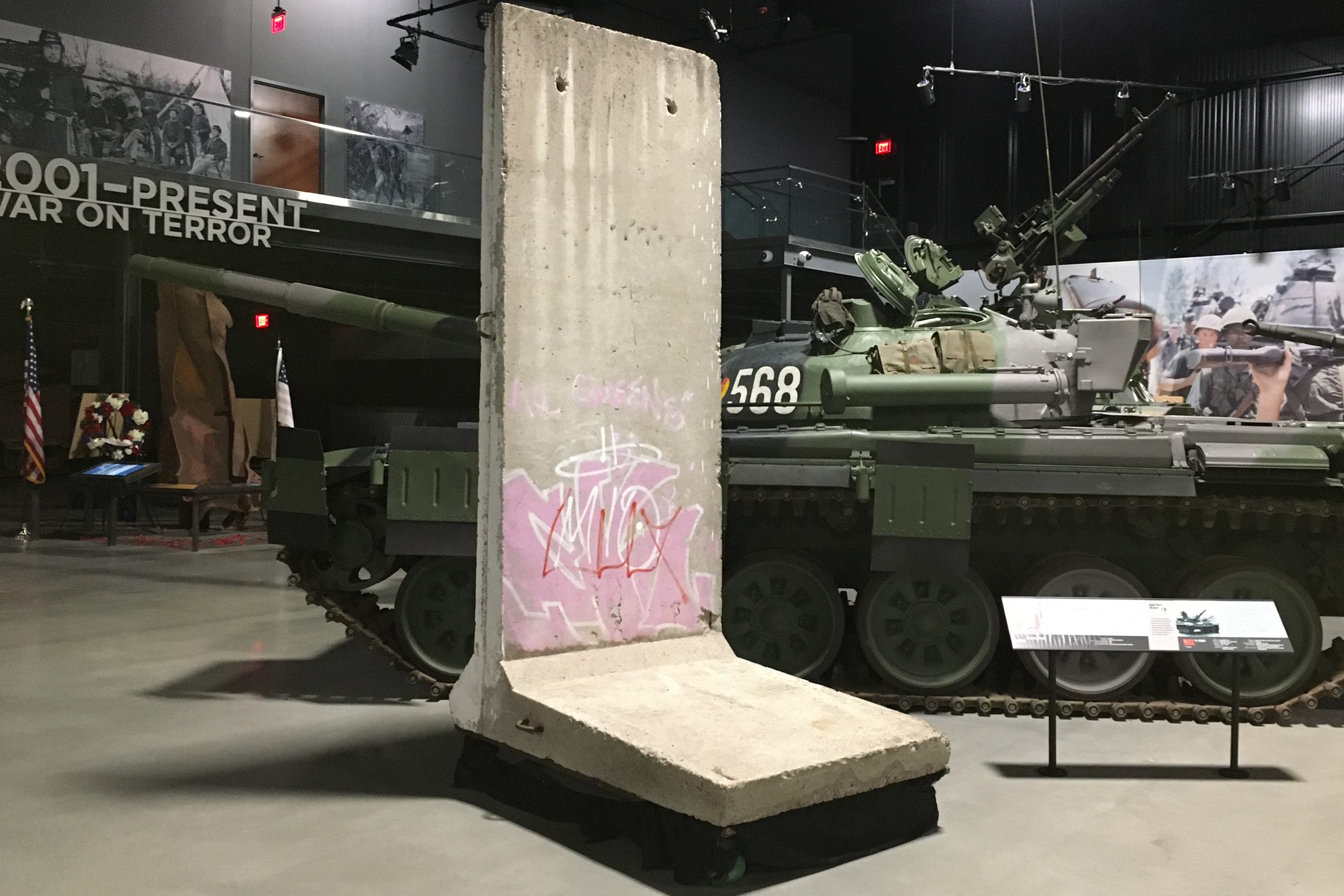
The original Berlin Wall segment displayed at the American Heritage Museum comes from Potsdamer Platz, a historic square that had once been among Berlin’s busiest intersections. During the Cold War, the Wall transformed this vibrant urban center into a heavily fortified no-man’s-land. On November 12, 1989, sections of the Wall at Potsdamer Platz were removed to establish one of the first new border crossings following its historic opening.
Displayed in the American Heritage Museum’s Cold War Gallery, this authentic section of the Berlin Wall provides a tangible connection to nearly three decades of division and stands as an enduring reminder of the human desire for freedom, the costs of political oppression, and the historic events that brought the Cold War toward its conclusion.