Artifacts
1938 #16 Ranger Powered Sprint Car
United States | 1938–1940s | Golden Age of American Sprint Car Racing
| General Information | |
|---|---|
| Model | #16 Ranger Powered – Powder Puff Blue Sprint Car |
| Class | Vehicle |
| Type | Race Car, Sprint Car |
| Use | Civilian |
| Era | 1930-1940 |
| Gallery Focus | Sprint Cars |
| Manufacturer | Ranger |
| Year | 1938 |
| Country | United States |
| Ownership | CF Trust |
| Gallery Location | Vintage Race Car Collection |
| Status | Operational, Offline |
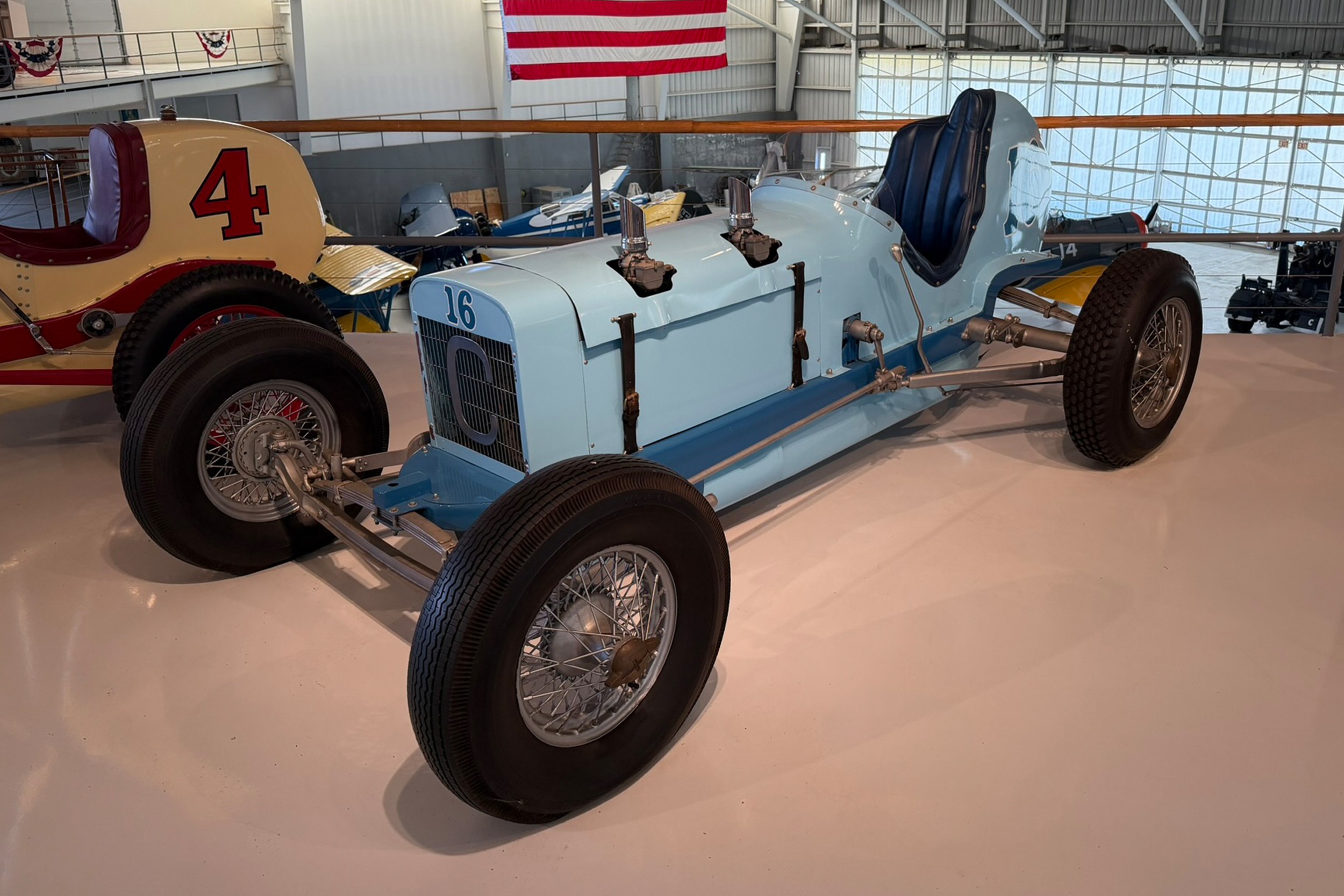
During the Golden Age of American Sprint Car racing, innovative mechanics and daring drivers constantly searched for new ways to gain a competitive advantage. While many racers relied on modified Ford automobile engines or expensive purpose-built Offenhauser powerplants, others looked toward an unconventional source of horsepower: aviation. The powder-blue Number 16 Ranger-Powered Sprint Car, identified as dating to approximately 1938, represents this extraordinary intersection of aircraft engineering and early American motorsports.
Powering this distinctive machine is a Ranger inline six-cylinder aircraft engine developed by the Ranger Aircraft Engine Division of the Fairchild Engine and Airplane Corporation. Ranger engines became particularly well known for powering the Fairchild PT-19 and PT-26 primary trainers, which helped prepare thousands of American military pilots during World War II. The widely used Ranger L-440 displaced approximately 441 cubic inches and produced between 175 and 200 horsepower in common aircraft configurations, delivering substantial torque from a relatively lightweight engine.
One of the most unusual aspects of adapting a Ranger aircraft engine for automobile racing was its original inverted configuration. In aircraft installations, the six cylinders extended downward beneath the crankshaft, providing improved forward visibility for pilots and a streamlined engine profile. To accommodate conventional racing car layouts, builders could rotate the engine 180 degrees, positioning the cylinders upright and the crankshaft below. These conversions required considerable mechanical ingenuity, particularly in adapting the engine’s lubrication and induction systems.
Unlike conventional automobile engines, which relied on liquid cooling and radiators, the Ranger was air-cooled. Number 16’s distinctive broad, upright nose and elongated engine compartment reflect the need to provide sufficient airflow around the engine’s cylinders. Maintaining adequate cooling could become especially challenging during slower running, when reduced airflow limited heat dissipation.
The automobile’s lightweight construction, exposed suspension, narrow cockpit, and wire-spoke wheels reflect the practical engineering of early Sprint Cars, commonly called “Big Cars.” These powerful single-seat racers competed on dirt tracks and fairgrounds ovals throughout the United States, where skilled drivers wrestled their machines around corners in spectacular sliding turns.
According to the museum’s collection history, Number 16 also competed in Mexico during World War II. Organized American automobile racing was largely suspended beginning in July 1942 as gasoline and rubber rationing, military mobilization, and wartime production took precedence. The reported Mexican racing history offers an intriguing example of how some competitors sought opportunities beyond the United States during this period.
Following the war, inexpensive surplus Ranger aircraft engines became attractive to budget-conscious Sprint Car builders, extending their competition history into the 1950s and 1960s.
Today, Number 16 preserves an exceptional example of American mechanical resourcefulness, illustrating how technology developed for aviation could find an unexpected second life on the nation’s racetracks.
Museum Display Location: Third Floor Race Car Collection, American Heritage Museum’s seasonal Storage Hangar Annex. Accessible during select special event weekends in the summer and fall.