Artifacts
#2 Sowers Powered Midget Car
United States | 1930s–1940s | Golden Age of American Midget Auto Racing
| General Information | |
|---|---|
| Model | #2 Sowers Powered – Red & Black Midget Sprint Car |
| Class | Vehicle |
| Type | Race Car, Midget Sprint Car |
| Use | Civilian |
| Era | 1930-1940 |
| Gallery Focus | Sprint Cars |
| Manufacturer | Sowers |
| Year | 1936 |
| Country | United States |
| Ownership | CF Trust |
| Gallery Location | Vintage Race Car Collection |
| Status | Operational, Offline |
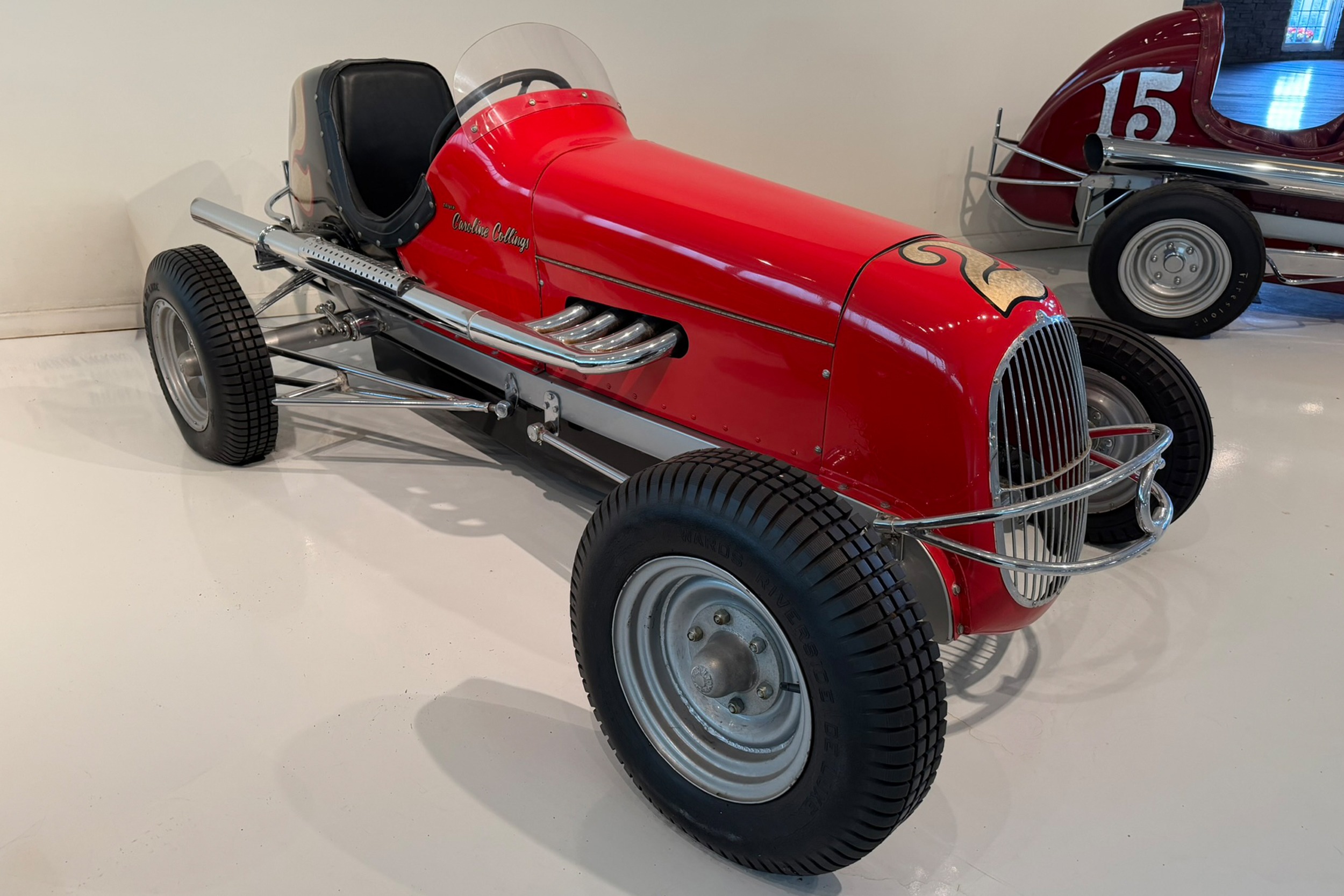
During the Golden Age of American Midget racing, independent engineers and mechanics competed to develop increasingly powerful engines for the sport’s remarkably small, lightweight automobiles. While the legendary Offenhauser four-cylinder engine became the dominant racing powerplant, a handful of ambitious builders developed their own sophisticated alternatives. The red Number 2 Sowers-Powered Midget Race Car represents one of the rarest examples of this remarkable period of American motorsports innovation.
Identified in the museum’s collection records as dating to approximately 1936, this distinctive automobile is powered by a Sowers racing engine, an exceptionally uncommon four-cylinder design developed to compete with the celebrated Offenhauser. Like its more famous rival, the Sowers employed advanced double-overhead-camshaft technology, allowing precise valve operation and efficient breathing at high engine speeds. This sophisticated engineering distinguished it from the comparatively simple production automobile engines adapted for many early Midget racers.
The Sowers engine emerged from the inventive racing workshops of Southern California, where independent machinists sought to challenge the dominance of expensive Offenhauser powerplants. Surviving examples demonstrate the sophistication of these engines, including five-main-bearing crankshafts, hemispherical combustion chambers, and twin overhead camshafts. One documented Sowers engine displaced approximately 108 cubic inches, placing it in direct competition with the 110-cubic-inch-class Offenhauser Midget engines.
Although produced in extremely limited quantities, Sowers-powered racers demonstrated their capabilities in organized competition. At California’s Carpinteria Thunderbowl on August 11, 1947, driver Bill Homeier finished fifth in the feature race driving a Midget equipped with a rare Sowers double-overhead-camshaft engine, competing against a field that included established Offenhauser-powered machines.
Number 2 features gracefully streamlined red bodywork, a contrasting black tail section, polished external exhaust headers, a narrow upright grille, and a compact single-seat cockpit. Its exposed suspension and broad rear tires illustrate the engineering priorities of early Midget racing, where minimizing weight and maximizing traction were essential to success on short dirt and paved oval tracks.
Unlike the relatively inexpensive Ford and motorcycle engines used by many independent racers, a purpose-built Sowers racing engine represented a substantial investment in specialized engineering. These uncommon machines belonged to an ambitious class of competition automobiles designed to challenge the fastest Midgets of their era.
Today, the Number 2 Sowers-Powered Midget Race Car preserves an exceptionally rare example of American racing ingenuity. Its unusual engine represents the determination of independent craftsmen to compete against established manufacturers and push the boundaries of high-performance automotive engineering.
Museum Display Location: Third Floor Race Car Collection, American Heritage Museum’s seasonal Storage Hangar Annex. Accessible during select special event weekends in the summer and fall.