Artifacts
M3 Gun Motor Carriage GMC
United States | 1941–1945 | World War II – Pacific Theater
| General Information | |
|---|---|
| Model | M3 Gun Motor Carriage GMC |
| Class | Military Vehicle |
| Type | Tank Destroyer |
| Use | Military |
| Era | 1940-1945 |
| Gallery Focus | WWII Pacific Theater |
| Manufacturer | Autocar Company |
| Year | 1943 |
| Country | United States |
| Ownership | CF Inc. |
| Gallery Location | Pacific Theatre |
| Status | Operational, Offline |
Additional Photos


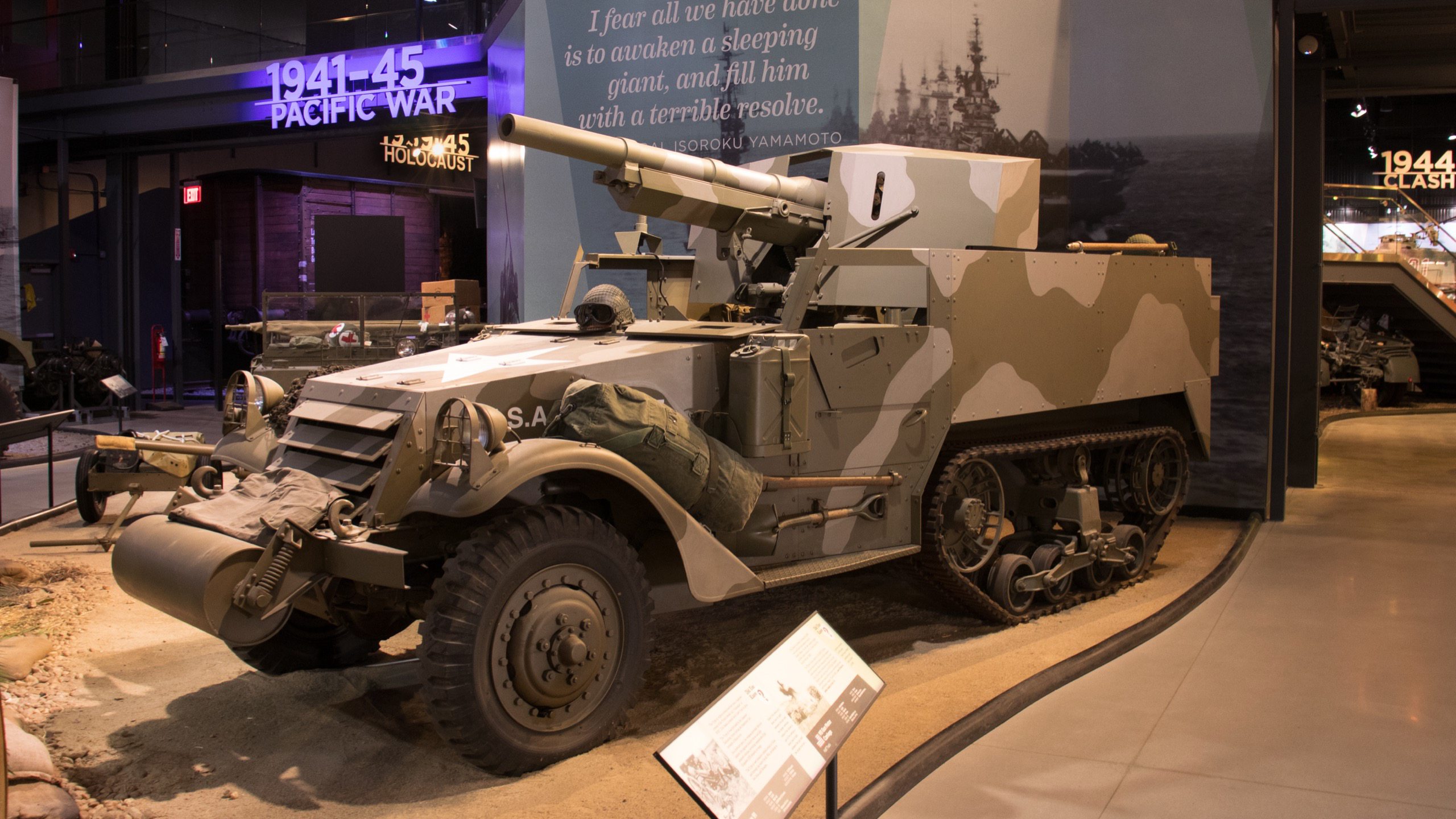
The American M3 Gun Motor Carriage (GMC) was one of the earliest self-propelled tank destroyers employed by U.S. forces during World War II. Developed in response to Germany’s devastating armored offensives in Europe, the M3 combined the mobility of an M3 Half-Track with the firepower of a 75mm cannon, creating a versatile weapon capable of engaging enemy tanks and supporting infantry operations.
Developed in 1941 and manufactured by the Autocar Company, the M3 mounted a modified version of the famous French-designed 75mm M1897 field gun, originally introduced during the late nineteenth century. The vehicle carried a five-man crew and could reach speeds approaching 45 mph. Its lightly armored, open-topped fighting compartment offered limited protection, but its mobility and powerful cannon made it an effective weapon against lightly armored enemy vehicles.
The M3 first entered combat during the Japanese invasion of the Philippines in December 1941, where early T12 models provided valuable anti-tank defense and direct fire support to American forces. The vehicle subsequently served in North Africa and Sicily before being largely replaced in U.S. Army service by the more heavily armed M10 tank destroyer.
In the Pacific, however, the M3 found renewed purpose with the U.S. Marine Corps. During the Battle of Saipan in June 1944, Marine M3 half-tracks helped repel a major Japanese armored counterattack involving the 9th Tank Regiment. Their 75mm guns proved particularly effective against the lightly armored Type 95 Ha-Go and Type 97 Chi-Ha tanks, contributing to the destruction of Japanese armored forces threatening the American beachhead.
Marine units continued employing the M3 during subsequent Pacific operations, including the battles of Peleliu and Okinawa. Its ability to deliver powerful direct fire made it valuable for supporting advancing infantry and engaging fortified Japanese defensive positions.
Approximately 2,200 M3 Gun Motor Carriages were produced during World War II. Although eventually superseded by more advanced vehicles, the M3 demonstrated the importance of mobile artillery and anti-tank firepower in supporting American ground forces.
Displayed in the American Heritage Museum’s Pacific War Gallery, the M3 Gun Motor Carriage represents the adaptability of American wartime engineering and the vital contribution of armored fire-support vehicles to Allied victory in the Pacific.