Artifacts
Boeing/Airco DH.4
United States | 1918–1923 | World War I and Early Airmail
| General Information | |
|---|---|
| Model | DH.4 |
| Class | Aircraft |
| Type | Bomber |
| Use | Military |
| Era | 1914-1919 |
| Gallery Focus | WWI / Great War |
| Manufacturer | Boeing/Airco |
| Year | 1918 |
| Country | United States |
| Ownership | CF Inc. |
| Gallery Location | N/A |
| Status | Operational, Offline |
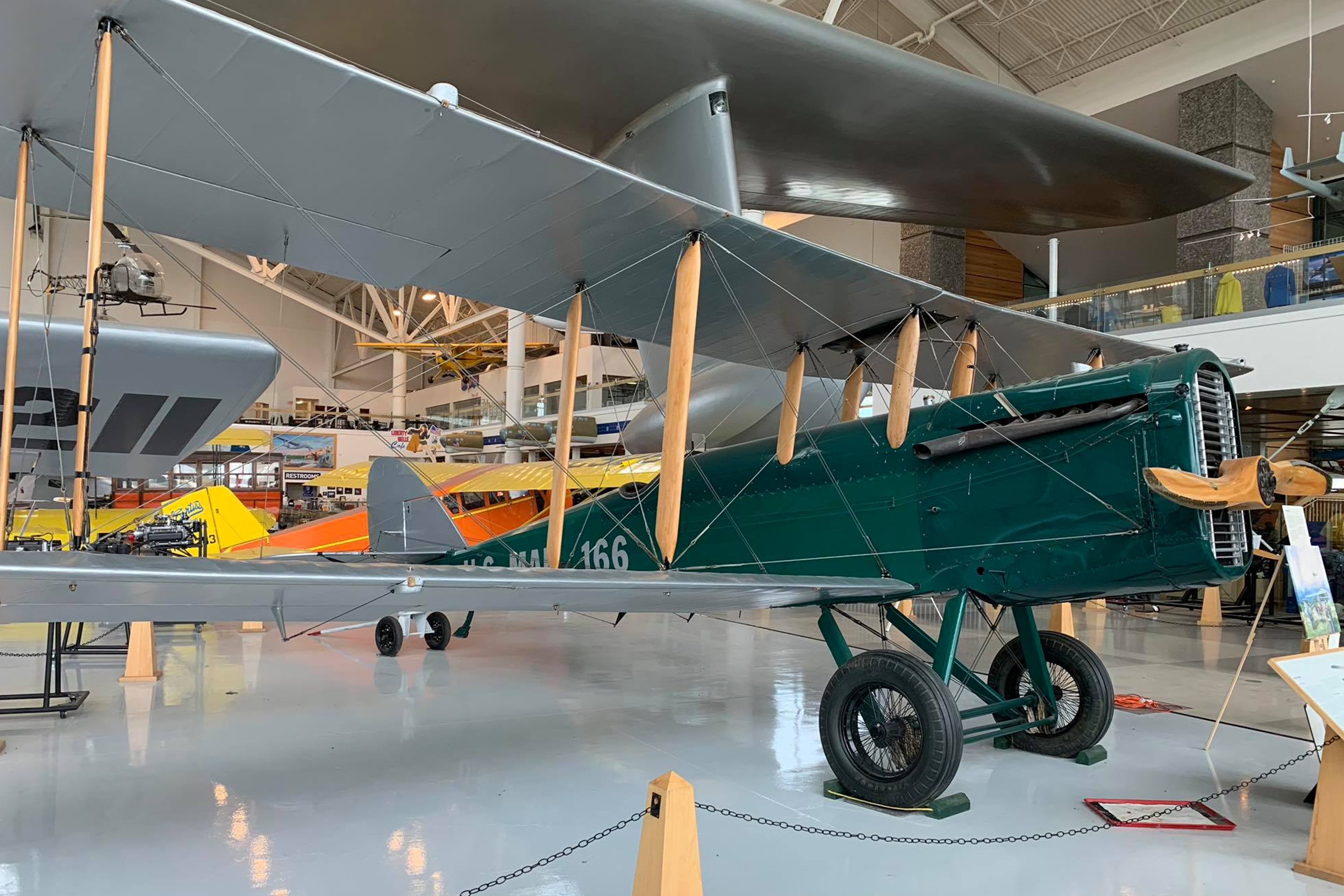
The Airco DH.4 holds a distinguished place in American aviation history as the only American-built aircraft type to enter combat with United States forces during World War I. Originally developed in Great Britain, this versatile biplane became an important reconnaissance and light bombing aircraft, later helping establish America’s pioneering airmail service and the foundations of commercial aviation.
Designed by British aviation engineer Geoffrey de Havilland for the Aircraft Manufacturing Company (Airco), the DH.4 first flew in August 1916 and entered British military service in March 1917. The aircraft featured a conventional wood-and-fabric biplane structure, with separate open cockpits for the pilot and observer. Its powerful engine, excellent speed, and ability to carry bombs and reconnaissance equipment made it one of the most effective Allied two-seat aircraft of the war.
When the United States entered World War I in April 1917, American military aviation faced an enormous challenge. The country lacked combat-ready aircraft of its own and needed to rapidly develop a modern air force. The British DH.4 was selected for American production and extensively modified to accommodate the newly developed 400-horsepower Liberty L-12 engine. Known as the “Liberty Plane,” the American DH-4 became the nation’s first mass-produced combat aircraft.
Nearly 4,850 American-built DH-4s were completed before the Armistice in November 1918. Arriving in France in May 1918, the aircraft entered combat that August, conducting daylight bombing, reconnaissance, and artillery observation missions. DH-4 crews distinguished themselves during the Meuse-Argonne Offensive, including heroic attempts to resupply the surrounded American soldiers of the famous “Lost Battalion.”
The American Heritage Museum’s aircraft, dating to 1918, represents an especially rare chapter in the DH-4’s continued development after World War I. Identified as a Boeing-modified DH-4M-1, the aircraft underwent significant modernization in 1923, including replacement of the original wooden fuselage structure with a stronger welded steel-tube framework. Boeing’s modifications helped extend the service life of these wartime aircraft, many of which were adapted for America’s expanding airmail operations.
The Museum’s DH-4, registered N3258, later became part of the renowned aircraft collection assembled by Hollywood stunt pilot and aviation pioneer Paul Mantz. It appeared in aviation films including The Court-Martial of Billy Mitchell (1955) and The Spirit of St. Louis (1957), helping recreate the early years of military and commercial aviation for motion picture audiences. The aircraft subsequently passed through several historic aviation collections before being acquired by the Collings Foundation in 2022.
Today, this extraordinary survivor represents the transformation of military aviation during World War I and the remarkable evolution of aircraft technology that followed. Its history connects America’s first wartime aviators with the pioneering pilots who established the nation’s early commercial aviation industry.
Current Location and Future Exhibit: The Boeing / Airco DH.4 is currently on loan to the North American Aerospace Museum (formerly Evergreen Aviation & Space Museum) in McMinnville, Oregon. Following completion of the American Heritage Museum’s planned Aviation Wing expansion, the aircraft will be relocated to Massachusetts for permanent exhibition within an expanded World War I aviation gallery, joining the Museum’s SPAD S.VII, Nieuport 28 C-1, and Caudron G.4.