Artifacts
LVT(A)-4 AMTANK
United States | 1944–1945 | World War II – Pacific Theater
| General Information | |
|---|---|
| Model | LVT(A)-4 AMTANK |
| Class | Armor |
| Type | Amphibious Landing Vehicle – Tracked |
| Use | Military |
| Era | 1940-1945 |
| Gallery Focus | WWII Pacific Theater |
| Manufacturer | Food Machinery Corporation (FMC) |
| Year | 1944 |
| Country | United States |
| Ownership | CF Inc. |
| Gallery Location | Pacific Theatre |
| Status | Operational, Offline |
Additional Photos


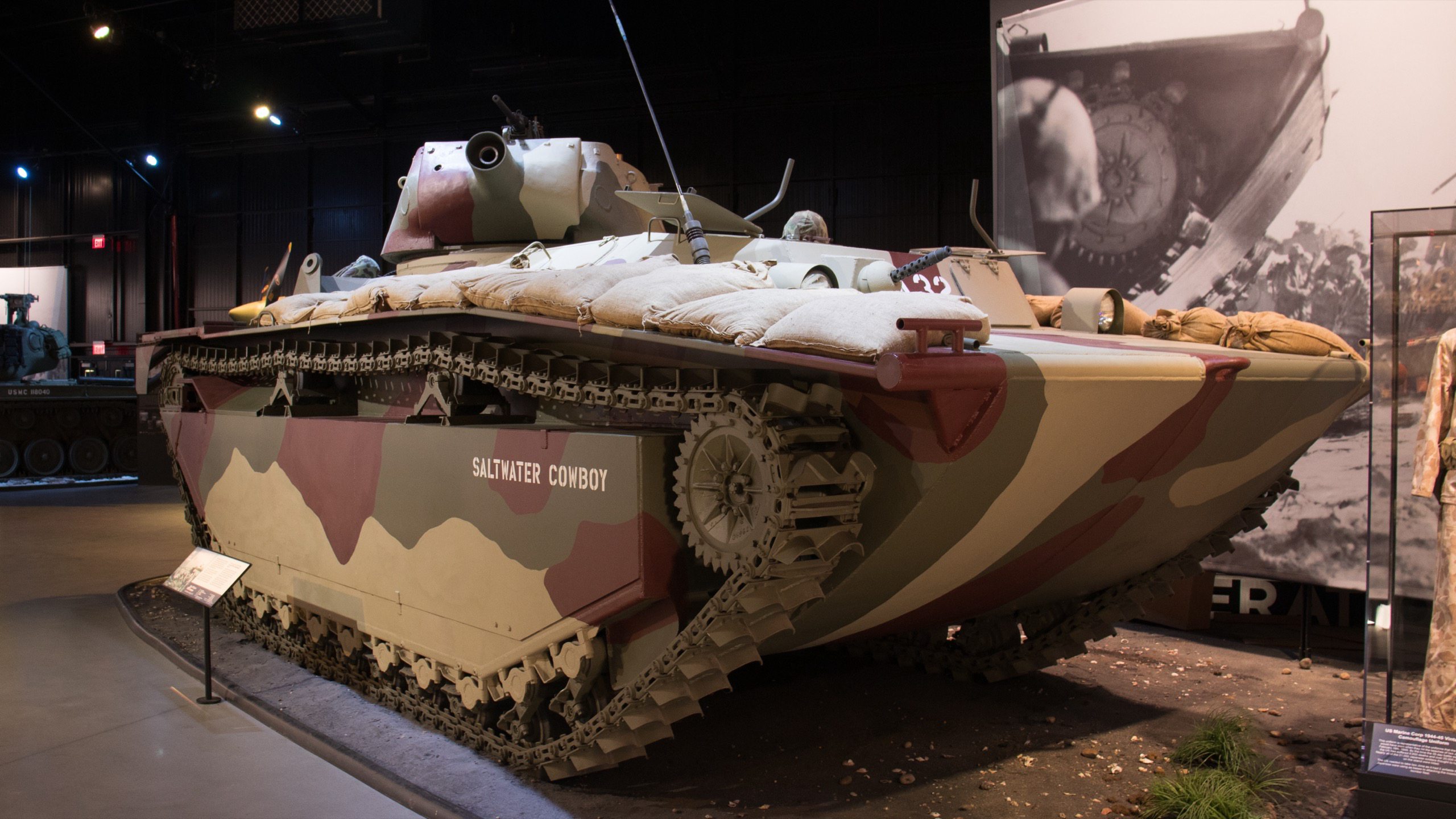
The American LVT(A)-4, commonly known as the AMTANK, was a heavily armed amphibious assault vehicle developed to support United States Marines and Army soldiers during the island-hopping campaigns of World War II. Combining the ability to travel through water and across land with the firepower of a 75mm howitzer, the AMTANK became an essential weapon in overcoming Japan’s heavily fortified Pacific island defenses.
The Landing Vehicle, Tracked (LVT) originated from an unlikely source: the Alligator, an amphibious rescue vehicle developed in 1935 by American inventor Donald Roebling for use in Florida’s swamps. Recognizing its military potential, the U.S. Marine Corps worked with Roebling and the Food Machinery Corporation to develop a vehicle capable of carrying troops and supplies from offshore transports directly onto enemy-held beaches.
Early LVTs served primarily as cargo carriers, but their importance became unmistakable during the Battle of Tarawa in November 1943. When unexpectedly shallow water prevented conventional landing craft from crossing the surrounding coral reef, tracked amphibious vehicles carried Marines through intense enemy fire to reach the beaches. Their performance demonstrated the need for more heavily armed vehicles capable of providing immediate fire support during an amphibious landing.
The resulting LVT(A)-4 entered combat in 1944, replacing the earlier LVT(A)-1’s 37mm cannon with a substantially more powerful 75mm howitzer mounted in an open-topped turret adapted from the M8 Howitzer Motor Carriage.
Weighing approximately 20 tons and operated by a six-man crew, the AMTANK was powered by a 250-horsepower Continental radial engine. Its distinctive paddle-equipped tracks propelled the vehicle through water at approximately seven miles per hour and allowed it to continue directly onto shore without stopping.
The 75mm howitzer could fire high-explosive and smoke ammunition against Japanese bunkers, machine-gun positions, and fortified defenses. Machine guns provided additional protection against enemy infantry. However, the vehicle’s relatively thin armor and exposed turret left its crew vulnerable to artillery, anti-tank weapons, and close-range attacks.
AMTANKs first saw combat during the 1944 Marianas campaign, including the assault on Saipan. They subsequently participated in major amphibious operations at Guam, Tinian, Peleliu, Iwo Jima, and Okinawa.
At Iwo Jima on February 19, 1945, LVT(A)-4s led the initial assault waves, firing upon Japanese defensive positions as troop-carrying amphibious tractors approached the beaches. Many encountered steep volcanic sand terraces that restricted movement, forcing crews to continue delivering fire support from the water.
Approximately 1,890 LVT(A)-4s were manufactured during World War II.
Displayed in the American Heritage Museum’s Pacific War Gallery, this exceptionally rare surviving AMTANK illustrates the extraordinary engineering innovations that made Allied amphibious invasions possible. It stands as a tribute to the courage of the American servicemen who faced intense enemy resistance while fighting their way ashore across the Pacific.