Artifacts
Daimler Mk. II Armored Car
United Kingdom | World War II | Pacific Theater – Burma Campaign
| General Information | |
|---|---|
| Model | Daimler Mk. II Armored Car |
| Class | Military Vehicle |
| Type | Scout Car |
| Use | Military |
| Era | 1940-1945 |
| Gallery Focus | WWII Pacific Theater |
| Manufacturer | Daimler |
| Year | 1943 |
| Country | United Kingdom |
| Ownership | CF Inc. |
| Gallery Location | Pacific Theatre |
| Status | Operational, Offline |
Additional Photos


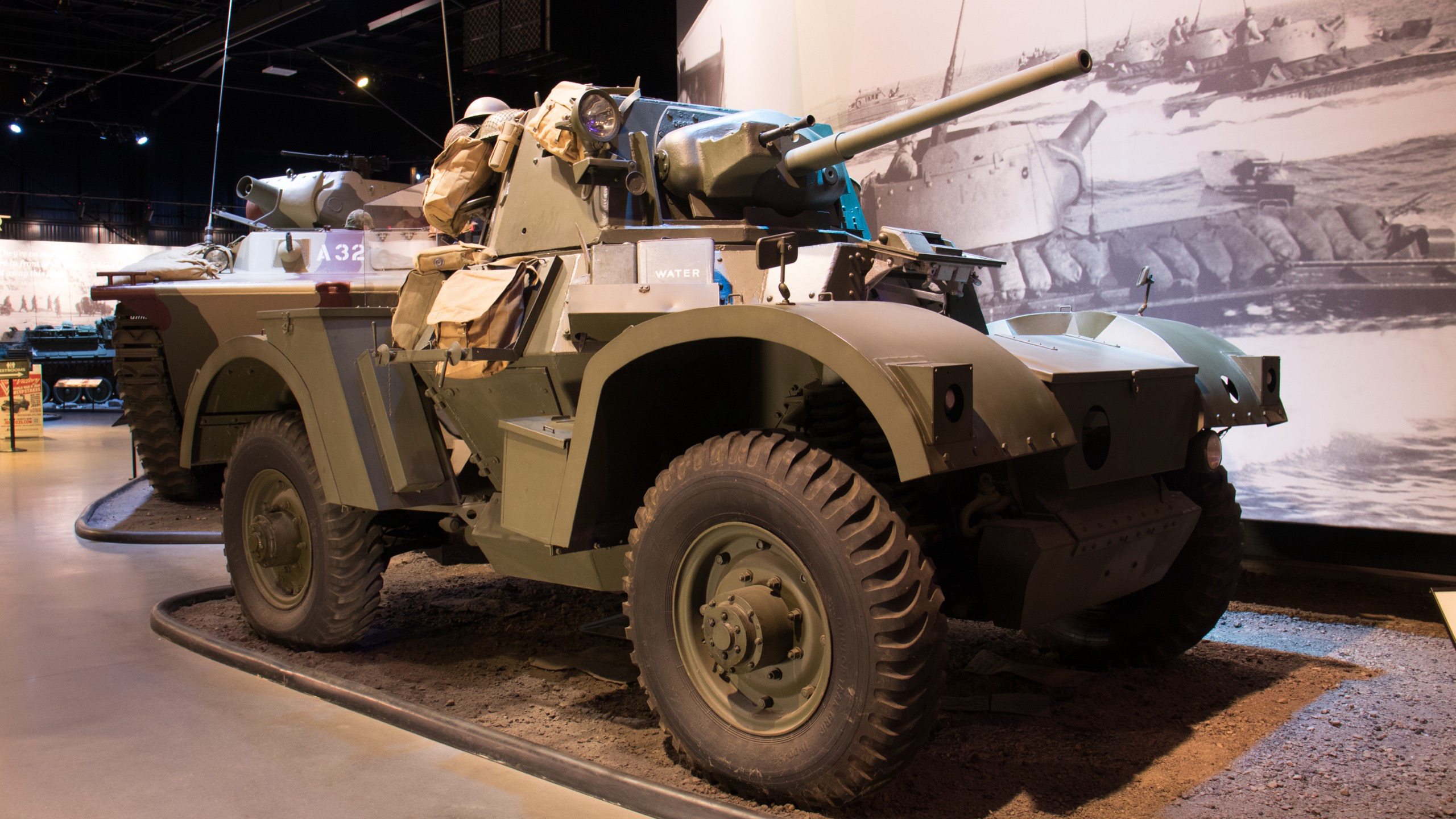
The British Daimler Mk. II Armored Car was a highly capable reconnaissance vehicle employed by British and Commonwealth forces during World War II. Designed for scouting, armed reconnaissance, and liaison missions, the Daimler combined speed, maneuverability, and firepower in a compact, heavily armed four-wheel-drive vehicle.
Developed by the Daimler Company and entering service in 1941, the armored car featured a three-man crew, independent suspension, and a powerful six-cylinder engine capable of reaching speeds approaching 50 mph. Its primary armament consisted of a turret-mounted 40mm Ordnance QF 2-pounder cannon supported by a coaxial 7.92mm Besa machine gun. The improved Mk. II incorporated a redesigned turret and gun mounting, upgraded radiator, and an additional driver’s escape hatch.
The Daimler first saw combat in North Africa in 1942, where its speed and reliability made it particularly valuable for reconnaissance missions across the vast desert. It subsequently served with British and Commonwealth forces throughout Italy and Western Europe.
Although most Daimlers operated in Europe, a smaller number were deployed to Southeast Asia during the final stages of World War II. The 16th Light Cavalry of the British Indian Army, serving under General William Slim’s Fourteenth Army, employed Daimler and Humber armored cars during the 1945 campaign to liberate Burma from Japanese occupation.
In Burma, armored reconnaissance units played an important role in scouting enemy positions, protecting advancing columns, and maintaining communications across an operational theater characterized by dense jungle, mountainous terrain, and limited road networks. The Daimler’s mobility and firepower made it valuable for these missions, although its relatively thin armor limited its effectiveness against heavier weapons.
Approximately 2,694 Daimler armored cars of all variants were manufactured during World War II. Their reliability ensured continued service with British and Commonwealth forces well into the postwar period, including service during the Korean War.
Displayed in the American Heritage Museum’s Pacific War Gallery, this rare Daimler Mk. II represents the often-overlooked contribution of British and Indian forces to the Allied victory over Japan and the vital importance of armored reconnaissance during the Burma Campaign.