Artifacts
M7B2 Priest
United States | 1942–1953 | World War II & Korean War
| General Information | |
|---|---|
| Model | M7B2 Howitzer Motor Carriage (HMC) Priest |
| Class | Armor |
| Type | Self-Propelled Artillery |
| Use | Military |
| Era | 1946-1955 |
| Gallery Focus | Korean War |
| Manufacturer | Pressed Steel Car |
| Year | 1950 |
| Country | United States |
| Ownership | CF Inc. |
| Gallery Location | Korean War |
| Status | Static Only |
Additional Photos


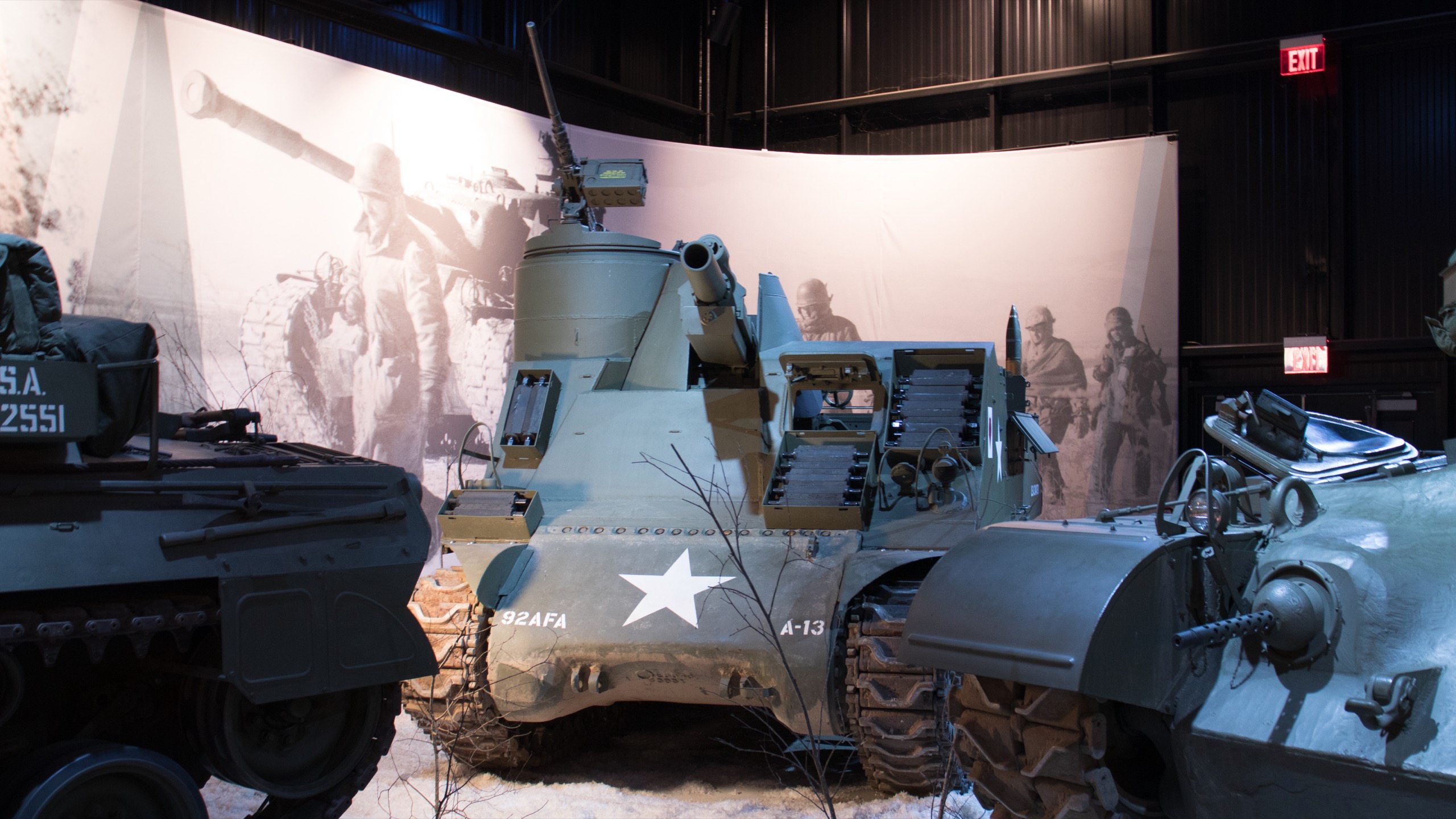
The American M7B2 Priest represents an important evolution in mobile artillery during the Korean War. Developed from the highly successful M7 Priest of World War II, this specialized version was adapted to deliver powerful artillery support across Korea’s rugged, mountainous terrain.
The original M7 entered American service in 1942 as one of the first fully tracked, self-propelled artillery vehicles produced in substantial numbers for the U.S. Army. Built initially upon the chassis of the M3 Lee medium tank, later versions incorporated components from the M4 Sherman. The improved M7B1 was based on the M4A3 Sherman chassis, combining proven automotive technology with a powerful 105mm howitzer.
The vehicle acquired its unusual nickname from British soldiers, who thought the elevated circular mount for its .50-caliber machine gun resembled a church pulpit. The name “Priest” became synonymous with American mobile artillery throughout World War II.
Unlike conventional tanks, which were designed primarily for direct combat, the Priest’s principal mission was to deliver indirect artillery fire against enemy concentrations, defensive positions, and supply routes. Its 105mm howitzer could fire high-explosive, smoke, and other specialized ammunition to distances exceeding six miles. Carrying up to 69 artillery rounds, the vehicle allowed artillery crews to accompany rapidly advancing armored formations without relying upon separate towing vehicles.
Priests served extensively during World War II, beginning with British Commonwealth operations in North Africa. They subsequently supported Allied forces in Sicily, Italy, Normandy, the Battle of the Bulge, and campaigns across the Pacific.
When the Korean War began in June 1950, the M7 remained an important component of American artillery forces. However, the mountainous Korean landscape exposed a significant limitation in the original design: its 105mm howitzer could elevate only 35 degrees, restricting its ability to fire over steep hills and engage enemy positions concealed behind ridgelines.
To overcome this problem, 127 M7B1 Priests were modified into the M7B2 configuration, increasing the howitzer’s maximum elevation to 65 degrees. This improvement allowed artillery crews to deliver high-angle fire over intervening terrain, an essential capability during the fighting in Korea.
The modifications also required raising the distinctive machine-gun pulpit, giving its .50-caliber Browning machine gun an unobstructed 360-degree field of fire.
The Priest’s tracked mobility, armored protection, and ability to rapidly reposition made self-propelled artillery particularly valuable during the Korean conflict. However, its open-topped fighting compartment left crews exposed to harsh weather and threats from above.
Following the Korean War, surviving Priests continued serving with allied nations, including several European NATO countries.
Displayed in the American Heritage Museum’s Korean War Gallery, the M7B2 Priest illustrates how American military engineers adapted proven World War II technology to meet the demanding conditions of a new conflict. Its distinctive raised gun mounting and machine-gun pulpit demonstrate the practical innovations that helped shape the development of modern self-propelled artillery.