Artifacts
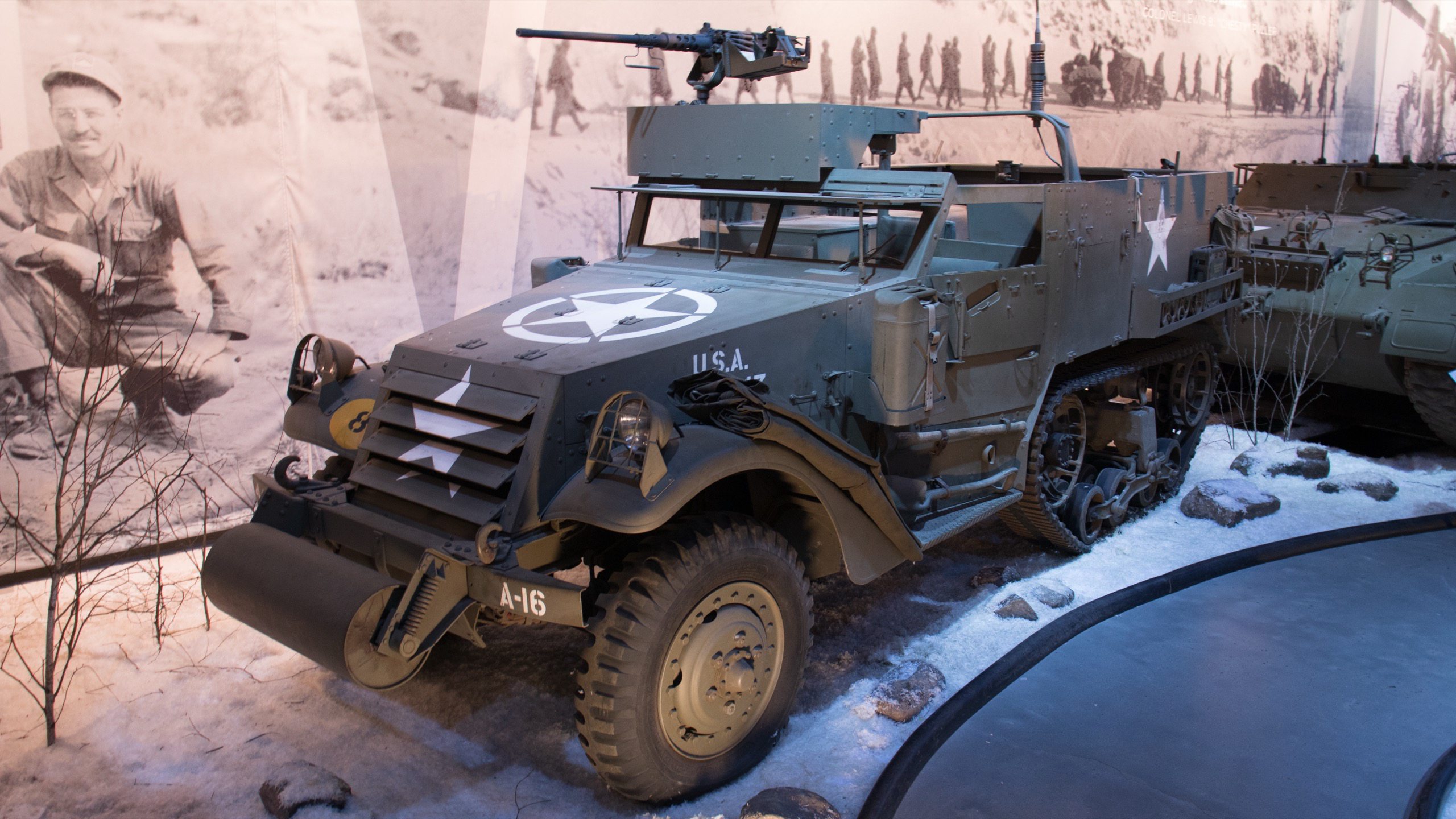
M2A1 Half-Track
| General Information | |
|---|---|
| Model | M2A1 Half-Track |
| Class | Military Vehicle |
| Type | Utility & Personnel Carrier |
| Use | Military |
| Era | 1946-1955 |
| Gallery Focus | Korean War |
| Manufacturer | White Motor Corporation |
| Year | 1944 |
| Country | United States |
| Ownership | CF Inc. |
| Gallery Location | Korean War |
| Status | Operational, Offline |
Additional Photos


The American M2 Half-Track was a versatile armored vehicle developed during World War II to transport soldiers, tow artillery, and support mechanized military operations. Combining conventional front wheels with powered tracks at the rear, the M2 offered the speed and maneuverability of a truck with improved traction over mud, snow, and rough terrain.
Developed in the late 1930s and entering U.S. Army service in 1941, the M2 was manufactured primarily by the White Motor Company and Autocar. Originally designed as an artillery tractor and ammunition carrier, it also transported machine gun squads and served in reconnaissance and command roles. Armed with a .50-caliber Browning heavy machine gun and additional mounting positions for lighter machine guns, the M2 provided mobile defensive firepower for its crew.
During World War II, M2 Half-Tracks served extensively with American forces in North Africa, Europe, and the Pacific, while similar vehicles were supplied to Allied nations. Their combination of mobility and carrying capacity made them valuable for supporting advancing armored and infantry formations.
Despite their versatility, half-tracks had significant limitations. Their thin armor provided protection against some small-arms fire and shell fragments but offered little defense against heavier weapons. Most dangerously, their open-topped compartments exposed occupants to artillery bursts, grenades, and enemy fire from elevated positions. Reflecting these vulnerabilities, American soldiers sometimes grimly nicknamed them “Purple Heart Boxes,” referring to the military decoration awarded to those wounded or killed in combat.
When the Korean War began in 1950, World War II-era half-tracks remained part of the American military’s equipment inventory. Related variants, particularly the heavily armed M16 Multiple Gun Motor Carriage, provided valuable mobile fire support during the conflict. Their continued service demonstrated the utility of the half-track concept while highlighting the growing need for improved armor protection and fully tracked personnel carriers.
Displayed in the American Heritage Museum’s Korean War Gallery, the M2 Half-Track illustrates the evolution of American mechanized warfare and the enduring influence of World War II military technology on the battlefields of Korea.