Artifacts
Bell HH-1K Iroquois (Huey) "Seawolves"
American Naval Search and Rescue / Gunship Helicopter | Vietnam War & Cold War Era (1970–1980s)
| General Information | |
|---|---|
| Model | HH-1K Iroquois (Huey) "Seawolves" |
| Class | Aircraft |
| Type | Helicopter |
| Use | Military |
| Era | 1956-1975 |
| Gallery Focus | Vietnam War |
| Manufacturer | Bell |
| Year | 1966 |
| Country | United States |
| Ownership | Loan, US Navy |
| Gallery Location | Hangar |
| Status | Static Only |
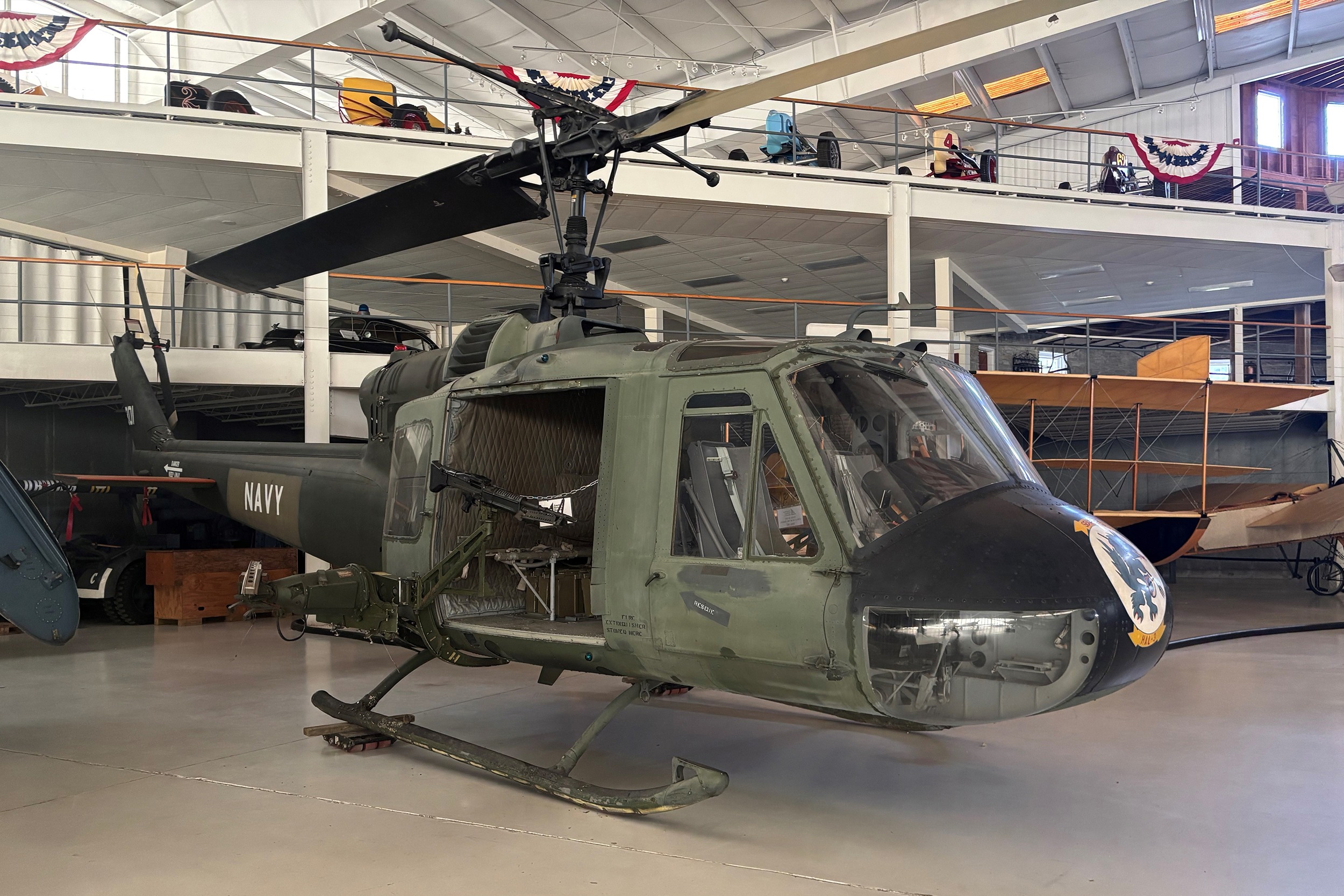
The Bell UH-1 Iroquois, universally known as the “Huey,” became one of the most recognizable symbols of the Vietnam War. Renowned for its distinctive rotor sound, versatility, and rugged reliability, the Huey transformed battlefield aviation by transporting troops, evacuating wounded personnel, and providing close air support. Among its most specialized variants was the Bell HH-1K, developed for the United States Navy and closely associated with the legendary naval helicopter squadrons known as the “Seawolves.”
Developed from the Marine Corps UH-1E, the HH-1K incorporated improved avionics and a more powerful 1,400-horsepower Lycoming T53-L-13 turboshaft engine. Originally designed for search and rescue operations, the aircraft could also be configured as an armed gunship. Only 27 HH-1K helicopters were manufactured, making it one of the rarer variants of the extensive Huey family.
The HH-1K’s history is closely connected to the U.S. Navy’s Helicopter Attack Squadron (Light) 3, HA(L)-3, nicknamed the “Seawolves.” Established in April 1967, the Seawolves supported the Navy’s riverine warfare operations in South Vietnam, particularly throughout the dangerous waterways of the Mekong Delta. Flying heavily armed Huey helicopters, their crews provided rapid-response fire support for river patrol boats, Navy SEAL teams, and other special operations forces.
Equipped with machine guns, electrically operated miniguns, 2.75-inch rockets, and occasionally 40mm grenade launchers, Seawolf helicopters became essential to protecting American personnel operating in contested waterways. During one particularly active year, the squadron accumulated more than 34,000 flight hours, demonstrating the extraordinary operational demands placed upon its pilots and crews.
The American Heritage Museum’s HH-1K, Bureau Number 157188, has a distinguished history of its own. The helicopter served with HA(L)-5, the “Blue Hawks,” a Naval Air Reserve squadron based at Naval Air Station Point Mugu, California. There, it supported naval special operations training, including the insertion and extraction of Navy SEAL teams. Remarkably, the aircraft still bears evidence of damage sustained during live-fire training exercises off San Clemente Island.
Before its transfer to the National Naval Aviation Museum in 1989, the helicopter was repainted in markings honoring the Vietnam-era HA(L)-3 Seawolves. Although its documented operational service was with HA(L)-5, its appearance commemorates the extraordinary courage and sacrifice of naval helicopter crews during the Vietnam War.
The HH-1K arrived at the American Heritage Museum on July 1, 2025, on long-term loan from the National Naval Aviation Museum and the U.S. Navy. Currently displayed in the museum’s seasonal Aircraft Storage Hangar Annex, the helicopter is being prepared for installation in the Vietnam War Gallery in 2027.
This rare survivor represents the evolution of naval helicopter warfare and honors the aviators who flew dangerous missions in support of American sailors, Marines, and special operations forces during the Vietnam War and Cold War.