Artifacts
Douglas TA-4J Skyhawk
American Two-Seat Jet Trainer | Vietnam War & Cold War Era (1960s–1990s)
| General Information | |
|---|---|
| Model | TA-4J Skyhawk |
| Class | Aircraft |
| Type | Trainer |
| Use | Military |
| Era | 1956-1975 |
| Gallery Focus | Vietnam War |
| Manufacturer | Douglas |
| Year | 1967 |
| Country | United States |
| Ownership | CF Trust |
| Gallery Location | N/A |
| Status | Operational, Online |
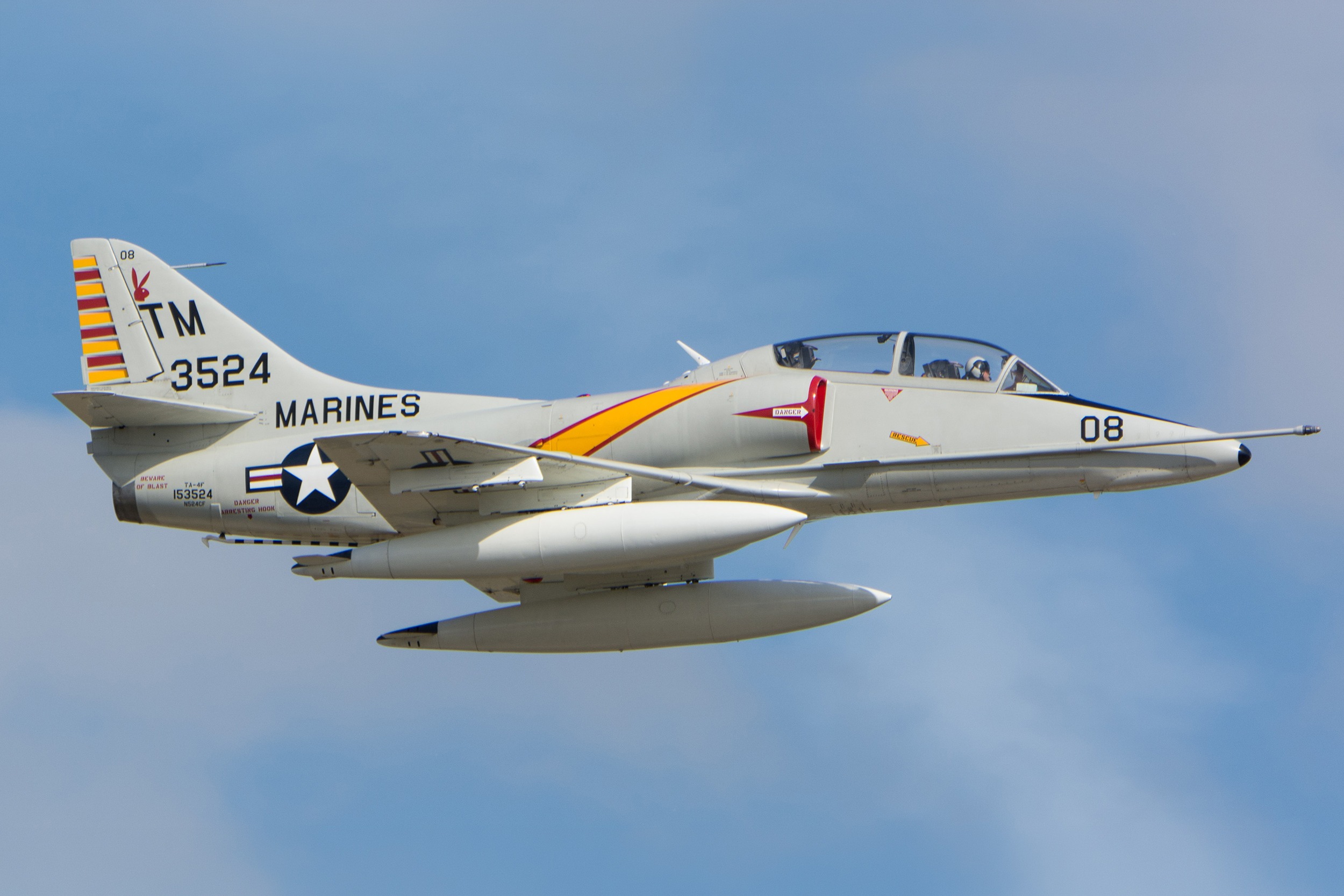
The Douglas TA-4J Skyhawk was a highly maneuverable, two-seat jet trainer developed from one of the most successful carrier-based attack aircraft in American naval aviation history. Renowned for its compact design, exceptional performance, and versatility, the Skyhawk served the United States Navy and Marine Corps for nearly five decades, playing important roles in combat operations, advanced pilot training, and aerial combat instruction.
Originally designed by legendary Douglas Aircraft engineer Ed Heinemann, the A-4 Skyhawk first flew in June 1954 and entered Navy service in 1956. Heinemann emphasized simplicity, light weight, and performance, creating an aircraft so compact that its wings did not require folding for storage aboard aircraft carriers. Nicknamed “Heinemann’s Hot Rod” and affectionately called the “Scooter” by its pilots, the Skyhawk became one of the Navy’s principal attack aircraft during the Vietnam War.
The TA-4J, introduced in 1969, was a dedicated advanced training variant featuring two tandem cockpits with dual flight controls for an instructor and student pilot. Powered by a Pratt & Whitney J52 turbojet engine, the aircraft could reach speeds exceeding 600 mph while retaining the exceptional maneuverability of its single-seat predecessors. The TA-4J trained generations of naval aviators in high-performance jet operations, instrument flying, air combat maneuvering, and aircraft carrier procedures. Its agility also made it an effective adversary aircraft, simulating enemy fighters during advanced tactical training.
The American Heritage Museum’s Skyhawk, Bureau Number 153524, has a distinguished individual history. Originally delivered to the U.S. Navy in July 1967 as a TA-4F, it served with VF-126 at Naval Air Station Miramar, California, where it supported adversary training for Navy fighter squadrons. Converted to TA-4J configuration in 1972, it subsequently supported naval research, parachute and escape-system testing, and flight evaluations. From 1983 until its retirement in 1994, it served with the U.S. Naval Test Pilot School at Patuxent River, Maryland.
Acquired by the Collings Foundation following Congressional authorization in 2000, the aircraft underwent an extensive restoration and returned to flight on December 15, 2004. It was subsequently repainted in the distinctive markings of the U.S. Marine Corps H&MS-11 “Playboys,” an elite volunteer Fast Forward Air Control unit that operated two-seat Skyhawks from Da Nang, South Vietnam, during 1969–1970. Flying dangerous missions over hostile territory, Playboy crews located enemy positions, coordinated air strikes, and supported American ground forces.
Although this particular aircraft did not serve with the Playboys, its markings honor their extraordinary contributions and the sacrifices of American aviators during the Vietnam War.
Today, the Collings Foundation’s TA-4J Skyhawk is leased to and operated by the Vietnam War Flight Museum at Ellington Field in Houston, Texas. Preserved as part of the American Heritage Museum and Collings Foundation’s historic aviation collection, the aircraft represents an enduring commitment to preserving aviation history and honoring the men and women who served during the Vietnam War and Cold War.