Artifacts
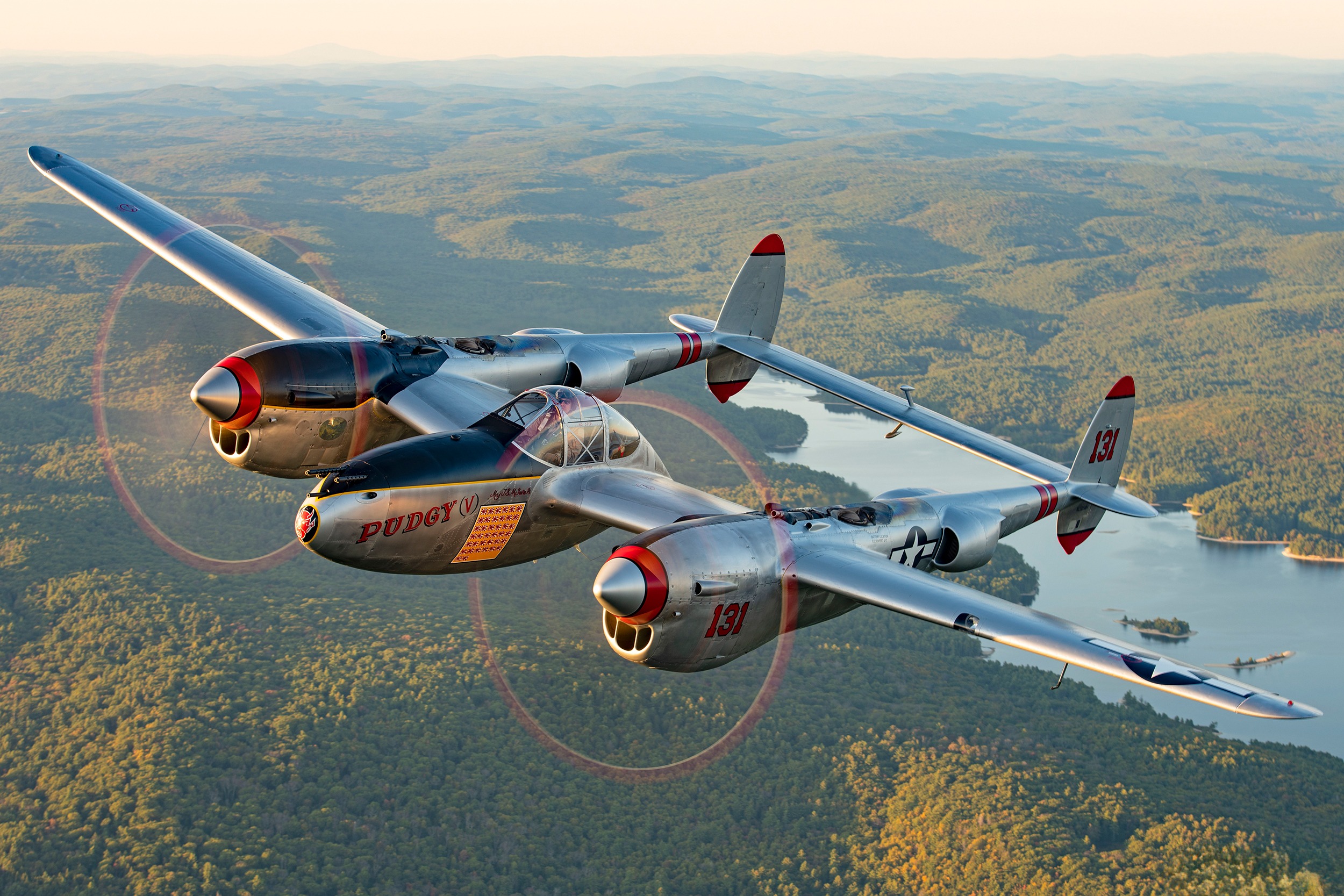
Lockheed P-38L Lightning "Pudgy V"
United States | 1942–1945 | World War II – Pacific Theater
| General Information | |
|---|---|
| Model | P-38L-5-LO Lightning |
| Class | Aircraft |
| Type | Fighter |
| Use | Military |
| Era | 1940-1945 |
| Gallery Focus | WWII Pacific Theater |
| Manufacturer | Lockheed |
| Year | 1944 |
| Country | United States |
| Ownership | CF Inc. |
| Gallery Location | N/A |
| Status | Operational, Online |
The Lockheed P-38 Lightning was one of the most distinctive and formidable American fighter aircraft of World War II. With its unmistakable twin-boom design, powerful engines, and exceptional range, the Lightning proved particularly effective in the vast Pacific Theater, where American pilots faced long overwater flights and determined Japanese opposition. The aircraft became synonymous with some of America’s greatest fighter aces, including Major Richard Bong and Major Thomas B. McGuire Jr.
Developed by Lockheed under the direction of legendary engineers Clarence “Kelly” Johnson and Hall Hibbard, the P-38 first flew in January 1939. Its unconventional configuration placed the pilot in a central nacelle between two engine booms, each housing a turbocharged Allison V-1710 engine. Unlike most contemporary fighters, its concentrated armament of four .50-caliber machine guns and a 20mm cannon fired directly forward without requiring synchronization with a propeller.
The P-38’s speed, firepower, and long range made it especially effective in the Pacific, where it served as a fighter, bomber escort, ground-attack aircraft, and photographic reconnaissance platform. The P-38L, introduced in 1944, represented the culmination of years of combat experience and technical improvements, becoming the most extensively produced Lightning variant.
The American Heritage Museum’s P-38L-5-LO, U.S. Army Air Forces serial number 44-53186, was manufactured in 1945 near the conclusion of World War II. Rather than entering combat, the aircraft was converted into an F-5G-6-LO photographic reconnaissance aircraft. Its original fighter nose was replaced with a specialized camera installation, allowing it to conduct high-speed, unarmed reconnaissance missions.
With the war ending, the aircraft was placed in storage at Kingman, Arizona, before being sold as surplus in March 1946 for just $1,250. It subsequently began a second career with civilian aerial surveying companies, including Kargl Aerial Surveys, Aero Exploration, and Mark Hurd Aerial Mapping. Registered as N505MH, the former military aircraft spent years photographing and mapping the American landscape.
Following retirement from commercial service, the Lightning entered the collection of automobile magnate William Harrah in 1967. Acquired by aircraft collector Frank Taylor in 1982, it underwent restoration and received a replacement fighter-style nose. In 1989, the aircraft crossed the Atlantic to Britain, where it flew under the name “Miss Behavin’,” before returning to the United States. A subsequent restoration for Evergreen Aviation returned the aircraft to a beautifully preserved P-38L configuration.
Acquired by the Collings Foundation in 2015, the Lightning was later restored in the markings of “Pudgy V,” honoring Major Thomas B. McGuire Jr. McGuire, who named his aircraft after his wife Marilynn, achieved 38 aerial victories against Japanese aircraft, making him America’s second-highest-scoring fighter ace of World War II. He was killed in combat over the Philippines on January 7, 1945, and posthumously received the Medal of Honor for his extraordinary courage.
Although this particular P-38 did not serve in combat, its restored markings pay tribute to McGuire and the thousands of American airmen who flew Lightnings across the Pacific. Its remarkable survival also preserves the story of the aircraft’s continued usefulness long after the war.
Current Location and Future Exhibit: The P-38L remains in flying condition and is currently stored in a private hangar in Worcester, Massachusetts, where it is not available for public viewing. It is planned for permanent exhibition within the American Heritage Museum’s proposed Aviation Wing expansion, as part of a new World War II Airpower in the South Pacific gallery.