Artifacts
Foster-Miller TALON
| General Information | |
|---|---|
| Model | Foster-Miller TALON |
| Class | Robot |
| Type | Military Robot, Tracked |
| Use | Military |
| Era | 2001-2024 |
| Gallery Focus | War on Terror / Iraq & Afghanistan |
| Manufacturer | QinetiQ-NA |
| Year | 2005 |
| Country | United States |
| Ownership | CF Inc. |
| Gallery Location | War on Terror |
| Status | Operational, Offline |
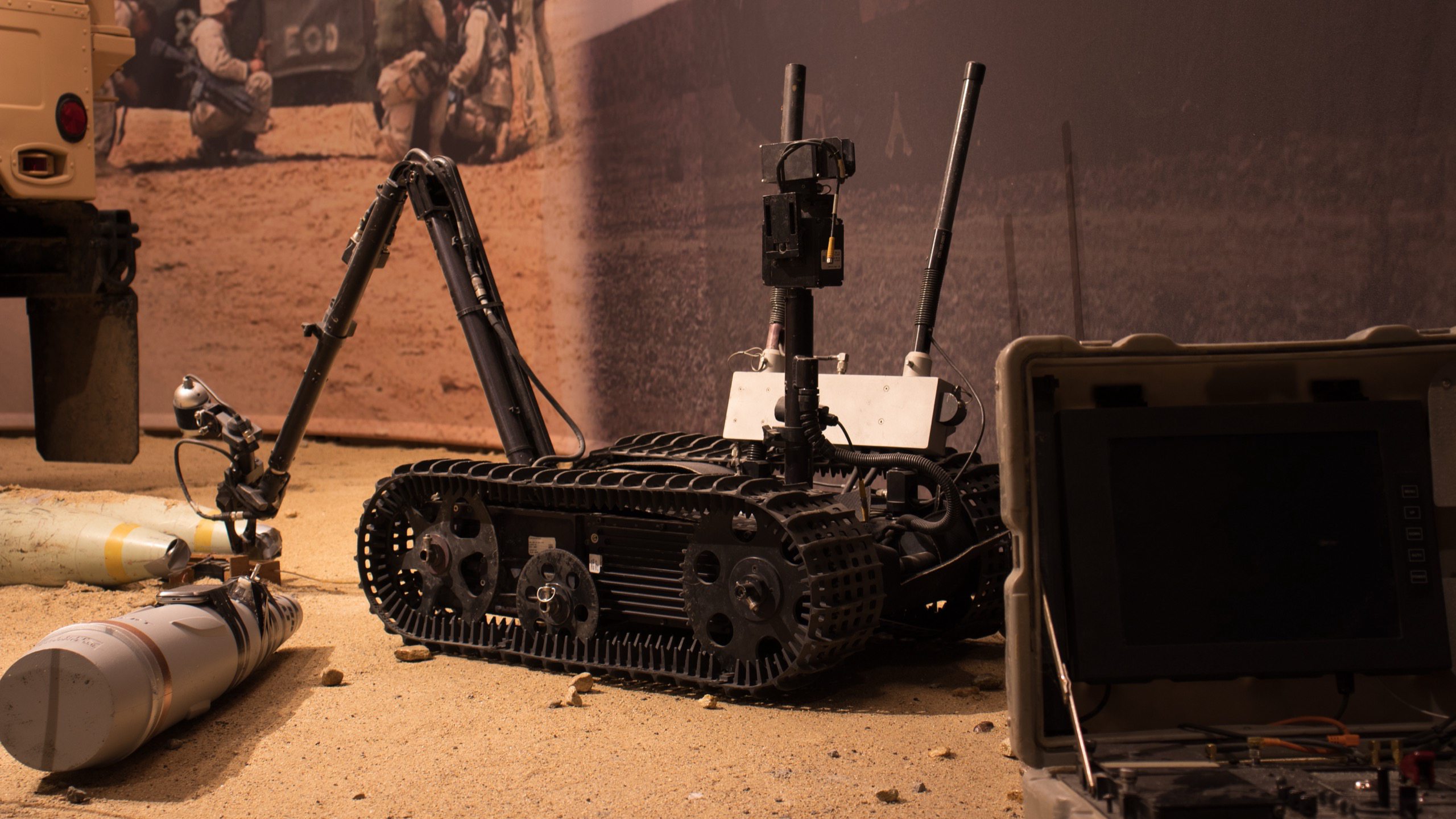
The Foster-Miller TALON Tactical Robot played a critical role in protecting American and Coalition forces during the wars in Iraq and Afghanistan. Developed by Massachusetts-based Foster-Miller, later acquired by QinetiQ, this remotely operated, tracked robotic vehicle became an essential tool for explosive ordnance disposal (EOD), reconnaissance, and other hazardous military operations.
First introduced in 2000, the TALON entered combat service in Afghanistan following the September 11, 2001 terrorist attacks. As insurgent forces increasingly relied upon improvised explosive devices (IEDs), roadside bombs, and concealed explosives, the TALON became particularly valuable in Iraq, where these weapons posed a constant threat to American military personnel and convoys.
Equipped with cameras, sensors, and a robotic manipulator arm, the TALON allowed EOD technicians to inspect suspicious objects, identify explosive devices, and assist in safely disabling them from a distance. Its rugged tracked chassis enabled it to navigate rubble, sand, stairs, and confined spaces, while transmitting real-time video to operators positioned away from potential explosions.
Thousands of TALON robots were deployed during the conflicts, conducting dangerous missions that would otherwise have exposed soldiers to potentially deadly threats. The platform also served as the basis for the experimental SWORDS armed robotic system, three examples of which were deployed to Iraq in 2007, demonstrating the emerging possibilities of unmanned ground combat vehicles.
Displayed in the American Heritage Museum’s War on Terror Gallery, the TALON represents a significant advancement in battlefield robotics and the evolving use of technology to protect military personnel during twenty-first-century warfare.