Artifacts
"Old Joe" Ford A/B Gemsa Sprint Car
United States | 1940s | Postwar American Sprint Car Racing
| General Information | |
|---|---|
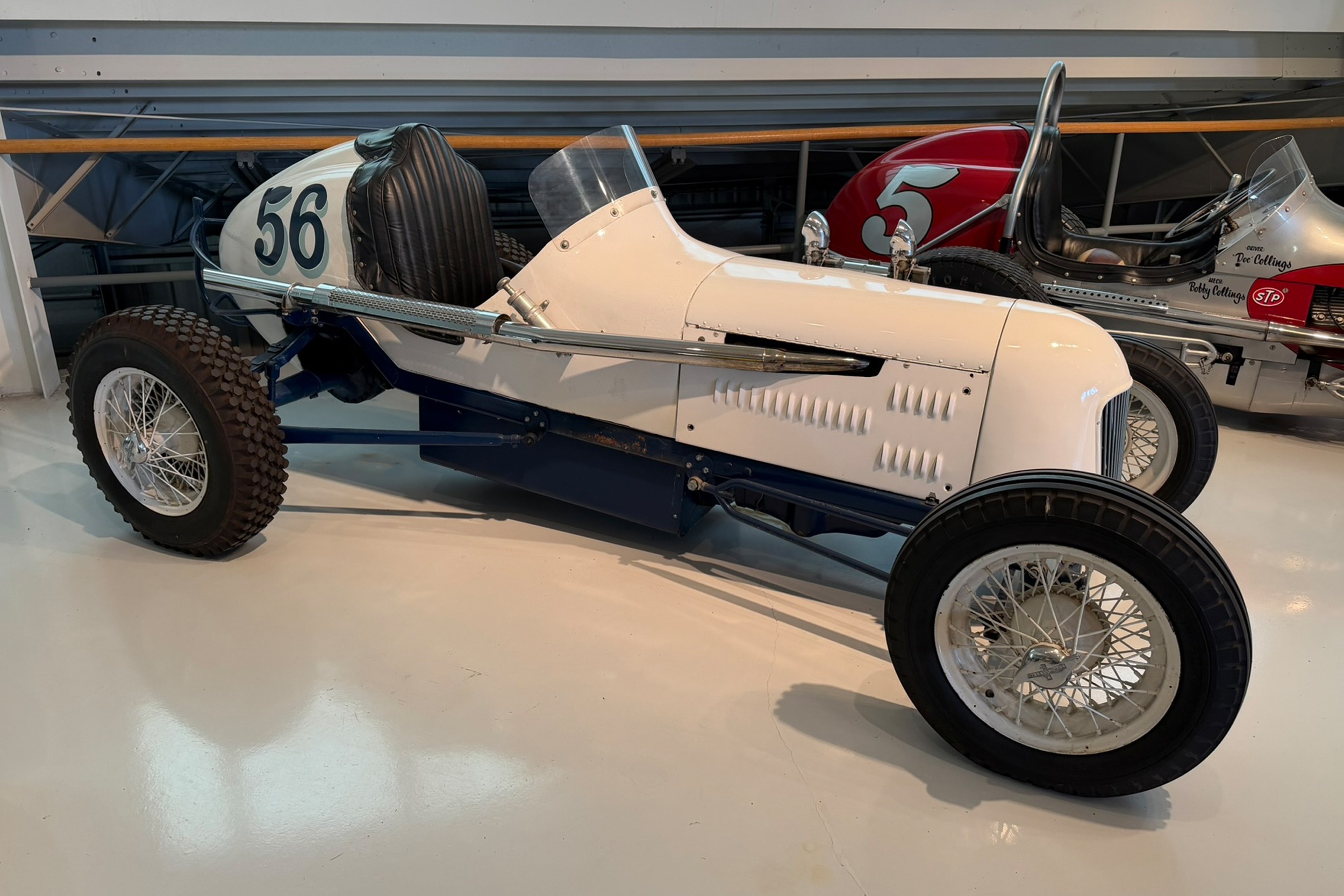
| Model | #56 "Old Joe" Ford A/B Gemsa – White Sprint Car |
| Class | Vehicle |
| Type | Race Car, Sprint Car |
| Use | Civilian |
| Era | 1940-1959 |
| Gallery Focus | Sprint Cars |
| Manufacturer | Ford |
| Year | 1948 |
| Country | United States |
| Ownership | CF Trust |
| Gallery Location | Vintage Race Car Collection |
| Status | Operational, Offline |
During the Golden Age of American Sprint Car racing, ingenuity and mechanical craftsmanship often mattered as much as horsepower. Independent racers and mechanics routinely transformed ordinary automobile engines into highly specialized competition powerplants, creating unique machines capable of challenging far more expensive factory-built racing cars. The white-and-blue Number 56 “Old Joe” Sprint Car is a remarkable example of this resourceful racing tradition.
According to the museum’s collection records, this automobile is powered by a 1932 Ford four-cylinder engine fitted with a specialized Gemsa racing cylinder head assembly. Ford’s rugged four-cylinder engines, introduced with the Model A in 1928 and further developed into the Model B in 1932, became favorites among independent racers because of their relatively low cost, widespread availability, and considerable potential for modification.
The 1932 Ford Model B engine displaced approximately 201 cubic inches and produced 50 horsepower in standard factory configuration. Racing mechanics could substantially increase that output through improved cylinder heads, modified valve arrangements, higher compression ratios, specialized carburetors, and other performance enhancements.
The Gemsa conversion connects Number 56 to one of the most accomplished craftsmen in American grassroots motorsports. Joe “Jiggler Joe” Gemsa was a California-based Sprint Car racer and master machinist who became renowned for developing and refining high-performance Ford four-cylinder engines. Working from his modest workshop in El Monte, California, Gemsa designed, manufactured, and modified specialized engine components, including overhead-valve, single-overhead-camshaft, and dual-overhead-camshaft cylinder head conversions. His innovative engineering allowed relatively simple Ford engine blocks to compete at levels far beyond their original passenger-car applications.
Known as “Old Joe,” Number 56 was owned by Glen Langford and carries an American Automobile Association (AAA) Contest Board registration dating to 1948. The AAA was among the principal governing bodies of American automobile racing during this period, overseeing championship competition and establishing regulations for organized racing events.
The car’s long, narrow white bodywork, contrasting dark-blue chassis, exposed suspension, wire-spoke wheels, and distinctive external exhaust system reflect the functional design of early Sprint Cars. These lightweight, open-cockpit racers competed on dirt ovals and fairgrounds tracks throughout the United States, where drivers relied on tremendous skill and mechanical reliability to negotiate rough racing surfaces at high speeds.
Today, “Old Joe” represents an important chapter in American racing history, preserving the ingenuity of independent competitors who transformed affordable production engines into remarkable racing machines. Its Gemsa-equipped Ford engine exemplifies the creativity and determination that helped shape the development of American open-wheel motorsports.
Museum Display Location: Third Floor Race Car Collection, American Heritage Museum’s seasonal Storage Hangar Annex. Accessible during select special event weekends in the summer and fall.