Artifacts
#2 “Riley Racing Equip” Sprint Car
United States | 1930s | Golden Age of American Sprint Car Racing
| General Information | |
|---|---|
| Model | #2 Riley Four-Port “Nelson & Sons Special” Sprint Car |
| Class | Vehicle |
| Type | Race Car, Sprint Car |
| Use | Civilian |
| Era | 1930-1940 |
| Gallery Focus | Sprint Cars |
| Manufacturer | Riley |
| Year | 1930 (~) |
| Country | United States |
| Ownership | CF Trust |
| Gallery Location | Vintage Race Car Collection |
| Status | Operational, Offline |
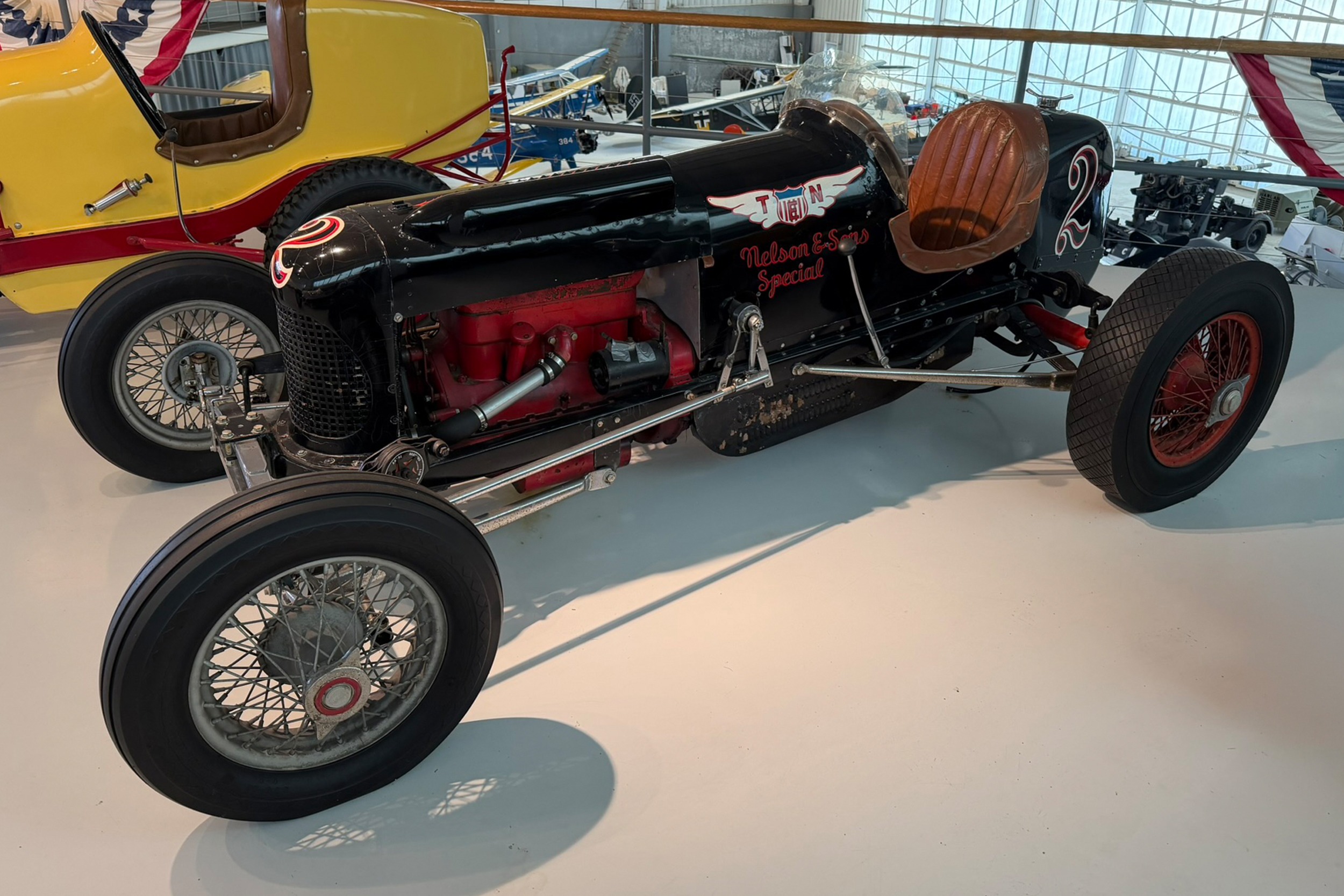
During the 1930s, American automobile racing was undergoing a remarkable transformation as innovative mechanics discovered ways to extract extraordinary performance from ordinary production engines. The black Number 2 “Nelson & Sons Special” Sprint Car represents this pioneering era, featuring a distinctive Riley Four-Port racing engine conversion that helped transform Ford’s dependable four-cylinder powerplant into a formidable competitor on America’s early dirt tracks.
The centerpiece of this automobile is its Riley-equipped engine, utilizing a specialized cylinder head developed by American inventor and racing engineer George Riley. Beginning in the 1920s, Riley became an influential figure in the growing automotive performance industry, developing equipment that substantially increased the power of Ford’s Model T, Model A, and Model B engines. His innovative Four-Port cylinder head, introduced to competition in 1932, became one of the most desirable performance modifications available to independent racers.
Unlike Ford’s original flathead design, which located both intake and exhaust valves within the engine block, the Riley Four-Port conversion relocated the intake valves into the cylinder head while retaining the exhaust valves in the block. This unusual arrangement, known as an F-head configuration, incorporated two overhead intake valves per cylinder and four separate intake ports, dramatically improving the engine’s ability to draw in the fuel-air mixture. Riley claimed that properly prepared engines could develop as much as 160 horsepower at 4,500 rpm, an extraordinary increase over the approximately 40 horsepower produced by a standard Ford Model A engine.
The Nelson & Sons Special features the narrow bodywork, exposed mechanical components, wire-spoke wheels, and compact cockpit characteristic of early American Sprint Cars. Its distinctive upright radiator and unusually configured front grille give the automobile an appearance reminiscent of earlier racing machines. The hand-finished black bodywork, contrasting red engine and wheels, and carefully lettered “Nelson & Sons Special” identification reflect the individuality of early racing teams and builders.
Known during this period as “Big Cars,” Sprint Cars competed primarily on dirt ovals and fairgrounds tracks, where drivers relied on mechanical ingenuity, precise throttle control, and considerable courage. Independent teams frequently combined production automobile components with specialized racing equipment, creating unique machines tailored to their drivers and available resources.
Today, the Number 2 Nelson & Sons Special preserves an important example of early American racing innovation, illustrating how pioneering aftermarket engineering helped bridge the gap between ordinary automobiles and the increasingly sophisticated purpose-built race cars that would follow.
Museum Display Location: Third Floor Race Car Collection, American Heritage Museum’s seasonal Storage Hangar Annex. Accessible during select special event weekends in the summer and fall.