Artifacts
1948 #7 Ford V8 – Midget Sprint Car
United States | c. 1948 | Postwar American Midget Auto Racing
| General Information | |
|---|---|
| Model | #7 Ford V8 – Purple Midget Sprint Car |
| Class | Vehicle |
| Type | Race Car, Midget Sprint Car |
| Use | Civilian |
| Era | 1940-1959 |
| Gallery Focus | Sprint Cars |
| Manufacturer | Ford |
| Year | 1948 |
| Country | United States |
| Ownership | CF Trust |
| Gallery Location | Vintage Race Car Collection |
| Status | Operational, Offline |
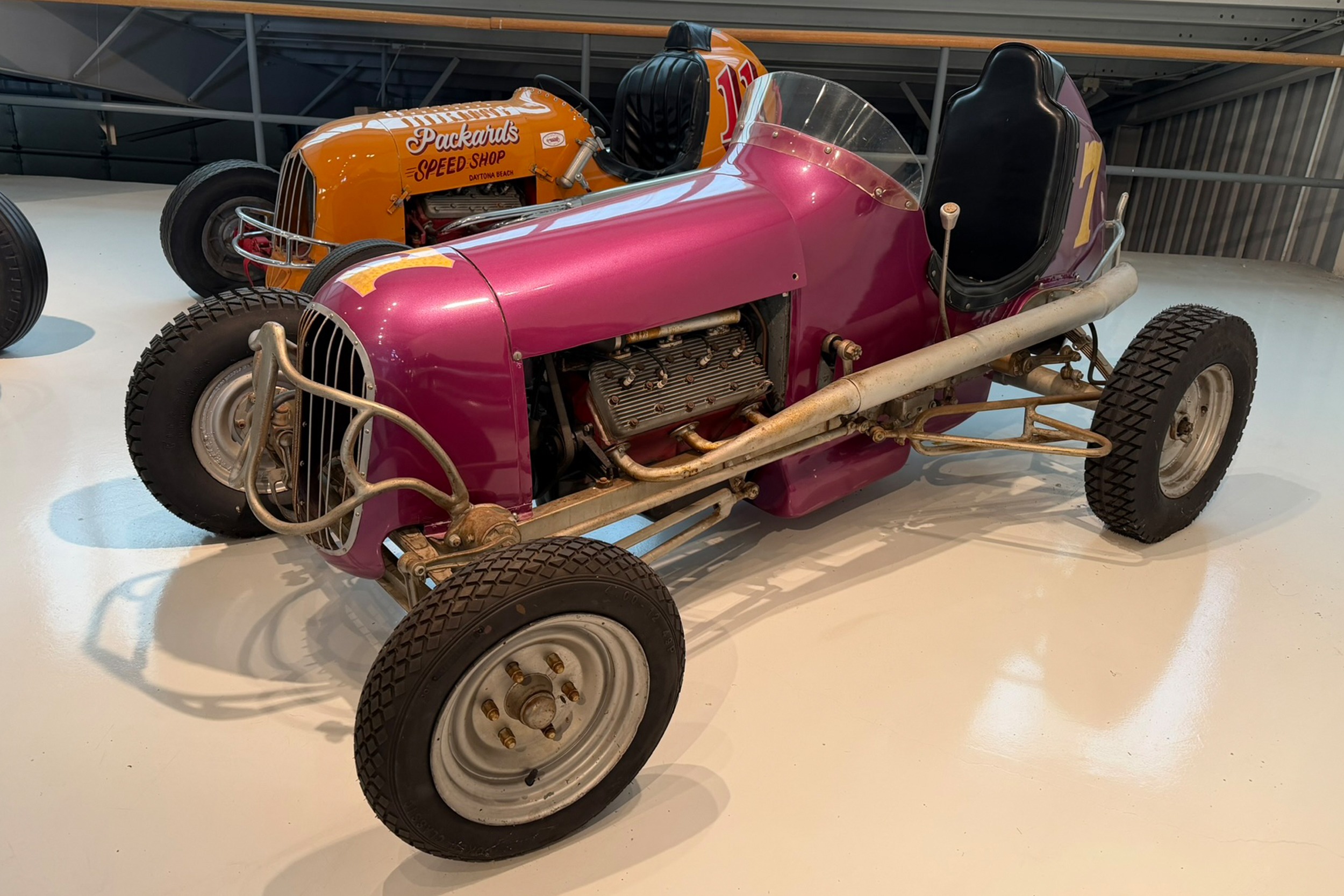
During the years following World War II, Midget auto racing became one of America’s most popular forms of motorsports, thrilling spectators with small, lightweight automobiles powered by surprisingly powerful engines. Among the most successful and affordable powerplants of the period was the Ford V8-60, a compact eight-cylinder engine that helped make competitive racing accessible to independent drivers and mechanics. The purple Number 7 Ford V8-60 Midget Race Car, believed to date from approximately 1948, represents this exciting chapter in American racing history.
Introduced by Ford Motor Company in 1937, the V8-60 was a smaller, economical version of the company’s legendary flathead V8 engine. Displacing 136 cubic inches, it produced 60 horsepower in factory configuration, compared with the 85 horsepower of Ford’s larger 221-cubic-inch V8. Although the smaller engine proved relatively underpowered in passenger automobiles, its compact dimensions, lighter weight, and straightforward construction made it particularly attractive for Midget racing.
The V8-60 quickly became a favorite among racers looking for an affordable alternative to the expensive four-cylinder Offenhauser racing engines that dominated the sport. Its displacement also made it eligible for various Midget racing classifications, where engine size was carefully regulated to encourage competitive racing.
Mechanics soon discovered that the little Ford V8 responded remarkably well to performance modifications. Specialized aluminum cylinder heads, high-compression pistons, multiple carburetors, improved intake manifolds, and modified camshafts could substantially increase power output. Companies such as Edelbrock developed dedicated performance equipment for the V8-60, helping transform an economical passenger-car engine into a serious racing powerplant.
Number 7 features the distinctive proportions of a traditional postwar Midget racer, with narrow streamlined bodywork, an exposed front suspension, compact single-seat cockpit, and a long external exhaust pipe. Its deep purple finish, contrasting gold numbering, and minimal bodywork capture the practical yet colorful character of these early racing machines. With little protection surrounding the driver, these lightweight automobiles demanded extraordinary skill and courage, particularly on the tightly packed dirt and paved oval tracks where Midgets competed.
Throughout the late 1940s and 1950s, Ford V8-60-powered Midgets remained popular with independent racers, helping sustain grassroots competition and developing drivers who would advance into Sprint Cars and Indianapolis-style racing.
Today, Number 7 preserves the resourcefulness and mechanical ingenuity that defined postwar American Midget racing, demonstrating how an ordinary Ford automobile engine could become the heart of an exciting competition machine.
Museum Display Location: Third Floor Race Car Collection, American Heritage Museum’s seasonal Storage Hangar Annex. Accessible during select special event weekends in the summer and fall.