Artifacts
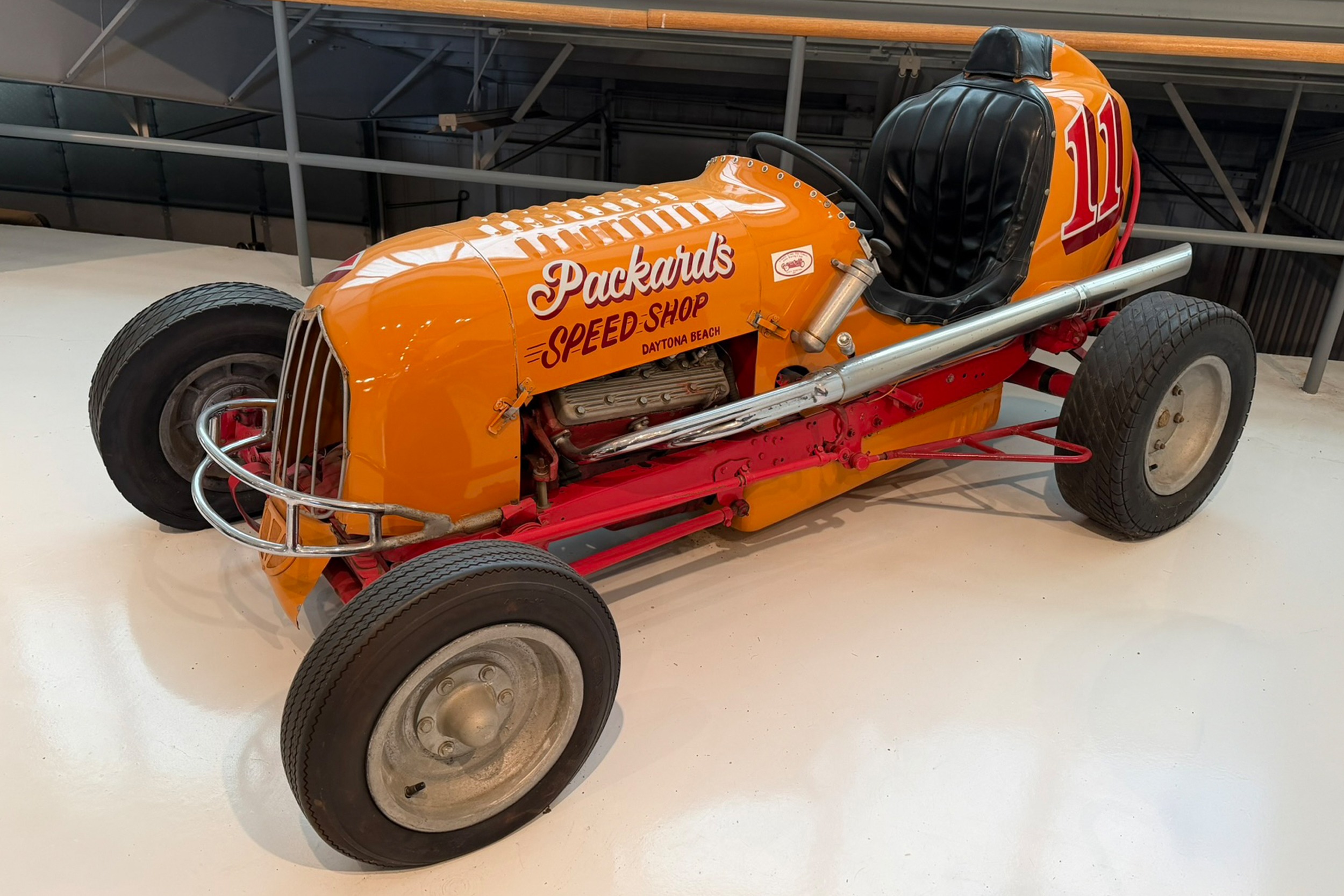
"Packards Speed Shop" V8 Sprint Car
United States | 1940s | Postwar American Open-Wheel Racing
| General Information | |
|---|---|
| Model | #11 "Packards Speed Shop" Ford V8 – Yellow Sprint Car |
| Class | Vehicle |
| Type | Race Car, Sprint Car |
| Use | Civilian |
| Era | 1940-1959 |
| Gallery Focus | Sprint Cars |
| Manufacturer | Ford |
| Year | 1949 |
| Country | United States |
| Ownership | CF Trust |
| Gallery Location | Vintage Race Car Collection |
| Status | Operational, Offline |
In the years following World War II, American Midget and Sprint Car racing flourished as talented mechanics transformed ordinary automobile engines into powerful racing machines. The bright yellow Number 11 “Packard’s Speed Shop” Ford V8 Sprint Car represents this resourceful era, when affordable production engines and innovative modifications allowed independent racers to compete against expensive purpose-built racing machinery.
Powering Number 11 is a Ford V8-60 engine, a compact version of Ford’s legendary flathead V8 introduced in 1937. Originally developed as an economical alternative to Ford’s larger 85-horsepower engine, the V8-60 displaced 136 cubic inches and produced 60 horsepower in factory configuration. Although relatively modest in ordinary passenger cars, its lightweight construction, compact dimensions, and affordable price made it particularly attractive to Midget racing competitors.
Racing mechanics quickly discovered the V8-60’s potential. Specialized cylinder heads, improved intake manifolds, multiple carburetors, and modified camshafts could dramatically increase power output. The engine became so popular that some racing organizations established separate classifications for Ford-powered competitors and the more powerful, considerably more expensive Offenhauser racing engines. In 1950, a highly modified Ford V8-60 prepared by Vic Edelbrock Sr. powered future Indianapolis 500 champion Rodger Ward to a remarkable victory over Offenhauser-equipped Midgets at California’s Gilmore Stadium.
The distinctive “Packard’s Speed Shop” lettering on Number 11 introduces another important figure in American motorsports history. Sam “Sammy” Packard was an accomplished New England racing driver, mechanic, and car builder who competed in Midget, Sprint, Indianapolis-style, motorcycle, boat, and stock car racing. Originally associated with the Boston area, Packard operated a speed shop near Providence, Rhode Island, before relocating to Daytona Beach, Florida, in 1959.
Packard also participated in the historic December 1947 meetings at Daytona Beach’s Streamline Hotel, where Bill France Sr. and other racing pioneers established the foundations of NASCAR. His involvement reflected the close relationship between grassroots open-wheel racing and the emerging world of organized American stock car competition.
Number 11’s streamlined yellow bodywork, red chassis, exposed suspension, compact cockpit, and long polished exhaust pipe evoke the distinctive appearance of postwar racing specials. The car’s Ford V8 powerplant and traditional construction preserve an era when resourceful builders could transform modest mechanical components into competitive racing machines.
Today, the Packard’s Speed Shop Special celebrates the ingenuity, entrepreneurial spirit, and colorful personalities that helped shape American motorsports.