Artifacts
#36 "Caruso" Kurtis Offy Sprint Car
United States | 1950–1955 | Postwar American Midget and Sprint Car Racing
| General Information | |
|---|---|
| Model | #36 "Caruso" Kurtis Offy – Black Sprint Car |
| Class | Vehicle |
| Type | Race Car, Sprint Car |
| Use | Civilian |
| Era | 1940-1959 |
| Gallery Focus | Sprint Cars |
| Manufacturer | Kurtis/Offenhauser |
| Year | 1955 |
| Country | United States |
| Ownership | CF Trust |
| Gallery Location | Vintage Race Car Collection |
| Status | Operational, Offline |
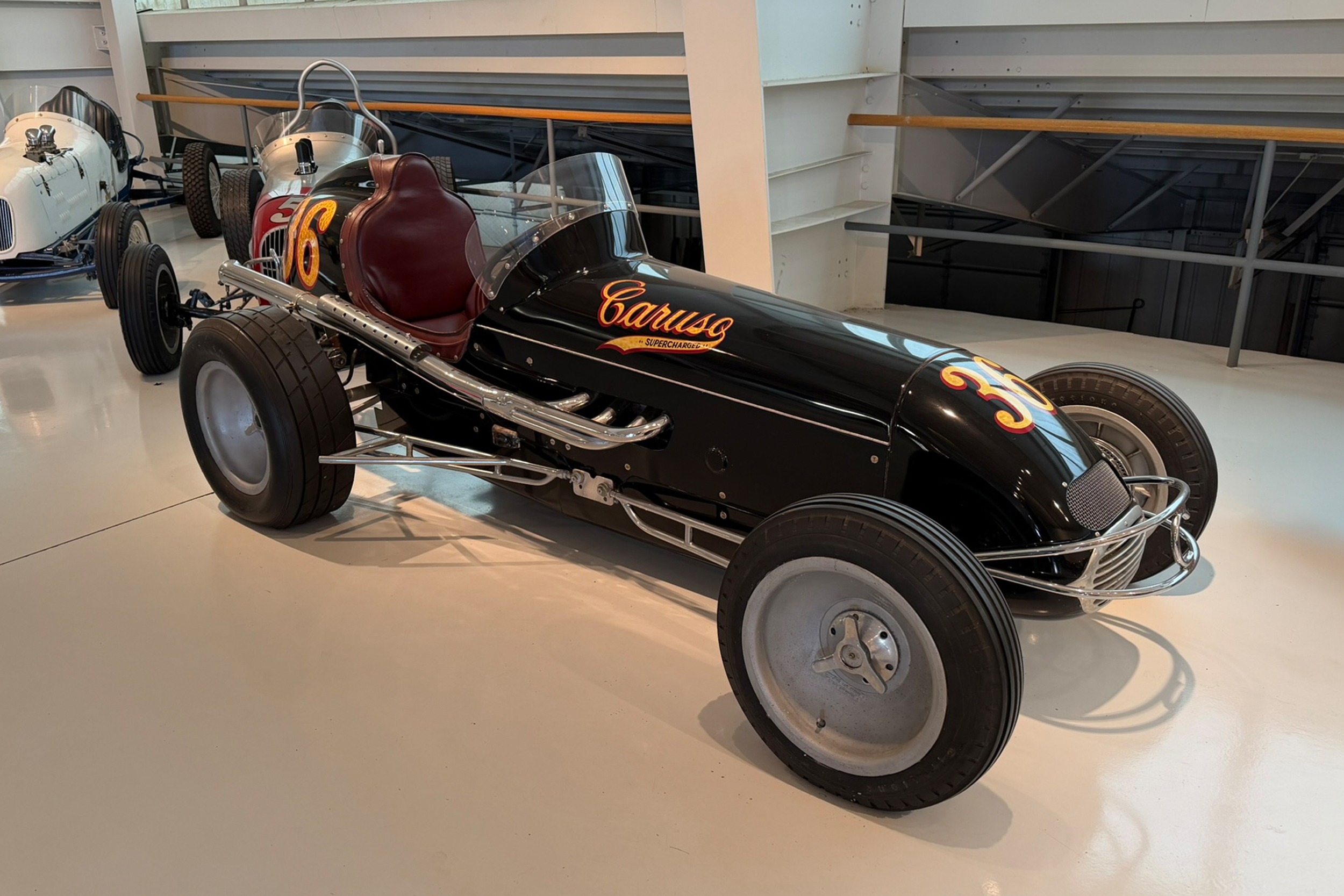
During the postwar Golden Age of American motorsports, few names were more closely associated with Midget racing success than Mike Caruso. A resourceful mechanic, innovative car builder, and successful racing team owner from Hicksville, New York, Caruso became famous for developing unconventional racing machines that challenged the established competition. The black Number 36 “Caruso” Kurtis-Offenhauser Sprint Car is a remarkable example of his ingenuity, combining a championship-caliber Midget racing heritage with an ambitious effort to create a more powerful Sprint Car.
Built around a Kurtis-Kraft chassis developed by legendary American racing car constructor Frank Kurtis, the automobile began life as a conventional Midget racer powered by a 110-cubic-inch, four-cylinder Offenhauser engine. The compact, double-overhead-camshaft “Offy” was among the most successful racing engines of its era, combining exceptional durability with impressive performance.
Around 1950, Caruso undertook an unusual experiment: lengthening a Midget chassis to meet the larger dimensions required for Sprint Car competition. Rather than replacing the relatively small Offenhauser engine with a conventional larger-displacement powerplant, he adapted a supercharger from a European racing automobile to increase its output. By forcing additional air into the engine, the supercharger allowed the compact Offenhauser to produce substantially more power while retaining its relatively lightweight construction.
The resulting machine became a successful competitor on the demanding dirt ovals of the eastern United States. With the talented Mike Nazaruk behind the wheel, Caruso’s Number 36 recorded victories during the 1950 season at Williams Grove Speedway in Pennsylvania, Harrington, Delaware, and Rutland, Vermont. Nazaruk subsequently advanced to Indianapolis, finishing second in his rookie appearance at the 1951 Indianapolis 500.
Caruso continued experimenting with the automobile and its unconventional engine configuration throughout the early 1950s. Drivers associated with his Sprint Car program included Paul Russo, Duke Nalon, Ernie McCoy, and Johnny Thomson, all prominent figures in American open-wheel racing.
The beautifully preserved black-and-red Number 36 features distinctive gold and red lettering, polished external exhaust plumbing, and a narrow, streamlined body. Museum collection records also note that the automobile raced locally under Number 3 during the 1950s, reflecting the changing identities and configurations common among actively campaigned racing machines.
Today, the Caruso Kurtis-Offenhauser represents an extraordinary intersection of racing innovation, mechanical ingenuity, and competition history. Its remarkable evolution from a conventional Midget into a supercharged Sprint Car illustrates the experimental spirit that helped define American motorsports during the 1950s.
Museum Display Location: Third Floor Race Car Collection, American Heritage Museum’s seasonal Storage Hangar Annex. Accessible during select special event weekends in the summer and fall.