Artifacts
M48A3 Patton
United States | 1952–1975 | Cold War & Vietnam War
| General Information | |
|---|---|
| Model | M48A3 Patton |
| Class | Armor |
| Type | Main Battle Tank |
| Use | Military |
| Era | 1956-1975 |
| Gallery Focus | Vietnam War |
| Manufacturer | Chrysler, Fisher Body, Ford Motor Company, American Locomotive Company |
| Year | 1957 |
| Country | United States |
| Ownership | Loan, USMC |
| Gallery Location | Vietnam War |
| Status | Static Only |
Additional Photos


The M48A3 Patton was one of the defining American tanks of the Vietnam War. Originally designed to confront Soviet armor during the Cold War, the M48 entered U.S. Army service in 1952 and was named for General George S. Patton Jr. Nearly 12,000 tanks of the M48 family were produced, making it a cornerstone of American armored forces during the 1950s and 1960s.
The M48A3 incorporated important improvements over earlier gasoline-powered models. Its 750-horsepower Continental diesel engine increased operating range and reduced fuel-related fire hazards, while the tank retained its powerful 90mm M41 rifled cannon. Crews could fire armor-piercing, high-explosive, and canister ammunition, supported by .50-caliber and 7.62mm machine guns. Four soldiers operated the approximately 50-ton vehicle: commander, gunner, loader, and driver.
Although designed for major tank battles in Europe, the Patton found a different mission in the jungles, villages, and cities of Vietnam. U.S. Marine Corps M48A3s arrived at Da Nang in March 1965, followed by tanks of several U.S. Army units. They supported infantry assaults, destroyed fortified bunkers, defended military bases, and escorted vulnerable supply convoys. During the 1968 Battle of Huế, Marine tanks provided vital direct fire against entrenched enemy positions during intense urban fighting.
Tank crews also developed tactics suited to guerrilla warfare. In operations known as “thunder runs,” armored units patrolled threatened roads at night, using movement and weapons fire to disrupt enemy ambushes and help keep vital routes open. Nevertheless, land mines and rocket-propelled grenades remained serious threats even to the Patton’s heavy armor.
One of the war’s rare tank-versus-tank engagements occurred at Ben Het on March 3–4, 1969. Four American M48s of Company B, 1st Battalion, 69th Armor, confronted North Vietnamese PT-76 amphibious tanks and BTR-50 armored personnel carriers. Two PT-76s and one BTR-50 were destroyed, while a direct hit on an American M48 killed two crewmen and wounded another.
As U.S. forces withdrew, M48 tanks were transferred to South Vietnamese units, which continued using them in major engagements through 1975.
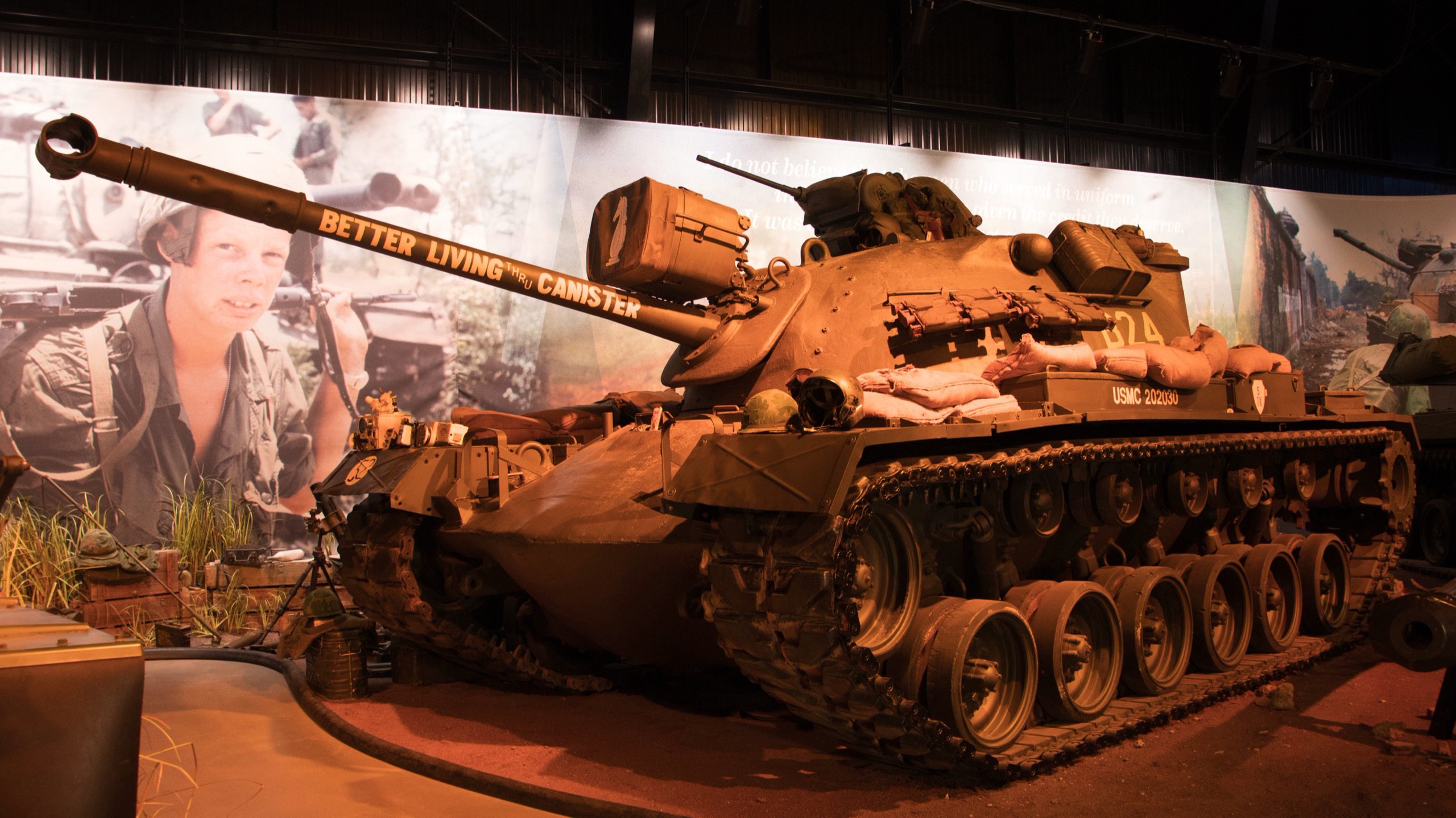
The M48A3 displayed at the American Heritage Museum was originally built around 1955 and later donated by the United States Marine Corps. Located in the museum’s Vietnam War Gallery, it illustrates both the adaptability of American armored forces and the risks faced by tank crews in a conflict far removed from the European battlefields for which the Patton was conceived.