Artifacts
Nieuport 28 C-1
France | 1917–1918 | World War I – Western Front
| General Information | |
|---|---|
| Model | Nieuport 28.C1 |
| Class | Aircraft |
| Type | Fighter |
| Use | Military |
| Era | 1914-1919 |
| Gallery Focus | WWI / Great War |
| Manufacturer | Nieuport |
| Year | 1917 |
| Country | FranceUnited States |
| Ownership | CF Inc. |
| Gallery Location | N/A |
| Status | Restoration |
Video
Nieuport 28 Restoration Complete, Engine Tests, Taxi Tests – March 2022
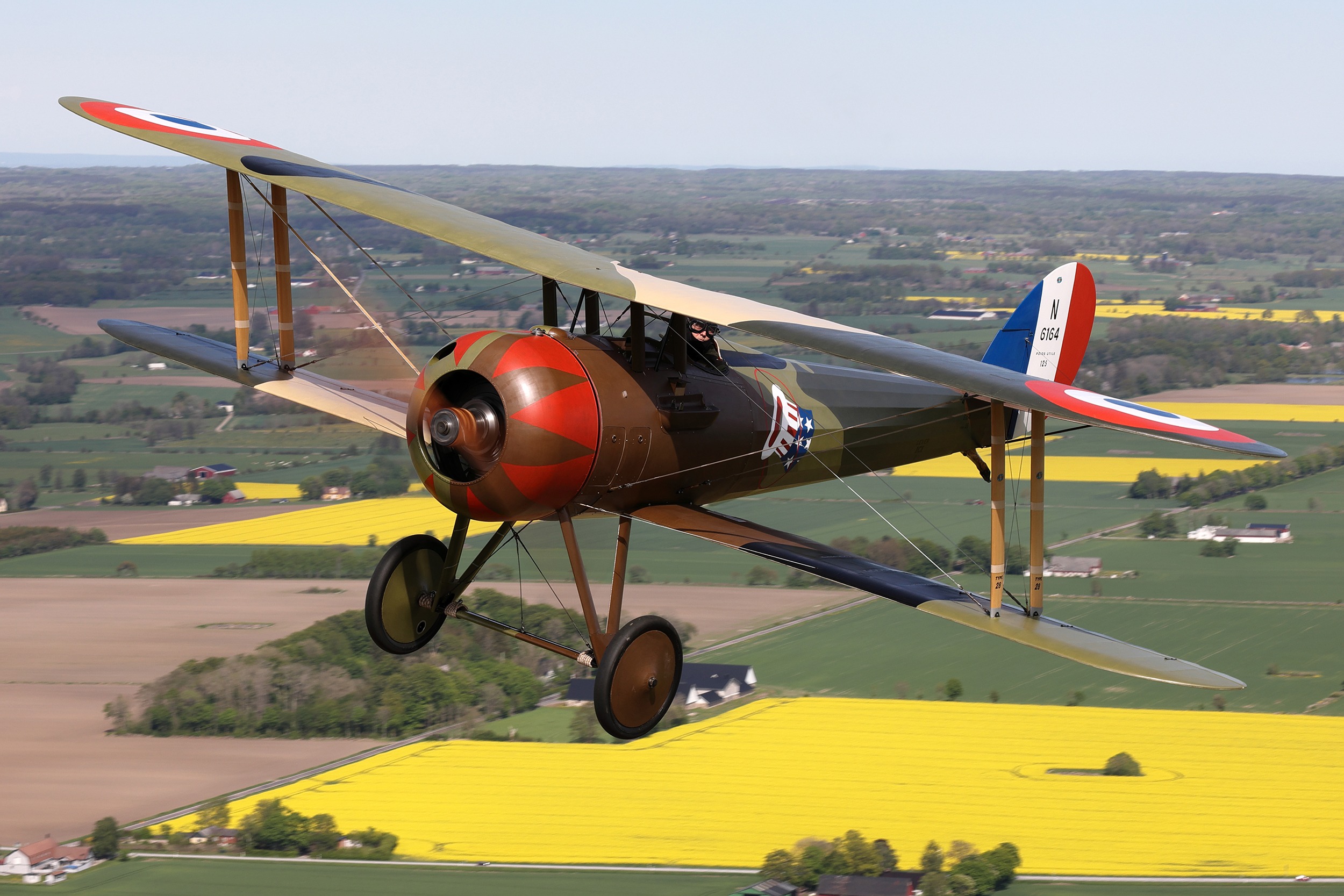
The Nieuport 28 C-1 holds a distinguished place in American military aviation as the first fighter flown into combat by the newly organized pursuit squadrons of the American Expeditionary Forces during World War I. Fast, agile, and distinctive in appearance, this French-built biplane helped launch the combat careers of some of America’s most celebrated aviators.
Developed in 1917 by the Nieuport company, the Nieuport 28 departed from the firm’s earlier sesquiplane designs with a more conventional biplane structure and streamlined fuselage. Powered by a 160-horsepower Gnome Monosoupape nine-cylinder rotary engine, the aircraft carried two synchronized Vickers machine guns. Although pilots appreciated its maneuverability and climbing performance, the fighter could shed fabric from its upper wing during high-speed dives, a dangerous weakness that limited its combat career.
With the more powerful SPAD XIII initially in short supply, the 27th, 94th, 95th, and 147th Aero Squadrons received Nieuport 28s in 1918. On April 14, Lieutenants Alan Winslow and Douglas Campbell of the 94th Aero Squadron each downed a German aircraft near Toul, France, securing the first aerial victories credited to an American Expeditionary Forces pursuit unit. Campbell later became the first American-trained fighter ace. Other notable Nieuport pilots included Eddie Rickenbacker and Quentin Roosevelt, the youngest son of former President Theodore Roosevelt.
The American Heritage Museum’s Nieuport 28 is an exceptionally rare original aircraft manufactured in France in 1918. Brought to the United States after the war, it later found a second career in Hollywood aviation films, including Hell’s Angels and The Dawn Patrol. It became part of the famed Tallmantz aviation collection and was purchased by legendary racing driver and engineer Jim Hall at a 1968 auction. After decades out of public view, the aircraft joined the Collings Foundation’s collection in 2019.
That year, the Nieuport traveled from Texas to Sweden for restoration by renowned historic aviation specialist Mikael Carlson. Remarkably, much of its century-old wooden structure and original metalwork survived, along with its historic Gnome rotary engine. Carlson painstakingly restored the airframe, reconstructing components where necessary using period techniques. The aircraft was finished in historically accurate markings representing the Nieuport flown by Douglas Campbell, honoring America’s pioneering fighter pilots.
On April 2, 2022, the Nieuport returned to flight in Sweden for the first time in nearly 50 years. It subsequently traveled to Massachusetts, where it participated in the Museum’s World War I aviation events. Following a landing accident in September 2023, the aircraft returned to Carlson’s workshop in Sweden for repairs and additional restoration work, completed in fall 2026.
Current Location and Future Exhibit: The Nieuport remains in Sweden, with plans to travel to France in spring 2027 to participate in commemorations marking the 110th anniversary of America’s entry into World War I. It is ultimately planned for permanent exhibition in flying condition within the American Heritage Museum’s proposed Aviation Wing expansion. There, alongside the Museum’s SPAD S.VII and Caudron G.4, it will help tell the extraordinary story of aviation’s transformation during the Great War.