Artifacts
17 cm Mittlerer Minenwerfer
German Empire | 1913–1918 | World War I – Western Front
| General Information | |
|---|---|
| Model | 17 cm Mittlerer Minenwerfer |
| Class | Artillery |
| Type | Mortar |
| Use | Military |
| Era | 1914-1919 |
| Gallery Focus | WWI / Great War |
| Manufacturer | Rheinmetall |
| Year | 1915 |
| Country | Germany |
| Ownership | CF Inc. |
| Gallery Location | Lobby |
| Status | Static Only |
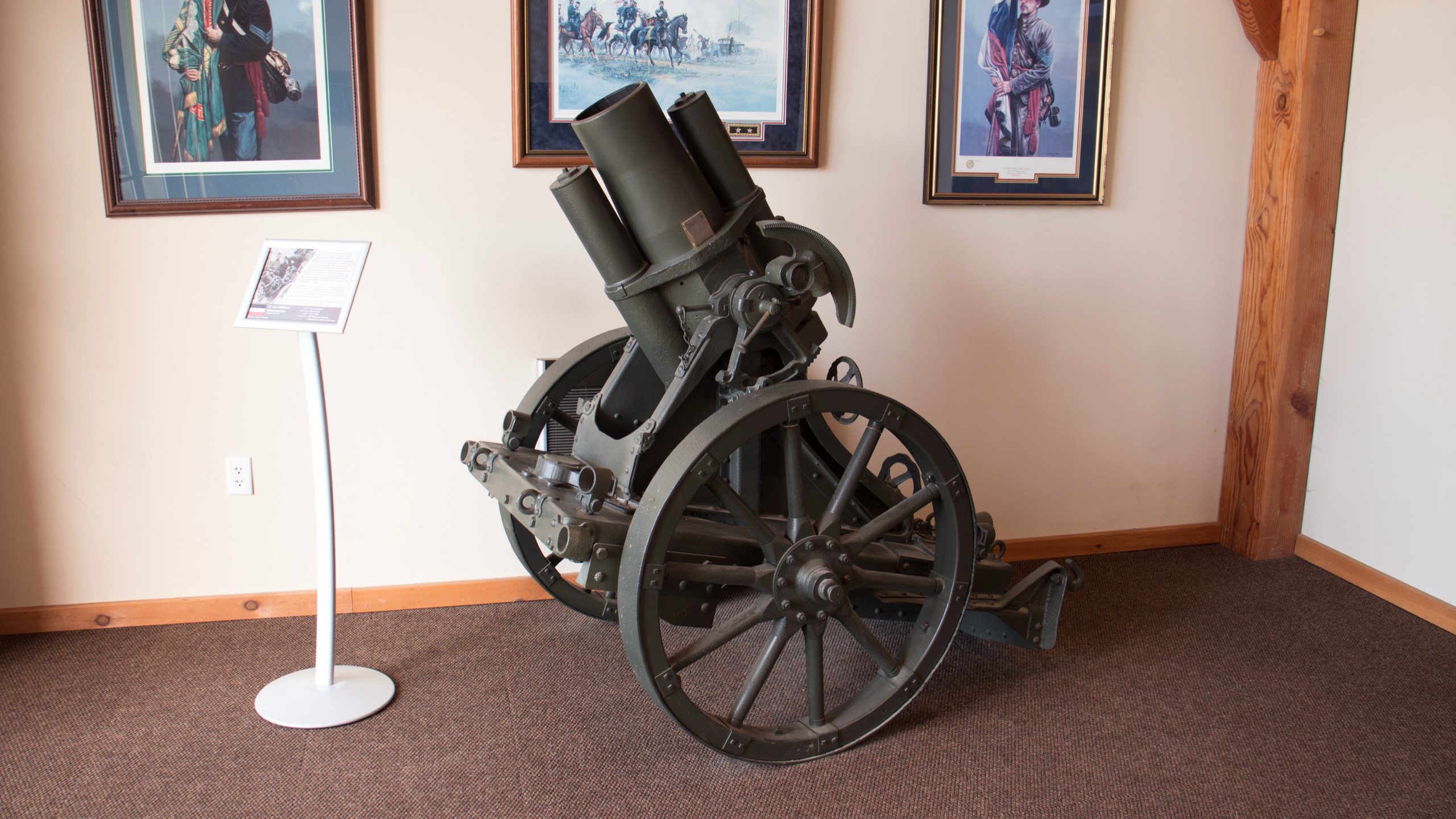
The German 17cm mittlerer Minenwerfer, meaning “Medium Mine Thrower,” was one of the most formidable trench mortars employed during World War I. Developed by Rheinmetall and introduced into German service in 1913, this powerful weapon was designed to destroy fortified positions, bunkers, and defensive obstacles that conventional field artillery often struggled to penetrate.
Its development was influenced by lessons from the Russo-Japanese War of 1904–1905, particularly the Siege of Port Arthur, which demonstrated the effectiveness of high-angle explosive fire against entrenched defenses.
Unlike conventional artillery, the Minenwerfer fired heavy projectiles at relatively low velocities and steep trajectories, allowing shells to drop directly into enemy trenches and fortified positions. Its 170mm rifled barrel could launch high-explosive projectiles weighing up to approximately 110 pounds over distances approaching one mile. The lower firing pressures permitted thinner shell casings and larger explosive charges, increasing their destructive effect.
During the brutal trench warfare of the Western Front, German engineer units employed Minenwerfers to demolish dugouts, destroy barbed-wire obstacles, and disrupt enemy defensive positions. Despite weighing more than 1,000 pounds, the weapon could be moved short distances using detachable wheels or transported in sections by soldiers. Once positioned, it was typically emplaced in a protective pit approximately five feet deep.
The weapon was not without danger to its operators. Some explosive fillings used during wartime ammunition shortages were unstable, occasionally causing premature detonations.
Only 116 medium Minenwerfers were in German service when war erupted in 1914, but that number had grown to approximately 2,361 by 1918, demonstrating the increasing importance of trench mortars.
Displayed in the American Heritage Museum’s entry lobby, this exceptionally rare surviving Minenwerfer represents the destructive innovations that transformed warfare and contributed to the devastating human cost of the First World War.