Artifacts
SPAD S.VII C.1
France | 1916–1918 | World War I – Western Front
| General Information | |
|---|---|
| Model | SPAD S.VII C.1 |
| Class | Aircraft |
| Type | Fighter |
| Use | Military |
| Era | 1914-1919 |
| Gallery Focus | WWI / Great War |
| Manufacturer | SPAD |
| Year | 1917 |
| Country | FranceUnited States |
| Ownership | Donor, Pending Donation |
| Gallery Location | N/A |
| Status | Restoration |
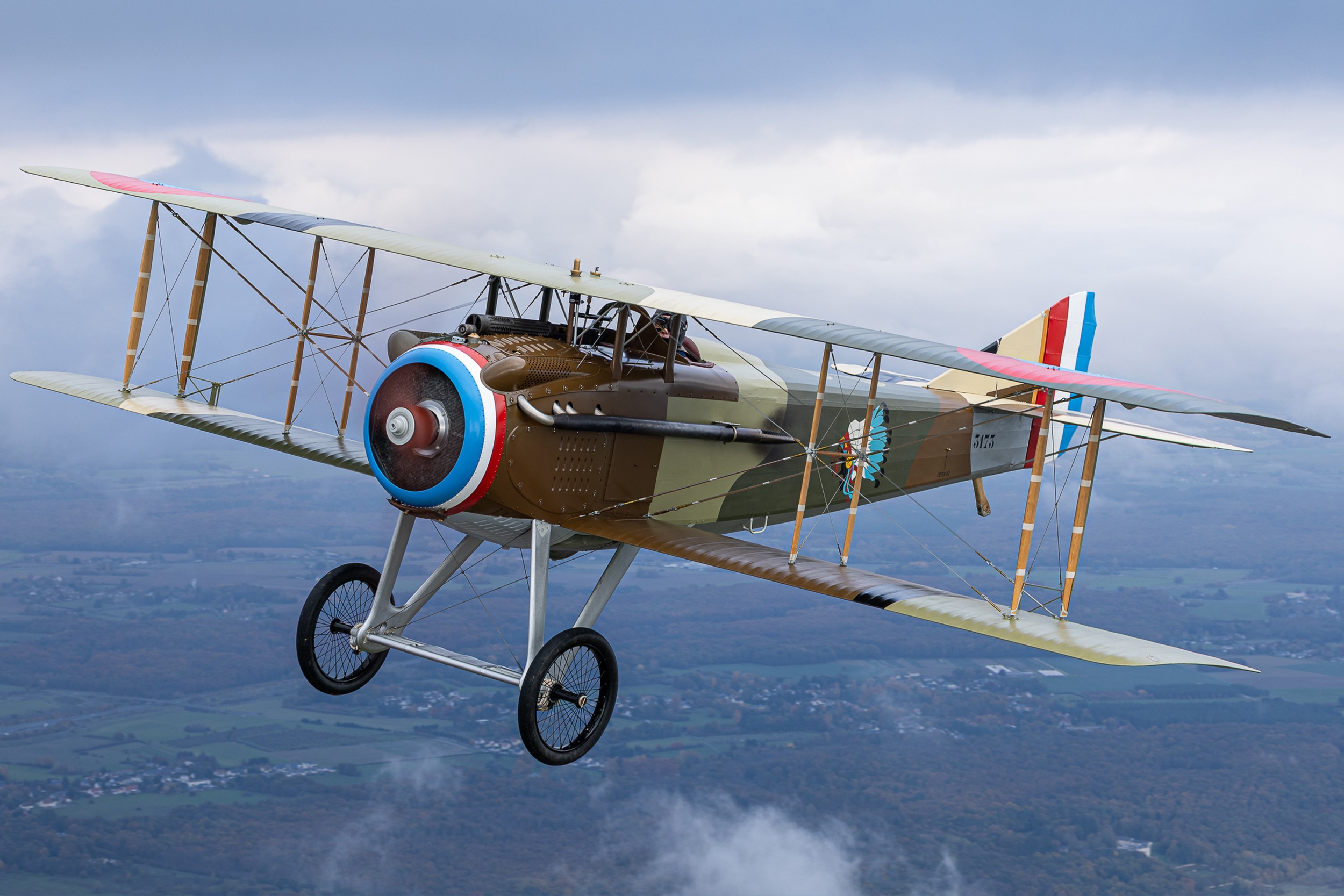
The SPAD S.VII was among the most successful Allied fighter aircraft of World War I, helping establish a new generation of powerful, rugged combat airplanes that transformed aerial warfare over the Western Front. Introduced in 1916, the French-built fighter became renowned for its exceptional speed, structural strength, and diving performance, earning the confidence of some of the war’s most accomplished aviators.
Designed by French engineer Louis Béchereau, the SPAD S.VII featured a sturdy wood-and-fabric biplane structure powered by a Hispano-Suiza liquid-cooled V-8 engine, initially producing 150 horsepower and later increased to 180 horsepower. Armed with a single synchronized Vickers machine gun firing through the propeller arc, the aircraft emphasized speed, climbing performance, and durability rather than the tight maneuverability of earlier fighters. Its rugged construction allowed pilots to dive aggressively and disengage from enemy aircraft when necessary.
The SPAD S.VII served with French, British, Italian, Belgian, and American aviators. Among its most celebrated pilots were French ace Georges Guynemer and American volunteers of the legendary Lafayette Escadrille, whose courageous service in French aviation helped forge an enduring bond between France and the United States.
The American Heritage Museum’s SPAD S.VII is an extraordinary restoration incorporating surviving components from an original aircraft, number 3270, manufactured in 1918 by the French firm Louis Janoir. The aircraft was painstakingly reconstructed at Tours-Sorigny Airfield in France by Early Aviators, under the direction of historic aircraft restorer Antoine Ros. Combining original structural components and a restored 180-horsepower Hispano-Suiza engine with newly fabricated parts produced using period construction techniques, the project represents an exceptional achievement in World War I aviation preservation.
The aircraft wears the historic markings of Paul Frank Baer, an American volunteer who flew with French aviation units before joining the Lafayette Escadrille and subsequently the U.S. Army Air Service’s 103rd Aero Squadron. Flying the SPAD S.VII, Baer became the first fighter ace of the American Army Air Service in April 1918, ultimately earning nine confirmed aerial victories.
In April 2026, the SPAD participated in ceremonies at Saint-Dizier Air Base commemorating the 110th anniversary of Escadron de Chasse 2/4 La Fayette, honoring the enduring legacy of American aviators who volunteered to fight for France.
On November 10, 2026, the restored SPAD S.VII returned to the skies above Tours-Sorigny, piloted by renowned Swedish historic aviator Mikael Carlson. Rob Collings, president of the Collings Foundation, subsequently flew the aircraft, including a commemorative flight on November 11 marking the 108th anniversary of the Armistice that ended World War I. The achievement returned one of the world’s rarest original-type World War I fighters to flying condition.
The aircraft will remain in France during the coming year, with plans to participate in commemorations marking the 110th anniversary of America’s entry into World War I in 1917.
Future Exhibit Location: The SPAD S.VII is planned for permanent exhibition in flying condition within the American Heritage Museum’s proposed Aviation Wing expansion. It will join the Museum’s growing World War I aviation collection, including the Nieuport 28 and Caudron G.4, helping tell the extraordinary story of aviation’s transformation during the Great War.