Artifacts
Curtiss Model F Flying Boat
United States | 1912–1918 | Early Naval Aviation
| General Information | |
|---|---|
| Model | Model F Flying Boat |
| Class | Aircraft |
| Type | Flying Boat |
| Use | Civilian |
| Era | 1914-1919 |
| Gallery Focus | WWI / Great War |
| Manufacturer | Curtiss |
| Year | 1914 |
| Country | United States |
| Ownership | CF Inc. |
| Gallery Location | Hangar |
| Status | Operational, Offline |
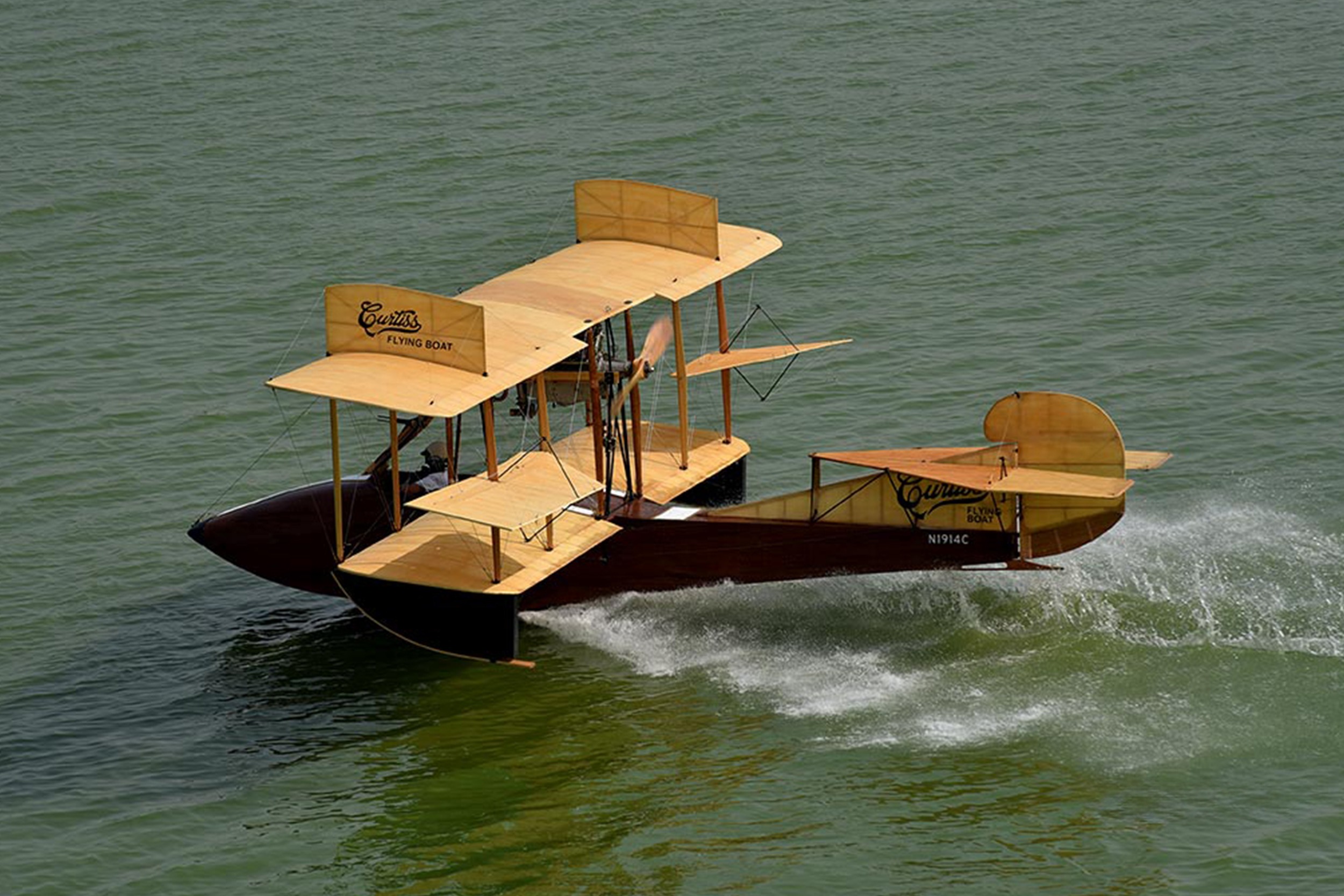
The Curtiss Model F Flying Boat represents a remarkable milestone in the development of naval aviation, helping establish the airplane as a practical means of operating over water. Developed by American aviation pioneer Glenn H. Curtiss, the Model F was among the earliest successful flying boats and helped lay the technological foundations for generations of seaplanes and maritime patrol aircraft.
Curtiss began experimenting with waterborne aircraft in 1911, initially using conventional airplanes mounted on floats. By 1912, his designs had evolved into true flying boats, incorporating a boat-shaped hull that allowed the aircraft to take off and land directly on water. First developed in 1912 and formally designated the Model F in 1913, the aircraft became one of the most successful American flying boats of the period.
The Model F featured a lightweight wooden hull, fabric-covered biplane wings, and an open cockpit accommodating a pilot and passenger side by side. A single engine mounted between the wings drove a rear-facing pusher propeller. Its distinctive large ailerons were positioned between the wings, extending outward beyond the lower wing’s tips. The aircraft’s innovative stepped hull helped reduce water resistance during takeoff, an important advancement in seaplane design.
The Model F quickly attracted international attention, with aircraft supplied to civilian operators and naval forces in the United States, Brazil, Italy, Russia, and Great Britain. In 1914, a U.S. Navy Model F conducted an aerial reconnaissance mission during American operations at Veracruz, Mexico, marking an important early use of military aviation. Another Model F made history in November 1915 when it became the first aircraft launched by catapult from a warship underway. Following America’s entry into World War I in 1917, the Model F became a standard U.S. Navy flying boat trainer, preparing naval aviators for increasingly demanding operations.
The American Heritage Museum’s 1914 Curtiss Model F is an extraordinary survivor, painstakingly reconstructed from original components discovered more than a century after its manufacture. The aircraft’s remains were found in the rafters of an outbuilding near New Haven, Connecticut, where they had been stored following a reported 1915 crash. Initially mistaken for windmill parts, the collection included original tail surfaces, wing struts, flight controls, an aileron, and the manufacturer’s original Curtiss Aeroplane Company identification plate.
Acquired in 2016 by the Collings Foundation and aviation preservationist William Nutt, the components were entrusted to Century Aviation in East Wenatchee, Washington. Using surviving factory drawings and traditional construction techniques, restorers painstakingly rebuilt the aircraft, incorporating original components into a newly constructed wooden hull and wings. A period-correct Curtiss OX-5 V-8 engine was also restored for the project.
In August 2018, the Model F successfully returned to the air over Moses Lake, Washington, with test pilot Rob Kinyoun at the controls. The achievement brought an exceptionally rare example of early American aviation back to flying condition more than a century after its original construction.
Exhibit Location: The Curtiss Model F Flying Boat is currently housed in the American Heritage Museum’s seasonal Storage Hangar Annex, accessible to visitors only during select special event weekends in the summer and fall. Please consult the Museum’s event calendar for viewing opportunities.