Artifacts
Bleriot XI (Replica)
France | 1900–1913 | Early Civilian Aviation

| General Information | |
|---|---|
| Model | Bleriot XI (Replica) |
| Class | Aircraft |
| Type | Monoplane |
| Use | Civilian |
| Era | 1900-1913 |
| Gallery Focus | Early Aviation |
| Manufacturer | Bleriot |
| Year | 1909 |
| Country | France |
| Ownership | CF Inc. |
| Gallery Location | Hangar |
| Status | Operational, Offline |
The Blériot XI stands among the most important aircraft in aviation history, forever associated with the daring flight that proved airplanes could conquer significant geographical barriers. Developed by French aviation pioneer Louis Blériot, this remarkably simple monoplane became one of the most successful aircraft of the early aviation era and helped establish powered flight as a practical means of transportation.
Born in 1872, Louis Blériot was a French engineer and successful manufacturer of automobile headlights who became fascinated with aviation at the beginning of the twentieth century. Beginning with experimental flying machines in 1901, he pursued a series of increasingly sophisticated aircraft designs. His eleventh design, the Blériot XI, was developed primarily by engineer Raymond Saulnier with substantial contributions from Blériot himself. It made its first flight at Issy-les-Moulineaux, near Paris, on January 23, 1909.
The Blériot XI featured a lightweight wooden framework, fabric-covered wings, and a distinctive tractor configuration with the engine and propeller positioned ahead of the pilot. Unlike modern aircraft, which use hinged ailerons to control banking, the Blériot employed wing warping, twisting its flexible wings to achieve lateral control. Its simple construction and relatively reliable engine made it exceptionally well suited to the rapidly developing world of early aviation.
On July 25, 1909, Louis Blériot made aviation history by becoming the first person to fly an airplane across the English Channel. Competing for a £1,000 prize offered by London’s Daily Mail newspaper, Blériot departed the French coast near Calais at dawn in his Anzani-powered Blériot XI. Flying without a compass and navigating through uncertain weather, he completed the approximately 25-mile crossing to Dover, England, in just 36 minutes and 30 seconds. His successful landing electrified the world and demonstrated that aircraft could overcome natural barriers previously navigable only by ship.
The achievement transformed Blériot into an international celebrity and generated immediate demand for his aircraft. The Blériot XI became one of the first commercially successful airplanes, with examples produced in France and under license abroad. Its versatility made it popular for flight training, exhibitions, racing, and early military aviation. Variants continued operating into World War I, serving primarily in reconnaissance and training roles.
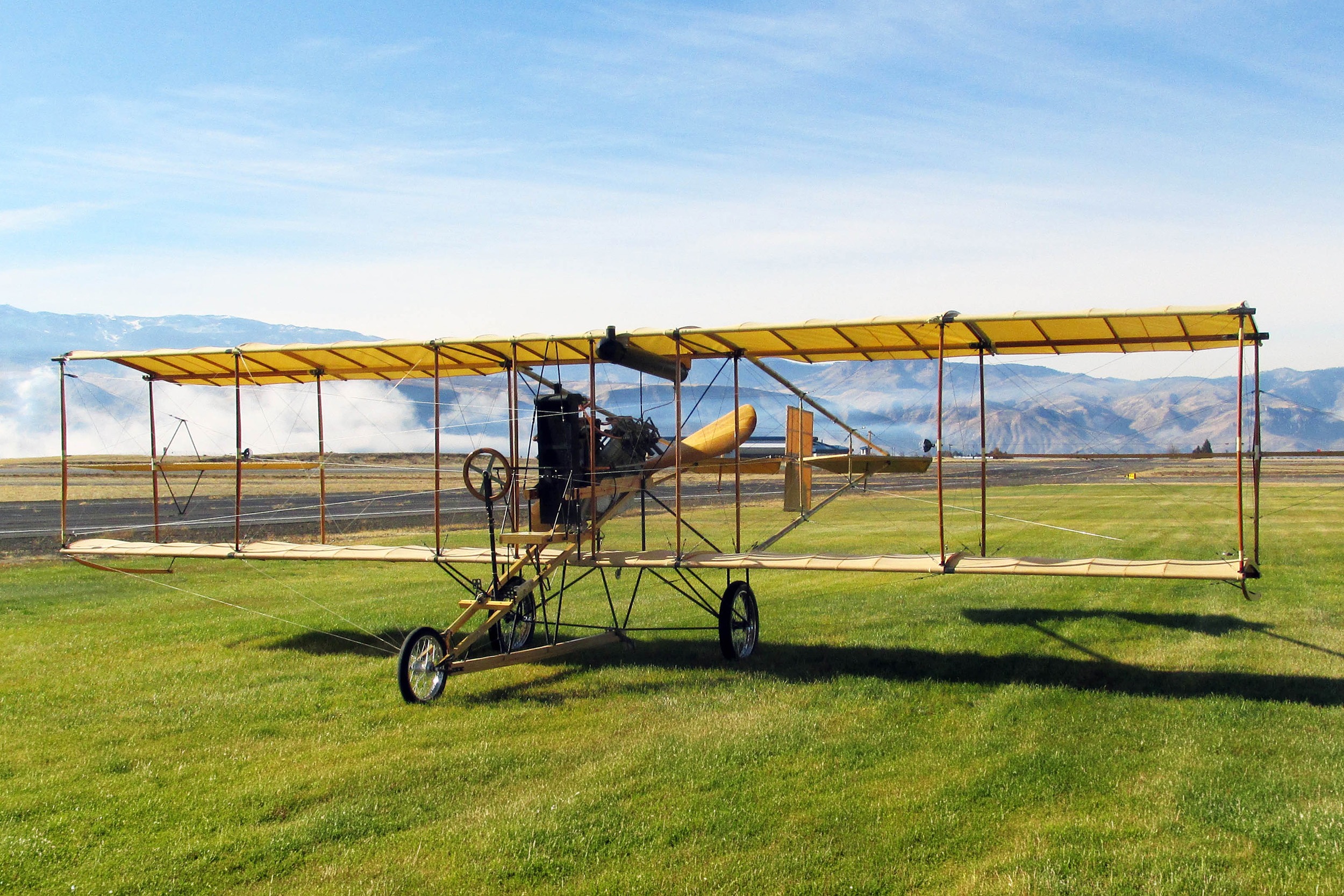
The American Heritage Museum’s Blériot XI is a later-built replica of this pioneering 1909 design. Originally flown on the West Coast of the United States, the aircraft underwent restoration in the early 1980s. Rather than the original 25-horsepower Anzani engine, the Museum’s example is equipped with an 80-horsepower Continental engine. This historically representative aircraft preserves the appearance, engineering, and pioneering spirit of one of aviation’s most influential early designs.
Exhibit Location: The Blériot XI replica is housed in the American Heritage Museum’s seasonal Storage Hangar Annex. This facility is accessible to visitors only during select special event weekends in the summer and fall. Please consult the Museum’s event calendar for opportunities to view the aircraft.