Artifacts
Curtiss Model D Headless Pusher
United States | 1900–1913 | Early Civilian Aviation
| General Information | |
|---|---|
| Model | Model D Headless Pusher |
| Class | Aircraft |
| Type | Biplane |
| Use | Civilian |
| Era | 1900-1913 |
| Gallery Focus | Early Aviation |
| Manufacturer | Curtiss |
| Year | 1912 |
| Country | United States |
| Ownership | CF Inc. |
| Gallery Location | Storage Hangar |
| Status | Operational, Offline |
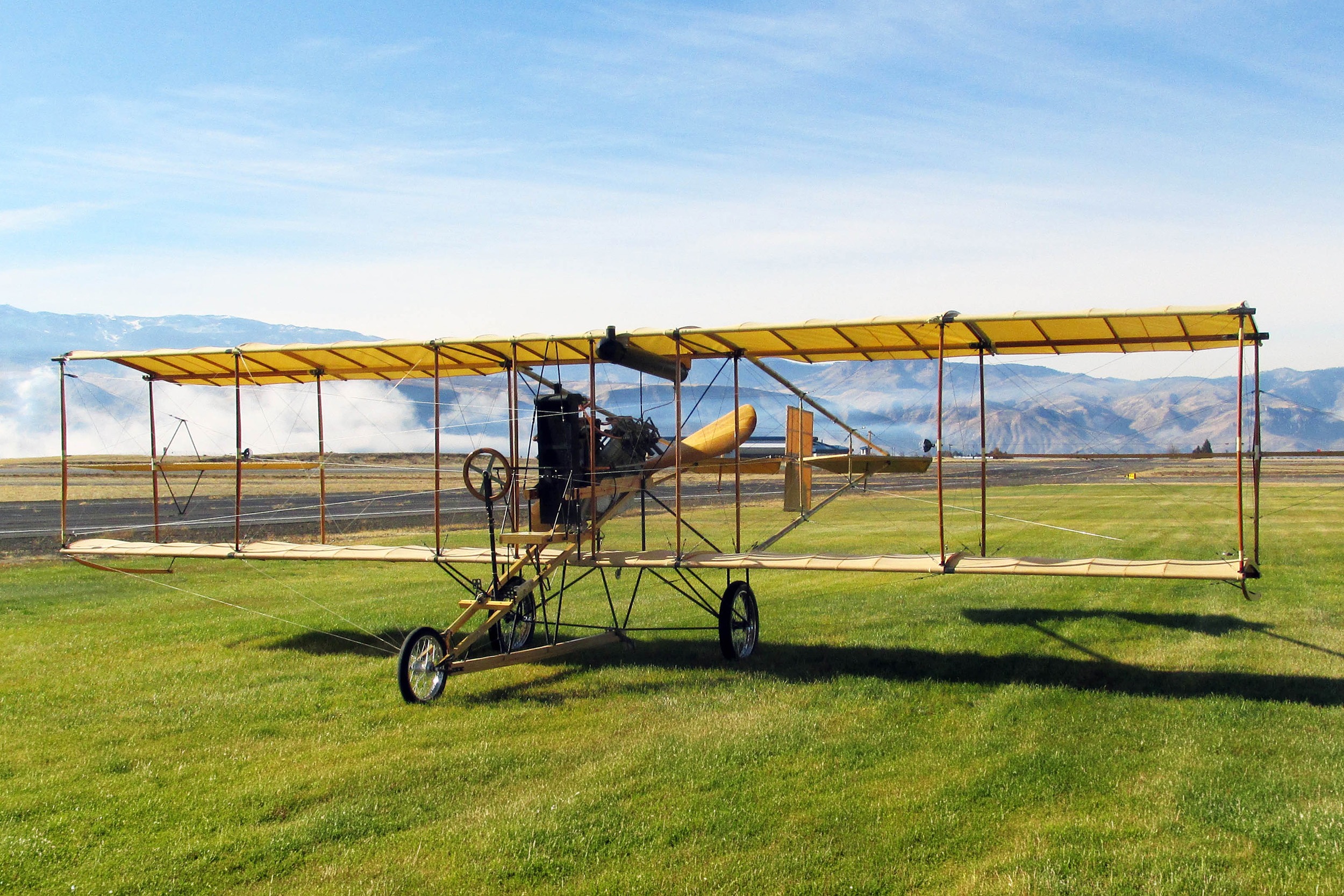
Few aircraft better represent the daring innovation of early aviation than the 1912 Curtiss Model D Headless Pusher, an example of one of America’s first commercially produced airplanes. Developed by aviation pioneer Glenn H. Curtiss, the Model D helped transform powered flight from an experimental pursuit into a practical technology with military and civilian applications.
Born in 1878, Curtiss began his career manufacturing bicycles and motorcycles in Hammondsport, New York. His remarkable mechanical abilities led him to develop powerful lightweight engines, culminating in a 1907 motorcycle speed record of more than 136 mph. Turning his attention to aviation, Curtiss emerged as one of the Wright brothers’ principal competitors and a driving force in America’s emerging aircraft industry.
Introduced in 1911 and descended from Curtiss’s successful 1909 Golden Flyer, the Model D was a lightweight, fabric-covered biplane constructed primarily of wood and wire bracing. Its distinctive “pusher” configuration positioned the engine and propeller behind the pilot, providing an unobstructed forward view. Curtiss also employed ailerons for lateral control, operated through an unusual shoulder-mounted mechanism that allowed pilots to bank the aircraft by leaning their upper bodies.
Early models incorporated a forward-mounted elevator for pitch control. Subsequent flight experience demonstrated that this forward surface was unnecessary. Eliminating it and relocating the elevator controls to the tail led to the distinctive “Headless Pusher” configuration, produced by 1912.
Earlier Curtiss Pusher aircraft also played an important role in establishing American naval aviation. On November 14, 1910, exhibition pilot Eugene Ely made the first airplane takeoff from a warship aboard USS Birmingham. On January 18, 1911, he accomplished the first successful landing aboard a ship, touching down on USS Pennsylvania in San Francisco Bay. These achievements established principles that would eventually lead to aircraft carrier operations.
The American Heritage Museum’s Curtiss Pusher represents an extraordinary restoration and preservation achievement. The Collings Foundation discovered 84 original airframe components, including ribs and spars, stored for generations in a Massachusetts attic, along with a historic Curtiss OX-5 V-8 engine discovered in a Pennsylvania basement. Remarkably, some of the original aircraft components were still wrapped in August 1915 editions of The Boston Globe.
Century Aviation of East Wenatchee, Washington, undertook a meticulous two-year restoration, combining surviving historic components with carefully reconstructed structures to return this pioneering aircraft design to airworthy condition. The completed aircraft preserves an extraordinary connection to the earliest years of American powered flight.
Exhibit Location: The Curtiss Model D Headless Pusher is currently housed in the American Heritage Museum’s Storage Hangar Annex and is accessible to visitors only during select special event weekends from May through October. The aircraft is planned for permanent public display as part of the Museum’s proposed aviation wing expansion within the next three to five years.