Artifacts
"Studebaker" – Kurtis Kraft Midget Car
United States | c. 1946 | Postwar American Midget Auto Racing
| General Information | |
|---|---|
| Model | #4 "Studebaker" – Kurtis Kraft Black Midget Sprint Car |
| Class | Vehicle |
| Type | Race Car, Midget Sprint Car |
| Use | Civilian |
| Era | 1940-1959 |
| Gallery Focus | Sprint Cars |
| Manufacturer | Kurtis Kraft |
| Year | 1946 |
| Country | United States |
| Ownership | CF Trust |
| Gallery Location | Vintage Race Car Collection |
| Status | Operational, Offline |
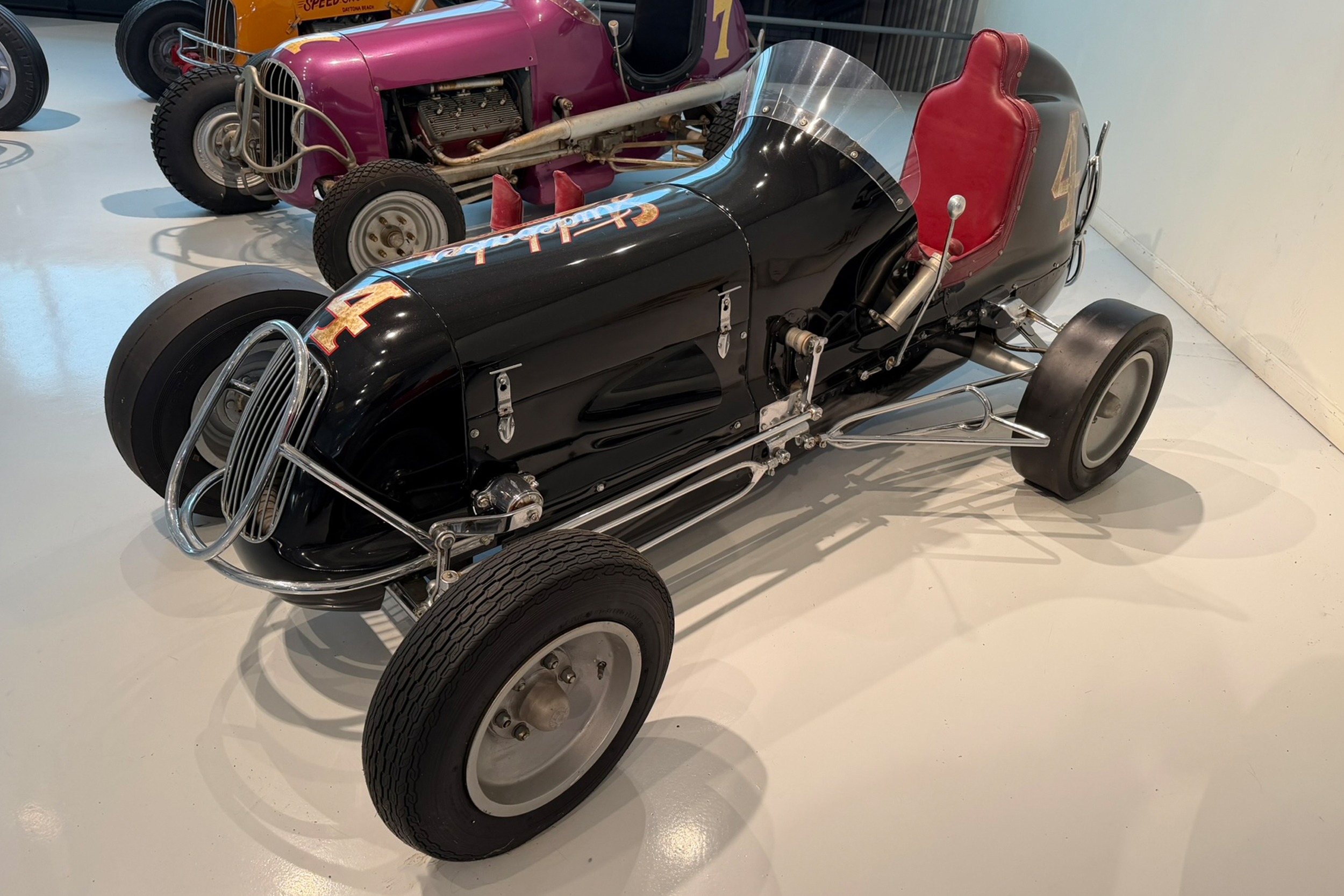
In the years immediately following World War II, American Midget racing entered a period of extraordinary innovation as builders developed increasingly sophisticated lightweight racing machines. Among the most influential names of this era was Frank Kurtis, whose beautifully engineered Kurtis-Kraft racers transformed the sport through advanced chassis construction and improved handling. The black Number 4 “Studebaker” Midget Race Car, believed to date from approximately 1946, represents this important period of postwar racing development.
The automobile is believed to feature a Kurtis-Kraft chassis powered by an inline six-cylinder Studebaker engine, an unconventional but surprisingly effective alternative to the expensive Offenhauser racing engines that dominated Midget competition. Studebaker’s Champion six-cylinder engine, introduced in 1939, became popular among independent racers for its lightweight construction, durability, and ability to operate at relatively high engine speeds. By 1946, the production Champion engine displaced approximately 170 cubic inches and developed 80 horsepower, providing an economical foundation for further racing modifications.
Frank Kurtis began building Midget racing cars during the mid-1930s, quickly establishing a reputation for innovative engineering and exceptional craftsmanship. His revolutionary postwar designs incorporated lightweight tubular steel chassis, lower centers of gravity, and improved suspension systems that allowed the wheels to maintain better contact with rough racing surfaces. These advancements provided superior traction and handling, particularly on the dirt ovals where Midget racing flourished.
Kurtis-Kraft became one of America’s most successful racing car manufacturers, eventually producing hundreds of complete Midget racers and chassis kits. When paired with the powerful four-cylinder Offenhauser engine, the Kurtis-Kraft chassis became a dominant combination in Midget competition for nearly two decades. Nevertheless, many independent competitors continued experimenting with alternative powerplants, including Ford V8s and Studebaker six-cylinder engines.
The effectiveness of Studebaker power was demonstrated in 1947 when Wisconsin racer Landy Scott captured the Badger Midget Auto Racing Association championship driving a Studebaker-powered special. Scott’s success illustrated how skilled mechanics could transform comparatively modest passenger-car engines into highly competitive racing powerplants.
Number 4 features streamlined black bodywork, a distinctive red racing seat, narrow upright grille, exposed suspension, wire-spoke wheels, and a compact single-seat cockpit. Its long hood and carefully formed body panels reflect the increasingly refined appearance of postwar Midget racing machines.
Today, this Studebaker-powered Midget represents the creativity and technical diversity of early American motorsports, when ingenious combinations of specialized racing chassis and modified production engines helped shape the evolution of modern open-wheel competition.
Museum Display Location: Third Floor Race Car Collection, American Heritage Museum’s seasonal Storage Hangar Annex. Accessible during select special event weekends in the summer and fall.