Artifacts
M18 Gun Motor Carriage (GMC) Hellcat
United States | 1944–1945 | World War II – European Theater
| General Information | |
|---|---|
| Model | M18 Gun Motor Carriage (GMC) Hellcat |
| Class | Armor |
| Type | Tank Destroyer |
| Use | Military |
| Era | 1940-1945 |
| Gallery Focus | WWII European Theater |
| Manufacturer | General Motors Buick Division |
| Year | 1944 |
| Country | United States |
| Ownership | CF Inc. |
| Gallery Location | Crossing the Rhine |
| Status | Operational, Online |
Additional Photos
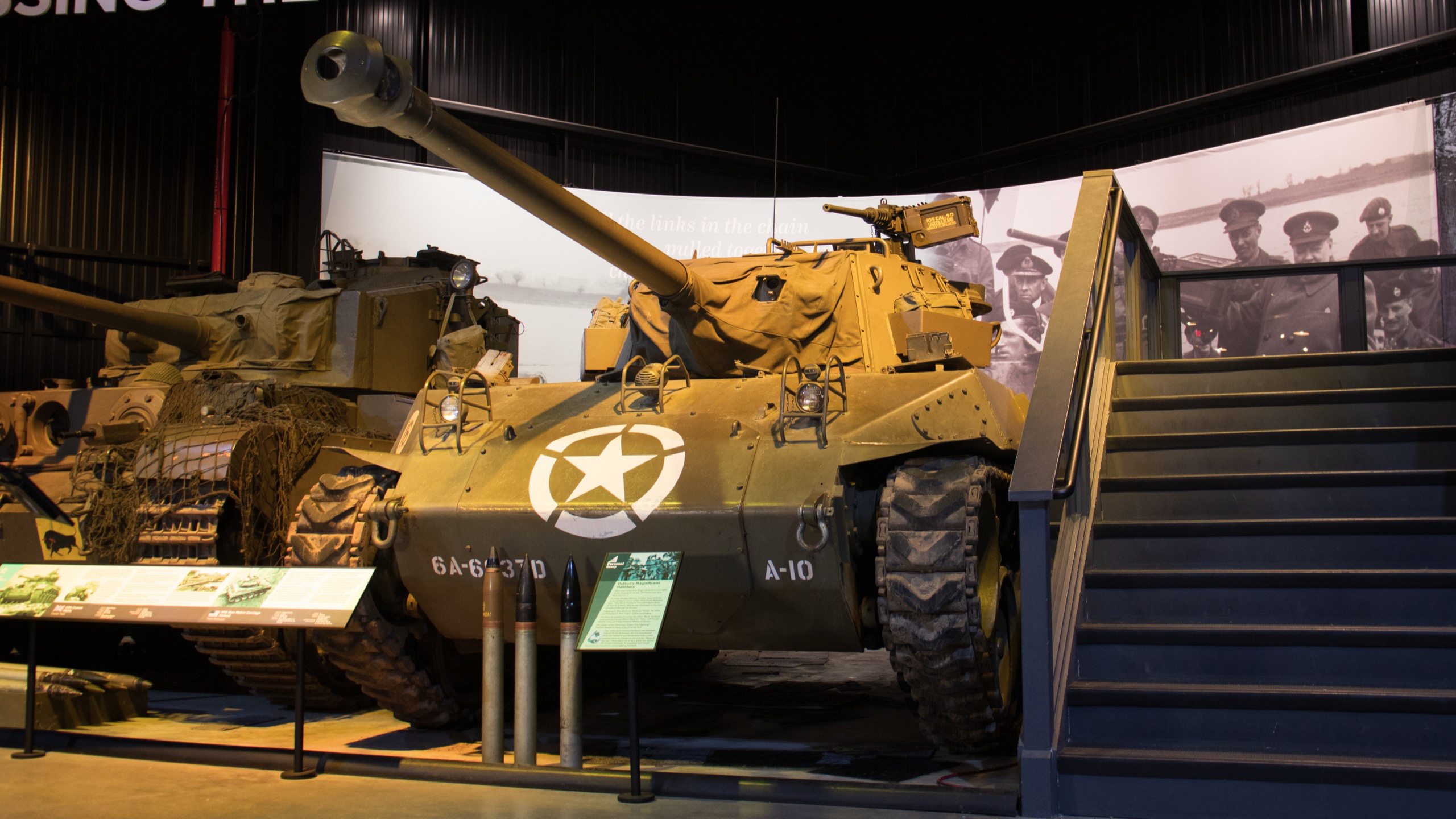
The American M18 Hellcat was one of the fastest and most innovative armored fighting vehicles of World War II. Designed to counter Germany’s powerful armored forces, the Hellcat combined exceptional speed, mobility, and a high-velocity 76mm cannon in a lightweight vehicle that became one of the U.S. Army’s most effective tank destroyers.
Unlike conventional tanks, which balanced firepower, armor protection, and mobility, the M18 was designed around the American Army’s developing tank destroyer doctrine. This strategy emphasized rapidly moving specialized anti-tank units into position to intercept enemy armored attacks, engaging from advantageous positions before withdrawing or repositioning.
Developed by General Motors’ Buick Division, the M18 featured a powerful Continental radial gasoline engine producing up to 400 horsepower, an innovative automatic transmission, and an advanced torsion-bar suspension. Weighing approximately 19 tons, the Hellcat could reach speeds approaching 55 mph, making it one of the fastest tracked armored fighting vehicles of the war.
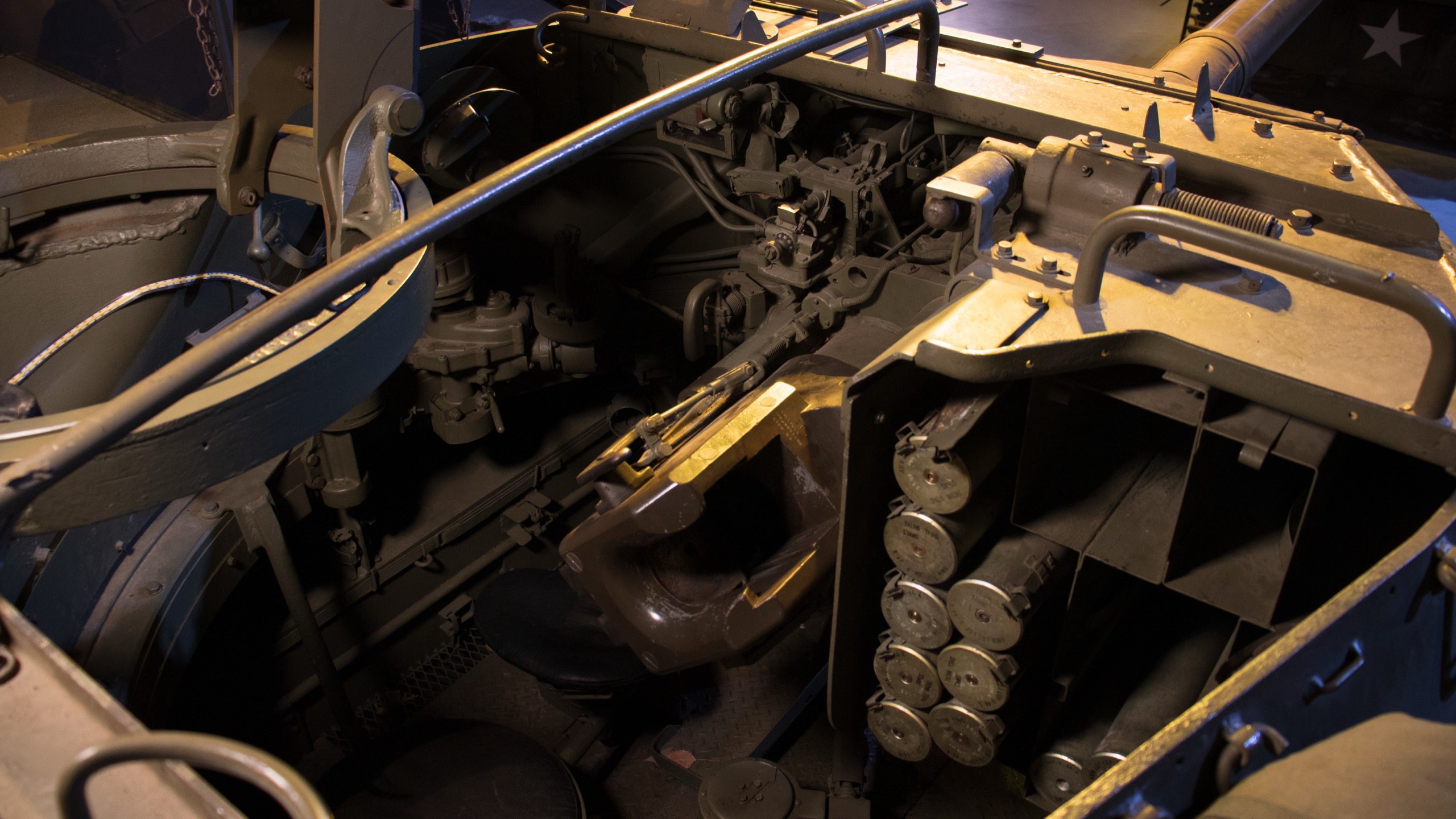
Its main armament was a 76mm M1-series cannon mounted in a fully rotating, open-topped turret, supplemented by a .50-caliber Browning machine gun. The five-man crew consisted of a commander, gunner, loader, driver, and assistant driver.
The Hellcat’s remarkable mobility came at a considerable cost: armor protection. With armor no thicker than one inch, the M18 was particularly vulnerable to German tank guns, anti-tank weapons, and artillery. Its open turret also exposed crew members to overhead fire, shell fragments, and severe weather.
Against heavily armored German Panthers and Tigers, Hellcat crews relied upon concealment, surprise, rapid maneuvering, and attacks against vulnerable side and rear armor rather than direct frontal engagements.
Entering combat in 1944, the M18 quickly demonstrated its capabilities. During the Battle of Arracourt in September 1944, Hellcats of the 704th Tank Destroyer Battalion helped defeat German armored counterattacks, using maneuvering tactics and coordinated fire to engage powerful Panther tanks.
During the Battle of the Bulge in December 1944, M18s of the 705th Tank Destroyer Battalion played a significant role in the defense of Bastogne, helping American forces resist German armored assaults.
As Allied armies advanced into Germany during the spring of 1945, Hellcat tank destroyers continued supporting infantry and armored formations. Their speed and maneuverability proved valuable during the final offensive operations, when American forces crossed the Rhine River and drove into the heart of Nazi Germany.
A total of 2,507 M18 Hellcats were produced between 1943 and 1944. Although their American military service was relatively brief, their remarkable performance secured an enduring place in the history of armored warfare.
Displayed in the American Heritage Museum’s Crossing the Rhine Gallery, the M18 Hellcat represents the ingenuity of American wartime engineering and the skill and courage of the tank destroyer crews who helped defeat Nazi Germany during World War II.