Artifacts
15 cm Nebelwerfer NbW 41
Germany | 1941–1945 | World War II – Eastern Front
| General Information | |
|---|---|
| Model | 15 cm Nebelwerfer NbW 41 |
| Class | Artillery |
| Type | Rocket Artillery |
| Use | Military |
| Era | 1940-1945 |
| Gallery Focus | WWII European Theater |
| Manufacturer | Donauwörth Machine Factory |
| Year | 1944 |
| Country | Germany |
| Ownership | CF Inc. |
| Gallery Location | Eastern Front |
| Status | Operational, Offline |
Additional Photos

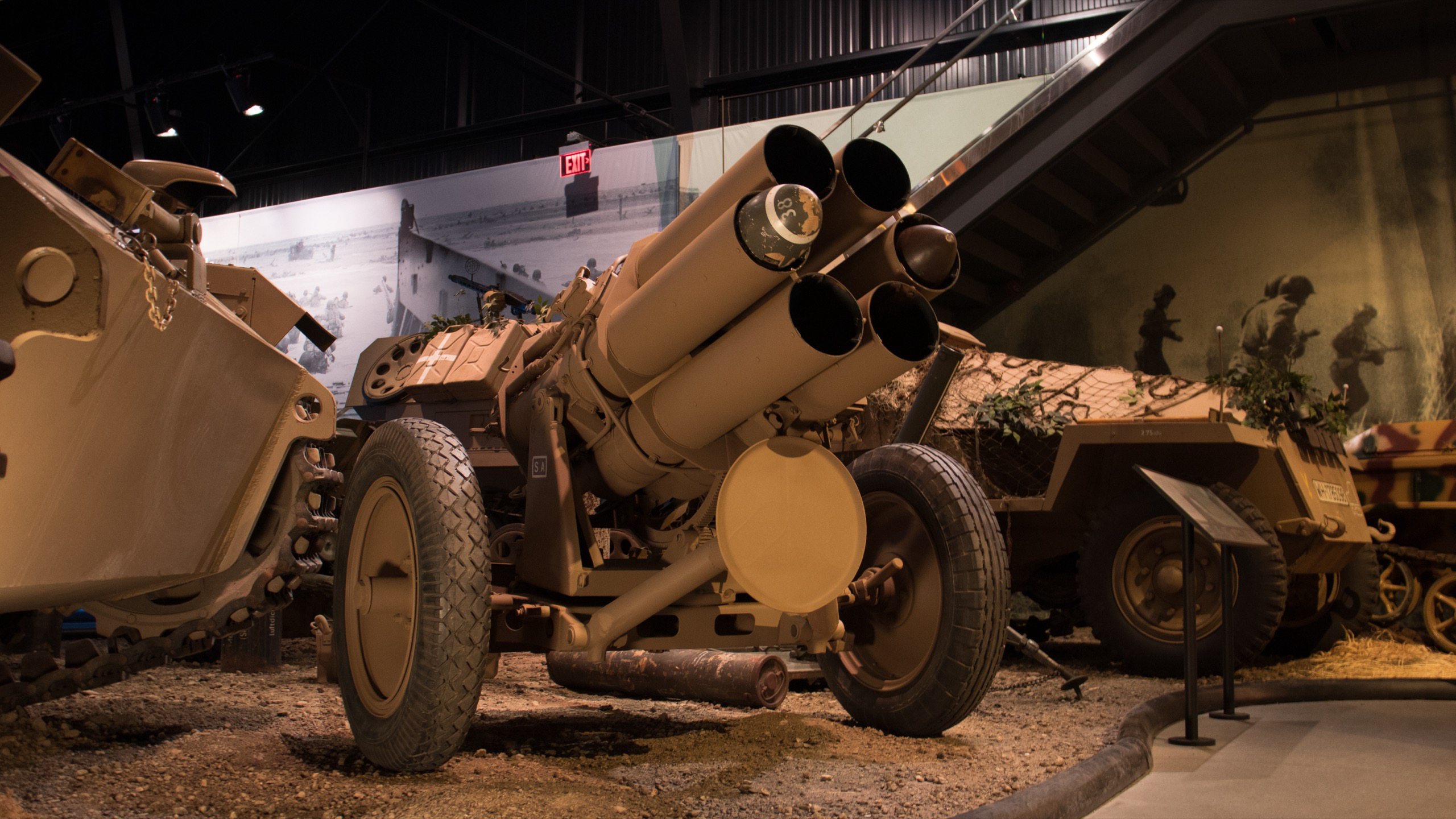
The German 15 cm Nebelwerfer 41 was one of the most distinctive and feared artillery weapons of World War II. This six-barreled rocket launcher could unleash a devastating barrage of high-explosive rockets against enemy infantry, defensive positions, and troop concentrations. Its projectiles produced an eerie, high-pitched shriek as they flew through the air, earning the weapon the Allied nicknames “Screaming Mimi” and “Moaning Minnie.”
Introduced in 1941, the Nebelwerfer, meaning “smoke thrower,” was originally developed for German chemical warfare units but became an important conventional artillery weapon. Mounted on a lightweight, two-wheeled carriage, the launcher fired six 150mm-class, spin-stabilized rockets with a maximum range of approximately 4.3 miles. Its five-man crew could deliver concentrated firepower over a wide area, making the weapon particularly effective at disrupting enemy formations and defensive positions.
During Operation Barbarossa, Germany’s invasion of the Soviet Union in June 1941, Nebelwerfer batteries supported German offensives across the vast Eastern Front. Their sudden rocket barrages inflicted casualties, disrupted communications, and created considerable psychological terror among defending Soviet troops.
Despite its destructive capabilities, the Nebelwerfer had significant limitations. Its rockets were less accurate than conventional artillery shells, while the enormous clouds of smoke and dust produced during firing frequently revealed the launcher’s position to enemy artillery observers. Crews therefore needed to relocate quickly to avoid retaliatory fire.
More than 5,000 Nebelwerfer 41 launchers were manufactured during World War II, contributing to the development of modern multiple-launch rocket artillery systems.
Displayed in the American Heritage Museum’s Eastern Front Gallery, the Nebelwerfer 41 illustrates the increasing importance of rocket artillery and the devastating firepower employed during one of history’s largest and most destructive military campaigns.