
Artifacts
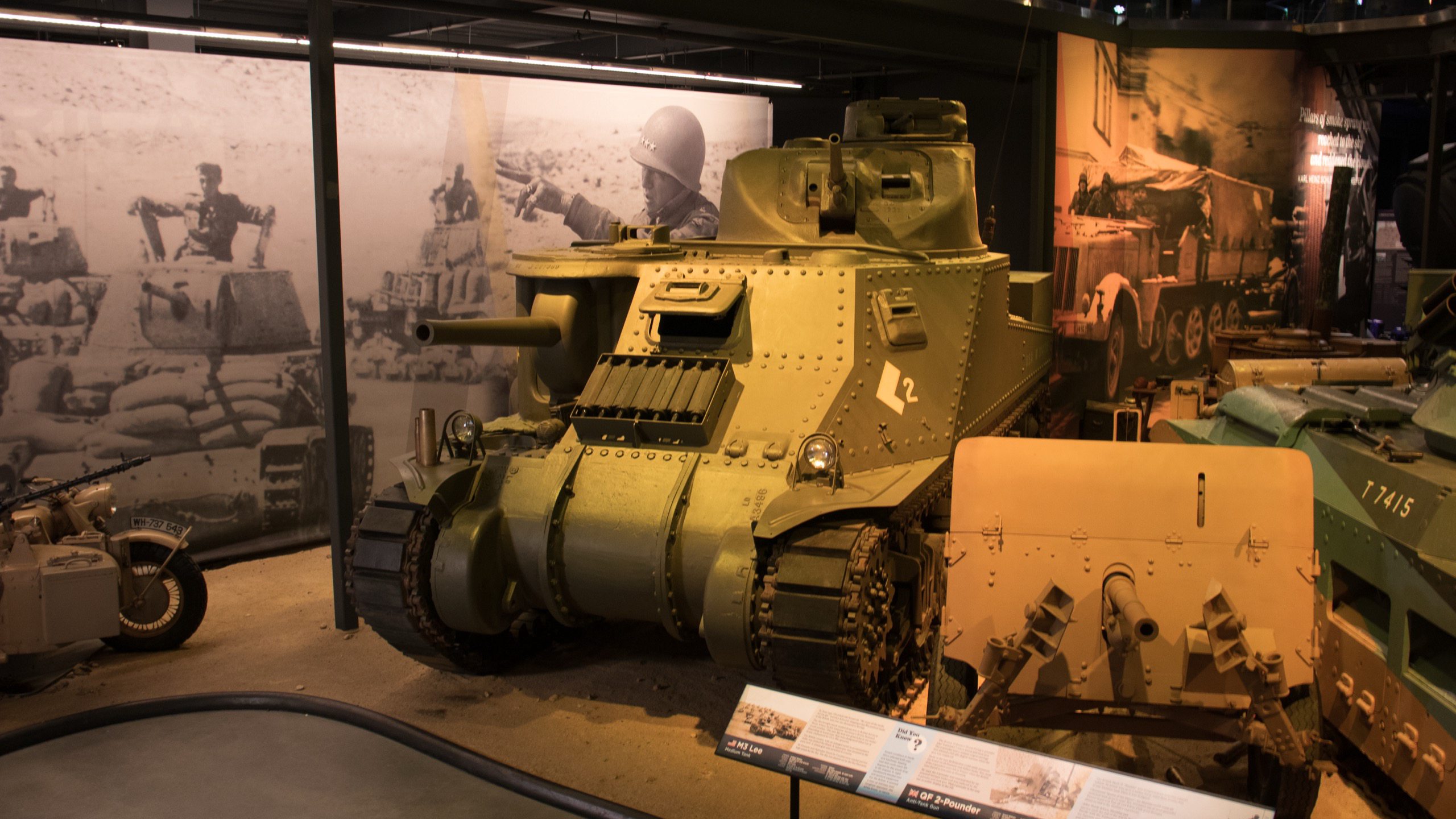
M3 Lee Medium Tank
American Medium Tank | World War II (1941–1945)
| General Information | |
|---|---|
| Model | M3 Lee |
| Class | Armor |
| Type | Medium Tank |
| Use | Military |
| Era | 1940-1945 |
| Gallery Focus | WWII European Theater |
| Manufacturer | Detroit Tank Arsenal, American Locomotive Company, Pullman Standard, Pressed Steel Car Company, Baldwin Locomotive Works |
| Year | 1941 |
| Country | United States |
| Ownership | CF Inc. |
| Gallery Location | North Africa |
| Status | Static Only |
Additional Photos


The M3 Lee was one of America’s first mass-produced medium tanks of World War II and played a vital role in the early Allied campaigns against German forces in North Africa. Developed as an urgently needed replacement for the inadequate M2 medium tank, the M3 represented an important transitional design that helped bridge the gap between America’s prewar armored forces and the highly successful M4 Sherman.
Development began in 1940, following Germany’s rapid victories in Western Europe, which demonstrated the need for more powerful and heavily armored tanks. American engineers faced a significant challenge: the U.S. Army required a 75mm cannon, but existing tank designs could not accommodate such a large weapon in a fully rotating turret. As an interim solution, the M3 incorporated an unusual arrangement featuring a 75mm main gun mounted in a sponson on the right side of the hull, a smaller 37mm cannon in a rotating turret above, and several .30-caliber machine guns.
This distinctive configuration gave the M3 an imposing, fortress-like appearance. The 75mm gun provided effective armor-piercing and high-explosive firepower, while the turret-mounted 37mm cannon could engage lighter armored vehicles and other targets. Powered by a 400-horsepower Continental radial engine, the approximately 30-ton tank could reach speeds of 26 mph and carried a crew of seven.
British forces received substantial numbers of M3 tanks through American production and Lend-Lease arrangements. They designated American-turreted vehicles “Lee,” after Confederate General Robert E. Lee, while versions incorporating a redesigned British turret were called “Grant,” after Union General Ulysses S. Grant. The Grant’s larger turret eliminated the upper machine-gun cupola and accommodated a six-man crew.
The M3 made its combat debut with British forces during the Battle of Gazala in May 1942, where its powerful 75mm cannon surprised German armored units. For the first time, British tank crews possessed a weapon capable of effectively engaging German tanks and anti-tank positions at substantial distances while also delivering powerful high-explosive ammunition. American M3 Lees subsequently entered combat during Operation Torch and the Tunisian Campaign.
Despite its advantages, the M3 suffered from significant limitations. Its tall silhouette made concealment difficult, while the hull-mounted main gun had limited traverse, requiring the entire tank to turn toward targets outside its firing arc. Early riveted armor also presented dangers to crews when enemy shells struck the hull.
A total of 6,258 M3 medium tanks were manufactured between 1941 and 1942. As the more advanced M4 Sherman entered mass production, the M3 was gradually withdrawn from frontline service in North Africa and Europe. Nevertheless, Lees and Grants continued serving with Allied forces, including the Soviet Red Army and British Commonwealth units in Burma.
The M3 Lee displayed in the American Heritage Museum’s North Africa Gallery represents a crucial period in the evolution of American armored warfare. Although quickly superseded, the M3 provided urgently needed firepower during the desert campaigns and helped establish the engineering and manufacturing foundation for the Sherman tanks that would ultimately carry Allied forces to victory.


