
Artifacts
Hawker Hurricane Mk.IIB / Mk.XII
United Kingdom / Canada | 1940–1945 | World War II – Battle of Britain and Eagle Squadrons
| General Information | |
|---|---|
| Model | Hurricane Mk XII |
| Class | Aircraft |
| Type | Fighter |
| Use | Military |
| Era | 1940-1945 |
| Gallery Focus | WWII European Theater |
| Manufacturer | Hawker |
| Year | 1943 |
| Country | United Kingdom |
| Ownership | CF Inc. |
| Gallery Location | N/A |
| Status | Operational, Online |
The Hawker Hurricane was one of the most important Allied fighter aircraft of World War II, playing a decisive role in Britain’s defense against the German Luftwaffe. Although often overshadowed by the more famous Supermarine Spitfire, the Hurricane accounted for the majority of enemy aircraft credited as destroyed by RAF fighters during the Battle of Britain in 1940. Its rugged construction, powerful armament, and dependable performance made it a cornerstone of Allied air power during the critical early years of the war.
Designed by Sydney Camm and first flown in November 1935, the Hurricane represented a major advancement over the biplane fighters then serving with the Royal Air Force. Its enclosed cockpit, retractable landing gear, and powerful Rolls-Royce Merlin engine provided the speed and performance necessary for modern aerial combat. Unlike the Spitfire’s all-metal construction, the Hurricane employed a traditional steel-tube fuselage structure with fabric covering, making it relatively straightforward to manufacture and repair.
As the war progressed, the Hurricane evolved through numerous variants, including the Mk.IIB, which carried twelve .303-caliber Browning machine guns. More than 14,000 Hurricanes were manufactured in Britain and Canada, serving as fighters, fighter-bombers, ground-attack aircraft, and convoy escorts across nearly every major theater of World War II.
The American Heritage Museum’s Hurricane, RCAF serial number 5481, was manufactured in 1942 by Canadian Car and Foundry in Fort William, Ontario. Originally built in Mk.IIB configuration and subsequently converted to the Canadian Mk.XII standard, the aircraft served with the Royal Canadian Air Force, including operational training and gunnery units. Retired from military service in November 1944, it survived decades of civilian ownership before undergoing an extensive restoration to flying condition.
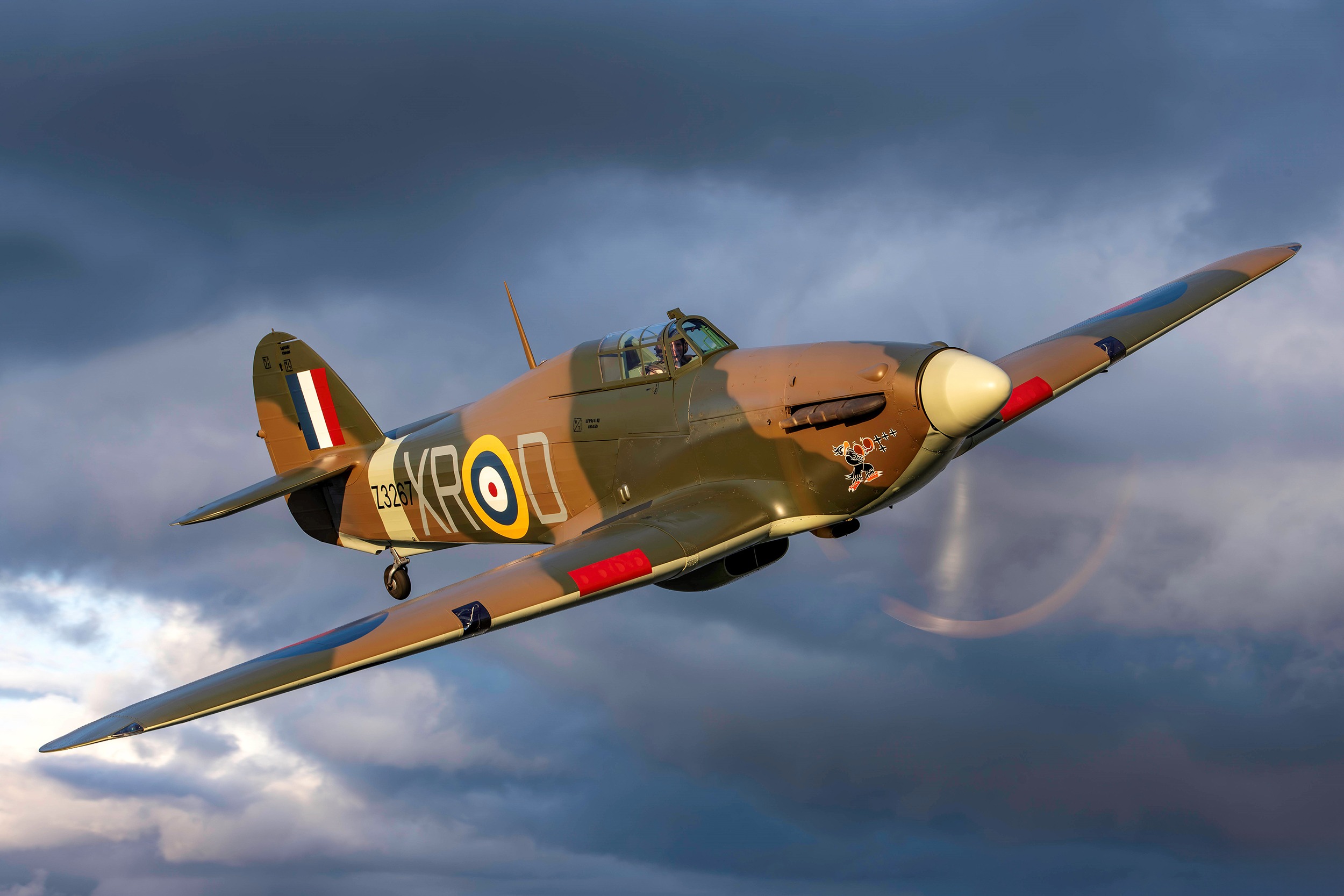
Today, the aircraft wears the markings of Hurricane Mk.IIB Z3267, flown by American volunteer pilot William Robert “Bill” Dunn of No. 71 (Eagle) Squadron, RAF. Formed in September 1940, the Eagle Squadron comprised American pilots who volunteered to fight Nazi Germany before the United States entered World War II.
Flying Hurricanes over German-occupied Europe in 1941, Dunn became one of the squadron’s earliest successful fighter pilots. His victories included several German Messerschmitt Bf 109 fighters. On August 27, 1941, after transitioning to the Spitfire, Dunn achieved ace status during a fierce aerial engagement in which he was seriously wounded. Credited with five aerial victories, he became the first American fighter ace of World War II.
Following extensive restoration work in Britain, Canada, and Australia, Hurricane 5481 returned to flying condition and eventually joined the Collings Foundation’s collection in 2024. Its historically recreated camouflage and distinctive Eagle Squadron markings honor Dunn and the courageous American volunteers who fought alongside Britain’s airmen before Pearl Harbor.
Current Location and Future Exhibit: The Hurricane remains in flying condition and is currently stored in a private hangar in Albany, New York, where it is not available for public viewing. It is planned for permanent exhibition within the American Heritage Museum’s proposed Aviation Wing expansion as part of the Battle of Britain Gallery, helping tell the story of Britain’s struggle for survival and the international volunteers who answered its call.


