Artifacts
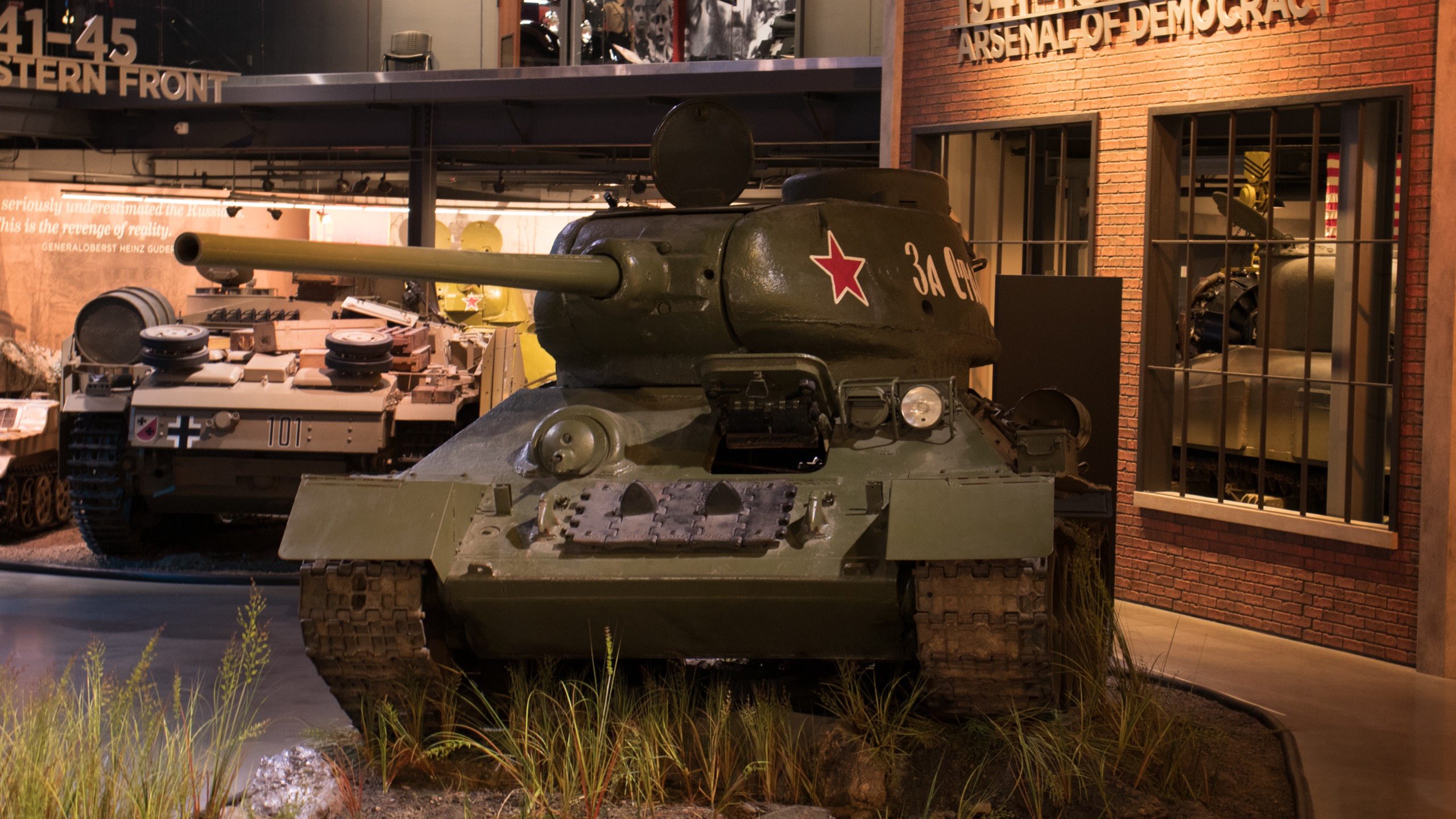
Soviet T-34-85
Soviet Union | 1944–1945 | World War II – Eastern Front
| General Information | |
|---|---|
| Model | T-34/85 |
| Class | Armor |
| Type | Medium Tank |
| Use | Military |
| Era | 1940-1945 |
| Gallery Focus | WWII European Theater |
| Manufacturer | Kharkiv Morozov Machine Building Design Bureau (KhMDB) |
| Year | 1944 |
| Country | Soviet Union |
| Ownership | CF Inc. |
| Gallery Location | Clash of Steel |
| Status | Static Only |
Additional Photos
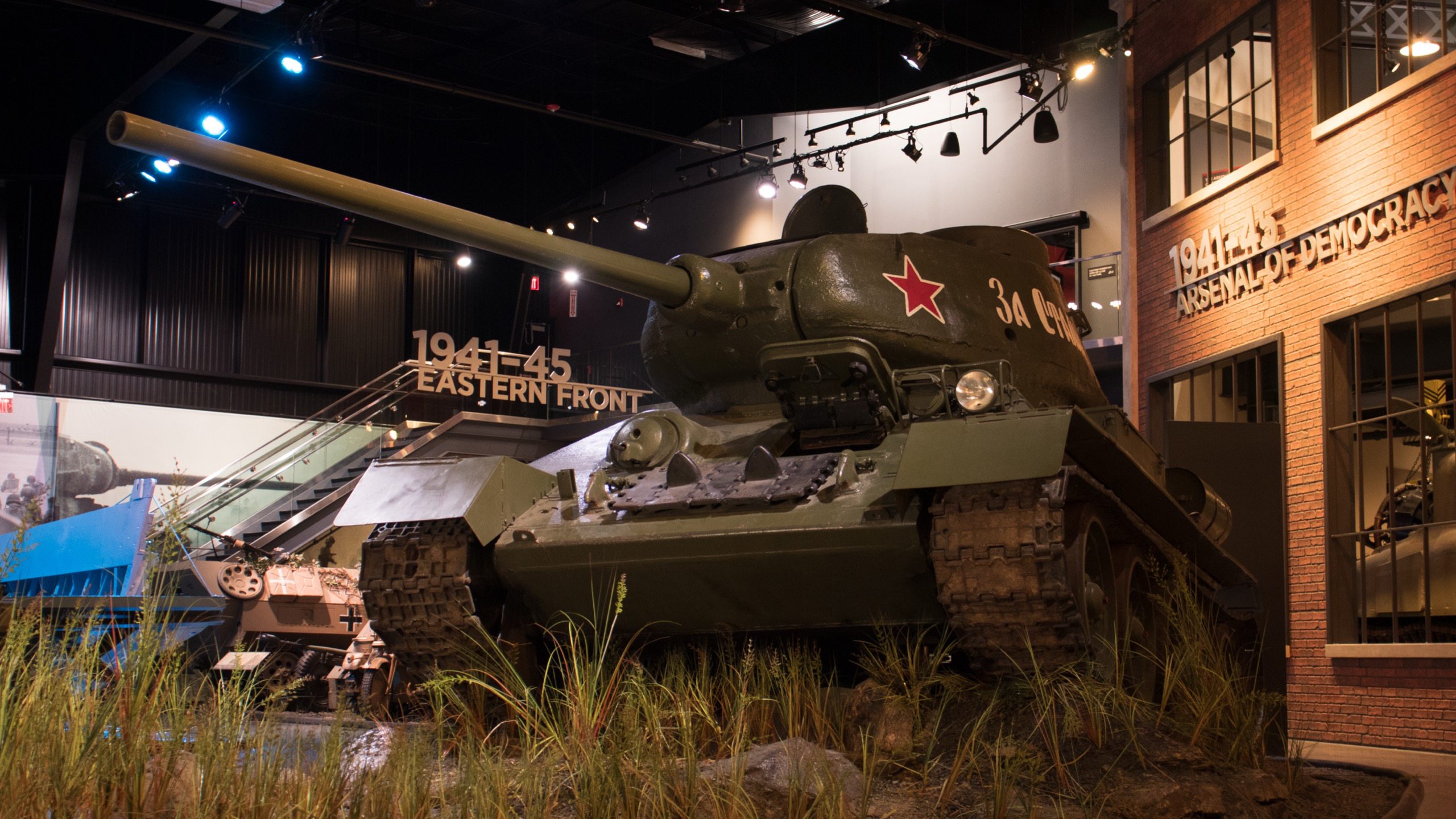
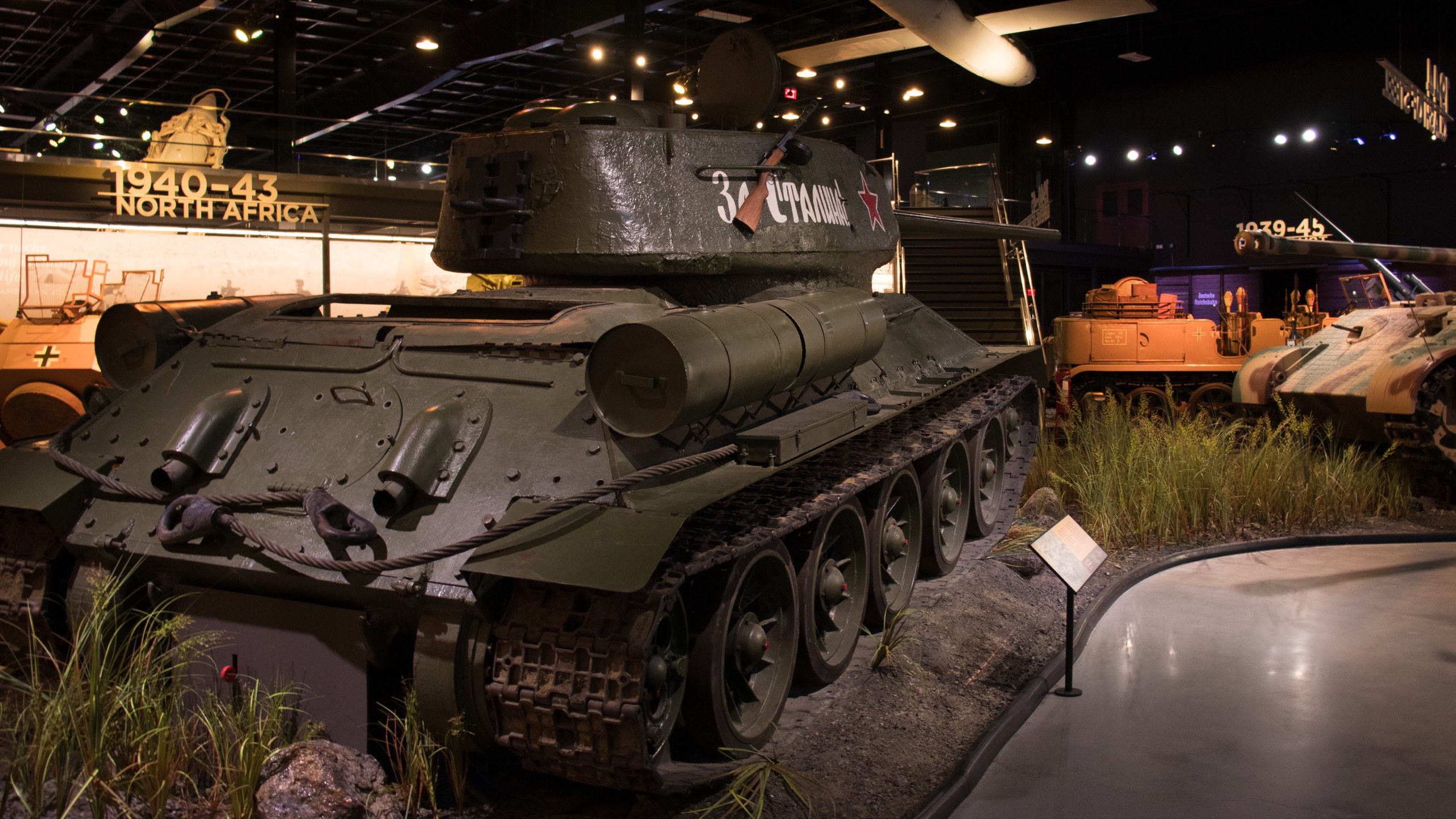
The Soviet T-34 was one of the most influential and widely produced tanks of World War II, revolutionizing armored warfare through its combination of firepower, mobility, protection, and remarkable manufacturing efficiency. Its improved T-34/85 variant became a cornerstone of Soviet armored forces during the final campaigns against Nazi Germany.
Introduced in 1940, the original T-34 represented a major advancement in tank design. Its sharply sloped armor provided greater protection than its thickness alone suggested, while its powerful 76.2mm cannon and rugged 500-horsepower V-2 diesel engine offered an effective combination of firepower and mobility. Wide tracks and a Christie-derived suspension system allowed the tank to traverse the mud, snow, and difficult terrain encountered across the Soviet Union.
When Germany launched Operation Barbarossa on June 22, 1941, German soldiers were surprised by the capabilities of the new Soviet tank. Although early T-34s suffered from limited visibility, cramped crew arrangements, unreliable communications, and inadequate training, their basic design proved formidable.
By 1943, however, the introduction of Germany’s powerful Panther and Tiger tanks threatened to undermine the T-34’s battlefield effectiveness. Soviet engineers responded with a substantially improved design.
Introduced in early 1944, the T-34/85 incorporated a powerful 85mm cannon and a larger, three-man turret. This improvement increased the crew from four to five, allowing the tank commander to concentrate on observing the battlefield and directing operations rather than also serving as gunner.
The 85mm ZiS-S-53 cannon provided significantly greater armor penetration than the earlier 76.2mm weapon, allowing Soviet crews to engage German Panzer IV tanks and assault guns more effectively. Improved turret armor, observation equipment, and communications further enhanced the tank’s combat capabilities.
Although the T-34/85 could challenge German Panthers and Tigers under favorable conditions, particularly through flank attacks, the heavier German tanks retained significant advantages in armor protection and long-range firepower.
The T-34’s greatest strategic advantage was its combination of battlefield effectiveness and extraordinary production efficiency. Soviet factories continually simplified manufacturing, producing tanks in enormous quantities despite devastating wartime losses. More than 80,000 T-34s of all variants were eventually manufactured, including postwar production.
During the Soviet offensives of 1944 and 1945, T-34/85 tanks spearheaded armored advances across Eastern Europe and into Germany. They played important roles in Operation Bagration, the Vistula–Oder Offensive, and the final Battle of Berlin, helping bring about the defeat of Nazi Germany.
Clash of Steel – Soviet T-34/85 vs. German Panther
At the American Heritage Museum, the T-34/85 Model 1944 is displayed directly opposite an authentic German Panther Ausf. A in the dramatic Clash of Steel Gallery.
Through an immersive multimedia presentation, visitors experience the ferocity of armored combat on the Eastern Front, examining the radically different engineering philosophies, battlefield tactics, and experiences of Soviet and German tank crews.
Together, these two extraordinary armored vehicles illustrate the technological struggle that helped determine the outcome of World War II—and the enormous sacrifices endured by the soldiers who fought inside them.