Artifacts
Type VIIC U-Boat Wintergarten Deck
Germany | 1943–1945 | World War II – Battle of the Atlantic
| General Information | |
|---|---|
| Model | Type VIIC U-Boat Wintergarten Deck |
| Class | Boat |
| Type | U-Boat |
| Use | Military |
| Era | 1940-1945 |
| Gallery Focus | WWII European Theater |
| Manufacturer | Stettiner Oderwerke |
| Year | 1942 |
| Country | United States |
| Ownership | CF Inc. |
| Gallery Location | Hangar |
| Status | Static Only |
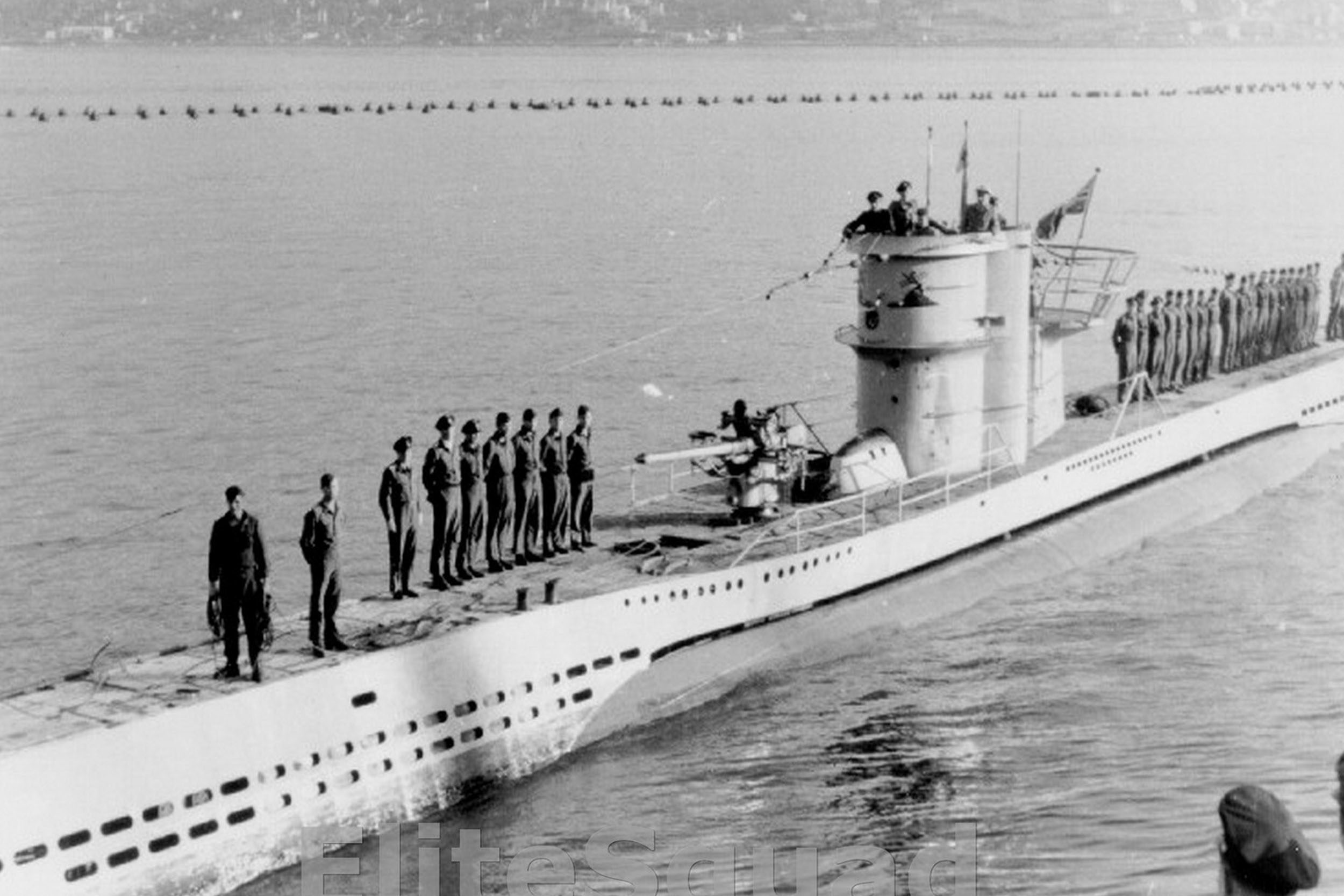
The German Type VII U-boat was the backbone of Nazi Germany’s submarine fleet during World War II and one of the most formidable threats to Allied shipping throughout the Battle of the Atlantic. More than 700 Type VII submarines were constructed, making them the most widely produced German submarine class of the war. Their primary mission was to disrupt the vital flow of troops, fuel, food, and military equipment crossing the Atlantic from North America to Great Britain.
Operating individually and in coordinated groups known as “wolfpacks,” German U-boats sank thousands of Allied merchant vessels. During the early years of the war, their successes threatened Britain’s ability to sustain its war effort. However, improvements in Allied radar, sonar, codebreaking, convoy escorts, and long-range maritime patrol aircraft gradually transformed the Atlantic into an increasingly dangerous environment for German submarines.
One of the greatest threats came from Allied aircraft, which could locate and attack U-boats while they operated on the surface. Early submarines carried relatively limited anti-aircraft protection, usually a single 20mm cannon. As Allied airpower expanded, the German Navy modified its submarines with increasingly powerful defensive armament.
The Wintergarten, meaning “winter garden,” was an extended anti-aircraft gun platform constructed behind the submarine’s conning tower. Beginning in 1942–1943, these platforms were enlarged and modified to accommodate additional weapons, including twin 20mm cannons and, on later configurations, heavier 37mm automatic anti-aircraft guns. These modifications attempted to improve the submarine’s chances of surviving encounters with Allied aircraft while surfaced.
The Type VIIC/41, introduced in 1943, incorporated a strengthened pressure hull that allowed deeper diving, alongside improvements intended to increase survivability. However, even with additional anti-aircraft weapons, U-boats remained highly vulnerable to Allied aircraft. The decisive turning point came during “Black May” of 1943, when mounting German submarine losses demonstrated the growing effectiveness of Allied anti-submarine warfare.
The original Wintergarten platform preserved by the American Heritage Museum has an extraordinary history of its own. This rare surviving structure was recovered from Wrocław, Poland, formerly the German city of Breslau, where it had stood for decades as an outdoor display at the Inland Navigation Technical School, later School Complex No. 14. Identified as a Type VIIC/41 anti-aircraft platform, the artifact was eventually removed in 2009 after years of exposure to the elements.
Acquired from a private collector by the American Heritage Museum, the surviving steel sections were transported to Massachusetts, where restoration technicians carefully reassembled the structure and fabricated supporting framework for its preservation and exhibition. Although its connection to a specific wartime U-boat has not been established, the artifact represents an exceptionally rare surviving component of Germany’s World War II submarine program.
Currently displayed in the American Heritage Museum’s seasonal Aircraft Hangar annex, the Wintergarten is available for viewing during select special event weekends. It is planned to become a centerpiece of a future Battle of the Atlantic Gallery within the museum’s proposed aviation wing expansion, alongside the restored Consolidated PBY-5A Catalina, one of the most successful Allied submarine-hunting aircraft of World War II.
Together, these extraordinary artifacts will illustrate the technological struggle between German submarines and Allied maritime patrol aircraft—a battle essential to securing the Atlantic lifeline and achieving Allied victory in Europe.