Artifacts
Japanese Type 4 "Ho-Ro"
Japan | 1944–1945 | World War II – Pacific Theater
| General Information | |
|---|---|
| Model | Type 4 15cm Self-Propelled Gun "Ho-Ro" |
| Class | Armor |
| Type | Self-Propelled Artillery |
| Use | Military |
| Era | 1940-1945 |
| Gallery Focus | WWII Pacific Theater |
| Manufacturer | Mitsubishi Heavy Industries |
| Year | 1944 |
| Country | Japan |
| Ownership | Loan, USMC |
| Gallery Location | Pacific Theatre |
| Status | Static Only |
Additional Photos


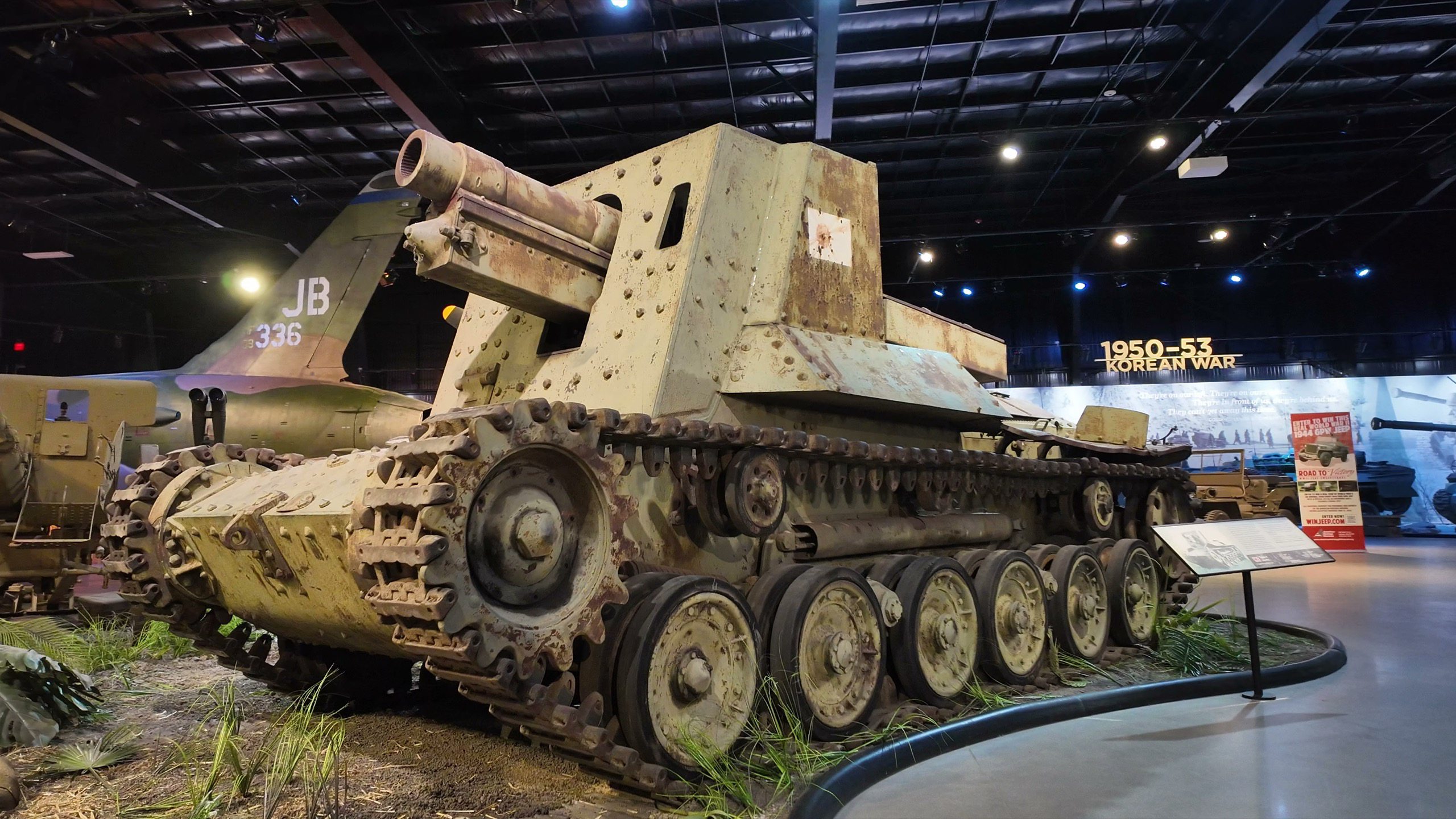
The Japanese Type 4 Ho-Ro is one of the rarest surviving armored fighting vehicles of World War II and an extraordinary artifact of the final battles in the Pacific. Developed by the Imperial Japanese Army in 1944, this powerful 150mm self-propelled howitzer was designed to provide mobile artillery support to Japanese ground forces as they struggled against advancing Allied armies.
Inspired by Germany’s successful Grille self-propelled artillery system, Japanese engineers adapted the chassis of the Type 97 Chi-Ha medium tank to carry a much larger artillery weapon. The result was a tracked vehicle mounting the Type 38 150mm howitzer, an older but powerful weapon originally introduced in 1905.
Capable of firing a high-explosive projectile weighing approximately 77 pounds (35 kilograms) to distances approaching four miles, the Ho-Ro could bombard enemy positions, destroy fortified defenses, and provide direct fire against approaching troops and armored vehicles.
Powered by a 170-horsepower Mitsubishi diesel engine, the approximately 16-ton vehicle could reach speeds approaching 24 mph. Its crew operated from a partially enclosed fighting compartment protected by a large armored gun shield. Although the front offered some protection, the open roof and exposed rear left the crew dangerously vulnerable to enemy infantry, artillery fragments, and aerial attacks.
The Ho-Ro entered service during the final year of World War II, when Japan faced overwhelming Allied military strength and increasing shortages of equipment, materials, and trained personnel. Production was extremely limited, and only a small number reached frontline units.
During the 1945 Battle of Luzon in the Philippines, Ho-Ro self-propelled guns were employed by Japanese forces defending the strategically important Clark Field airfield complex. Operating alongside Type 97 medium tanks and infantry, these artillery vehicles provided fire support as American forces advanced to liberate the Philippines.
Despite their powerful armament, the Ho-Ros faced significant disadvantages against American armored forces, artillery, and airpower. Their lightly protected fighting compartments, limited gun traverse, and small numbers restricted their effectiveness during the increasingly desperate Japanese defense.
The Type 4 Ho-Ro displayed at the American Heritage Museum was captured by American forces during the fighting near Clark Field in 1945. Following its capture, the vehicle was transported to the United States, where it was preserved as an important example of Japanese military technology.
Today, this remarkable vehicle is believed to be the only surviving Type 4 Ho-Ro in the world.
On long-term loan from the National Museum of the United States Marine Corps, the Ho-Ro is displayed in the American Heritage Museum’s Pacific War Gallery, preserving a tangible connection to the liberation of the Philippines and the final months of the war against Japan.