Artifacts
ZSU-23-4 Shilka
Soviet Union / Iraq | 1965–1991 | Persian Gulf War – Operation Desert Storm
| General Information | |
|---|---|
| Model | ZSU-23-4 Shilka (Zenitnaya Samokhodnaya Ustanovka-3) |
| Class | Armor |
| Type | Self-Propelled Anti-Aircraft Gun |
| Use | Military |
| Era | 1990-1995 |
| Gallery Focus | Gulf War / Desert Storm |
| Manufacturer | Ulyanovsk Mechanical Plant (UMZ), Mytishchi Machine-Building Plant (MMZ) |
| Year | 1978 |
| Country | Soviet Union |
| Ownership | CF Inc. |
| Gallery Location | Gulf War |
| Status | Operational, Offline |
Additional Photos
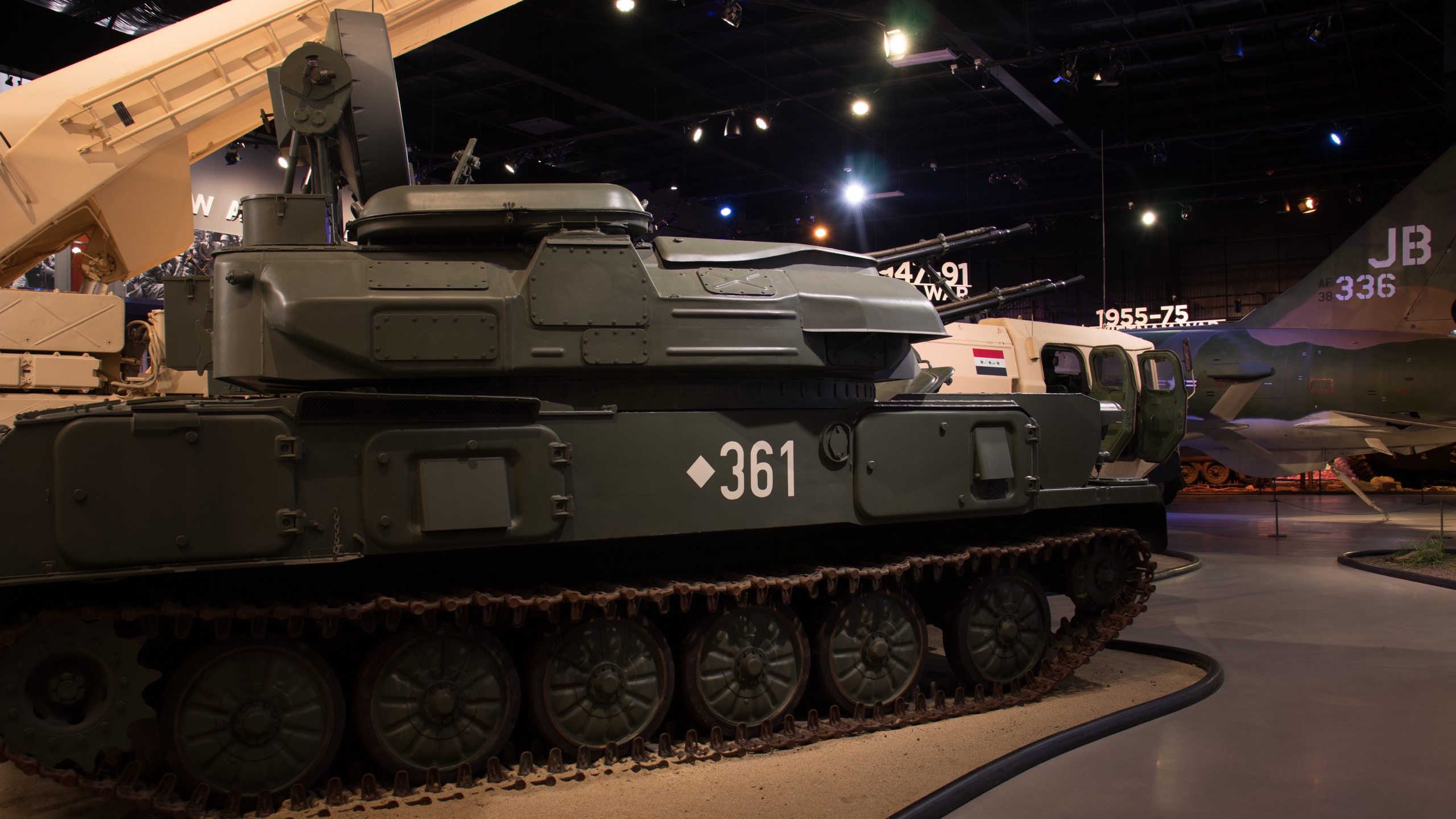
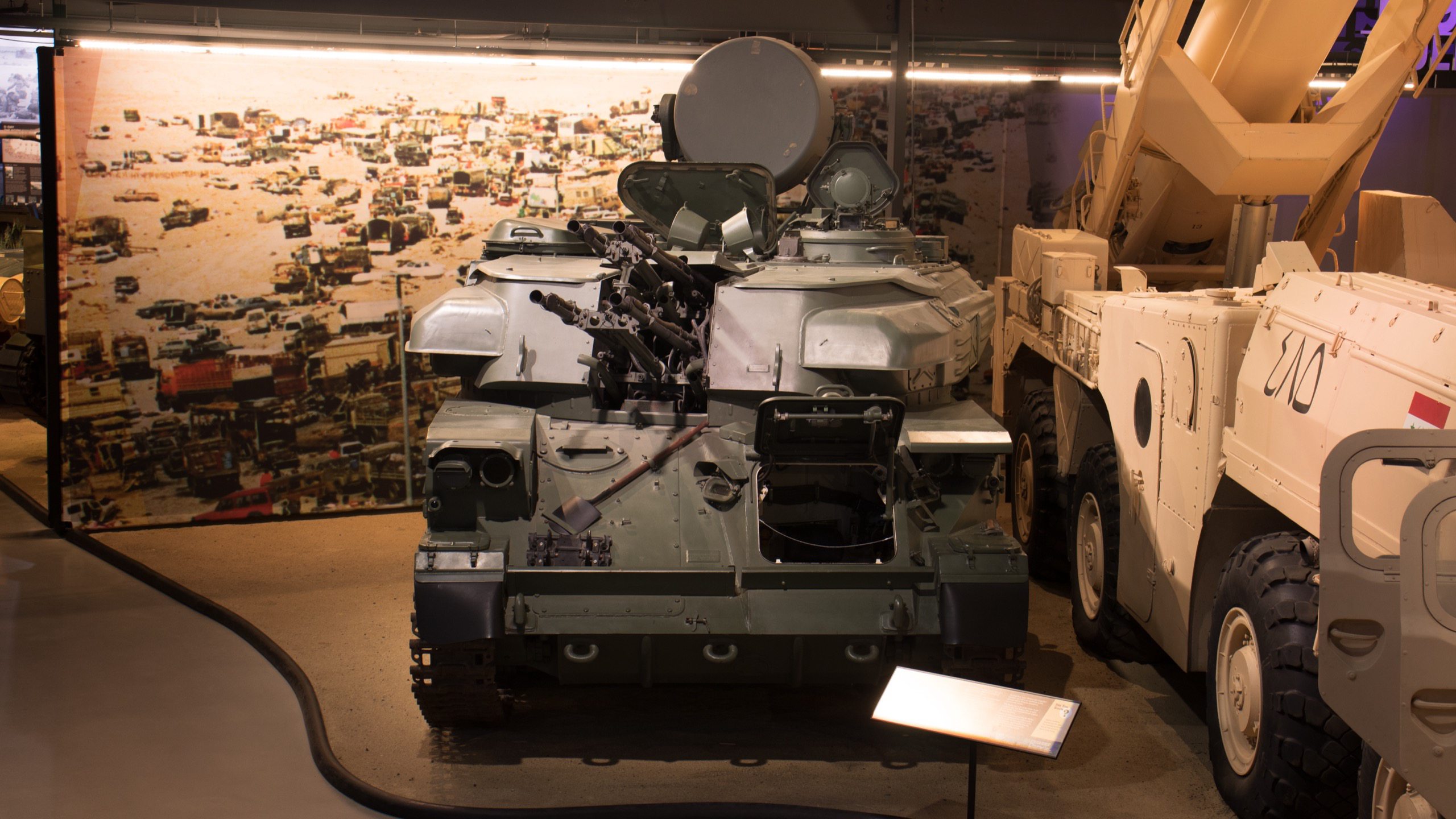
The Soviet ZSU-23-4 Shilka was one of the most formidable self-propelled anti-aircraft weapons developed during the Cold War. Introduced into Soviet service in 1965, this radar-guided, tracked vehicle was designed to protect armored formations, infantry units, and strategic installations against low-flying aircraft and helicopters. Its combination of mobility, sophisticated fire-control technology, and devastating firepower made it a revolutionary advancement in battlefield air defense.
The designation ZSU stands for Zenitnaya Samokhodnaya Ustanovka, meaning “Self-Propelled Anti-Aircraft System,” while “23-4” identifies its four 23mm automatic cannons. The Shilka’s four liquid-cooled guns could produce a combined theoretical firing rate of approximately 3,400–4,000 rounds per minute, creating an exceptionally dense concentration of fire against approaching aircraft.
Operated by a four-man crew, the Shilka featured an integrated radar system capable of detecting and tracking aerial targets at distances approaching 12 miles. Its computerized fire-control system calculated the necessary targeting corrections, allowing crews to engage fast-moving aircraft at effective ranges of approximately 1.5 miles. Its tracked chassis enabled the vehicle to accompany armored formations across difficult terrain, while its lightly armored hull provided protection against small-arms fire and artillery fragments.
The Shilka gained international attention during the 1973 Yom Kippur War, when Egyptian and Syrian forces employed it alongside Soviet surface-to-air missile systems. Israeli aircraft attempting to evade missiles by flying at low altitudes encountered deadly concentrations of radar-directed anti-aircraft fire. These experiences helped demonstrate the growing dangers of low-altitude aerial operations.
Iraq acquired substantial numbers of Soviet-built Shilkas, employing them during the Iran-Iraq War of 1980–1988 and subsequently during the 1991 Persian Gulf War. Following Iraq’s invasion of Kuwait in August 1990, Shilkas formed part of the layered Iraqi air-defense network positioned to confront American and Coalition aircraft.
During Operation Desert Storm, Iraqi Shilkas remained dangerous to aircraft operating at low altitude, particularly those conducting close air support missions. However, Coalition forces employed sophisticated electronic warfare, anti-radiation missiles, precision-guided weapons, and coordinated suppression of enemy air defenses. These capabilities significantly reduced the effectiveness of Iraq’s aging anti-aircraft systems, and numerous Shilkas were destroyed, abandoned, or captured during the conflict.
Although designed primarily for air defense, the Shilka’s four cannons could also deliver devastating direct fire against infantry positions and lightly armored vehicles. This versatility contributed to its continued use in conflicts around the world.
Displayed in the American Heritage Museum’s Gulf War Gallery, the ZSU-23-4M Shilka represents the extraordinary development of Soviet air-defense technology and the challenges faced by Coalition aviators during Operation Desert Storm. Its presence alongside other Iraqi military vehicles illustrates the technological transformation of aerial warfare during the final years of the Cold War.