Artifacts
Soviet PM M1910 Heavy Machine Gun
Soviet Union | 1910–1945 | World War II – Eastern Front
| General Information | |
|---|---|
| Model | Pulyemyot Maksima PM M1910 |
| Class | Firearm |
| Type | Heavy Machine Gun |
| Use | Military |
| Era | 1940-1945 |
| Gallery Focus | WWII European Theater |
| Manufacturer | Tula Arsenal |
| Year | 1942 |
| Country | Soviet Union |
| Ownership | CF Inc. |
| Gallery Location | Eastern Front |
| Status | Operational, Offline |
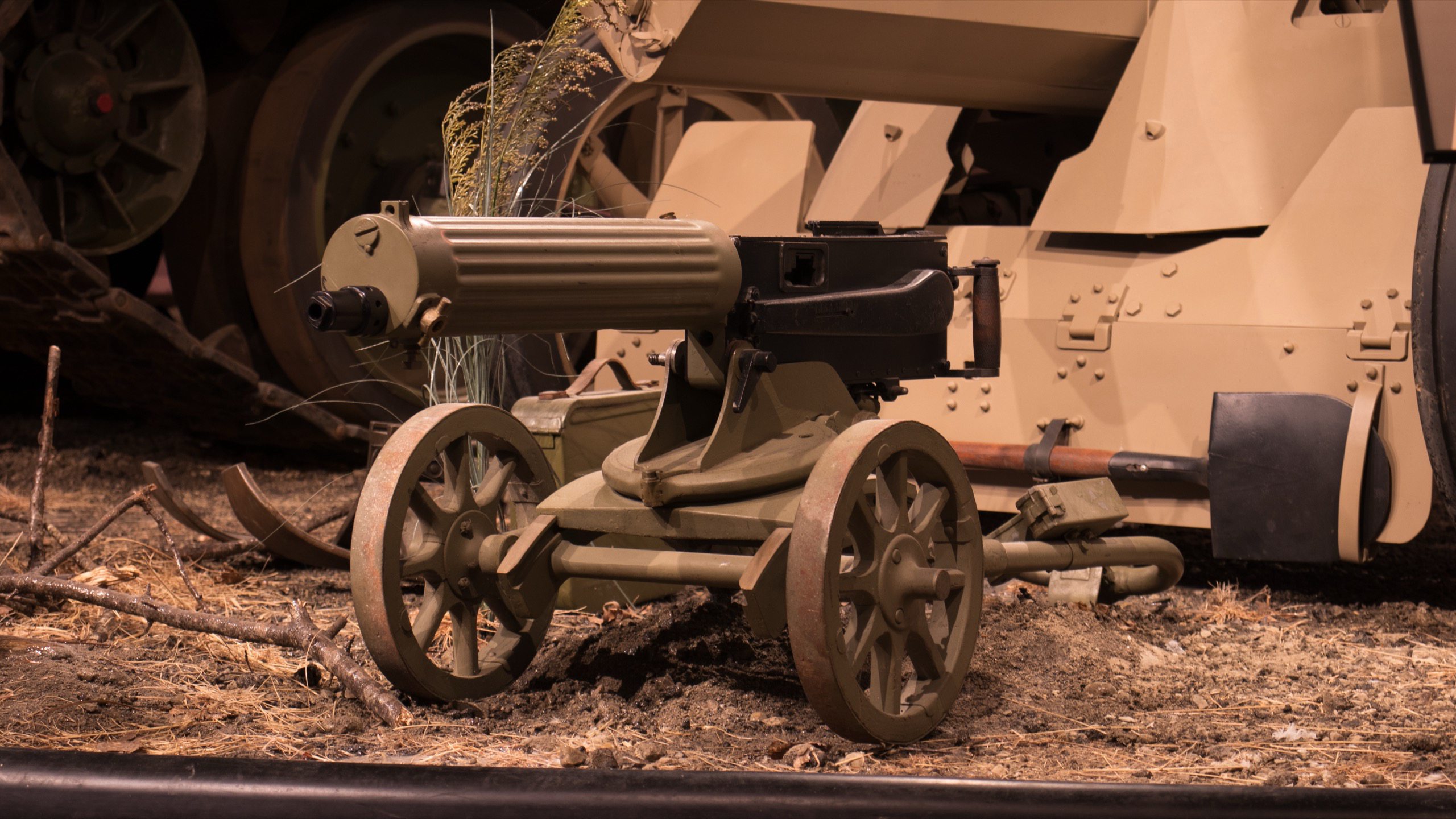
The Soviet PM M1910 Maxim Heavy Machine Gun was among the Red Army’s most important infantry support weapons during World War II. First adopted by Imperial Russia in 1910, it remained in Soviet service when Nazi Germany launched its massive invasion of the Soviet Union on June 22, 1941. Its proven design provided the sustained firepower needed to defend positions along the vast Eastern Front.
Based on Hiram Maxim’s pioneering machine-gun design, the PM M1910 fired 7.62mm ammunition from 250-round belts at a rate of approximately 600 rounds per minute. A water-filled jacket surrounded the barrel to prevent overheating during prolonged firing. Wartime improvements included an enlarged filler opening that allowed crews to use snow or ice as coolant, a particularly valuable adaptation during Russia’s brutal winters.
The gun rested on a distinctive two-wheeled Sokolov carriage, often fitted with a protective steel shield. Although heavy and cumbersome to maneuver, its wheeled mounting allowed crews to reposition the weapon across difficult battlefield terrain.
Throughout the Eastern Front, Maxim machine-gun teams defended trenches, villages, roads, and fortified positions against advancing German infantry. Their concentrated firepower proved especially valuable during the desperate defensive battles of 1941–1942 and the Red Army’s subsequent counteroffensives. Although the more modern SG-43 machine gun entered service in 1943, the dependable PM M1910 continued serving through the end of the war.
Displayed in the American Heritage Museum’s Eastern Front Gallery, the PM M1910 illustrates the evolution of automatic weapons and the essential role of sustained infantry firepower during one of the largest and most destructive military campaigns in history.